
Free Trade Wasn’t Canada’s Mistake. Dependence Was.

For 40 years, Canada prospered from extraordinary access to the United States. We should have used that opportunity to build the economic insurance we may now desperately need.


For forty years, Canada had an extraordinary economic opportunity. We lived beside the richest market on Earth. Free trade progressively lowered the barriers between us, supply chains became deeply integrated, investment flowed, and Canadian companies gained privileged access to hundreds of millions of American consumers. Canada prospered enormously.

But somewhere along the way, opportunity became assumption, integration became dependence, and efficiency became vulnerability. We forgot one of the most basic rules of business: never become too dependent on one customer, because someday that customer may change the terms.

The United States has changed the terms. Donald Trump has done so dramatically, but it would be a mistake to view Canada’s predicament simply as a Trump problem. Around the world, globalization is being reordered around industrial policy, national security, strategic supply chains, energy security, technology and economic sovereignty. The comfortable world around which Canada built much of its economic strategy is disappearing.

Over recent months, and particularly during a series of interviews on my radio program, I have explored what this means with economists, investors, trade experts, academics and energy specialists. Their prescriptions differ, but a remarkably consistent argument has emerged. Free trade wasn’t Canada’s mistake. Our mistake was failing to use the extraordinary benefits of forty years of integration to buy enough insurance against the possibility that one day that integration might fracture.

We didn’t diversify our trade enough. We didn’t build enough infrastructure connecting our resources to world markets. We didn’t improve productivity enough, commercialize enough Canadian research, retain enough intellectual property, process enough of what we pulled out of the ground or build enough globally competitive Canadian companies. We should have used the benefits of integration to make ourselves strong enough to withstand the possibility of disintegration. We didn’t. That was the insurance policy Canada forgot to buy, and the premium will now be considerably more expensive.

Trump may have done Canada one favour

Dr. Heather Exner-Pirot, one of Canada’s most compelling thinkers on energy and economic security, made what I thought was one of the most provocative arguments in my conversations. Whatever Canadians may think about Donald Trump and his policies, she suggested, perhaps the disruption coming from Washington has done Canada one favour: it has shaken us out of our complacency.

That word matters. Anne Fitz-Gerald of the Balsillie School of International Affairs had made almost exactly the same observation to me months earlier. Canada’s geography has been an extraordinary gift. Selling into the United States was so logical and profitable that doing the harder things often seemed unnecessary. Why build another route when the easiest customer was next door? Why aggressively cultivate distant markets when the world’s largest market was across the border? Why worry excessively about resilience when efficiency was making us rich?

COVID should have taught us the danger in that thinking. Russia’s invasion of Ukraine reinforced it. Broken global supply chains reinforced it again. Now the deterioration of the Canada-U.S. relationship has made the lesson impossible to ignore: efficiency and resilience are not the same thing. Resilience sometimes costs money. Redundancy sometimes looks inefficient. Domestic capacity can appear unnecessary right up until the moment you desperately need it.

For Canada, resilience means alternatives: another customer, another supplier, another pipeline, another port, another market. Alternatives create choices, and choices create sovereignty.

Sovereignty is the capacity to choose

When I interviewed international trade lawyer Barry Appleton, he argued that today’s Canada-U.S. dispute is about much more than tariffs. It is about sovereignty: who determines the rules governing our digital economy, culture, energy, critical minerals, data and ultimately our economic future? A tariff is a number. Sovereignty is something much more fundamental.

During the 1988 free-trade election, John Turner famously warned Canadians about surrendering economic sovereignty and potentially putting political sovereignty at risk. When I subsequently discussed Turner’s warning with political strategist Rick Anderson, an important distinction emerged. Free trade wasn’t the problem. Dependence was.

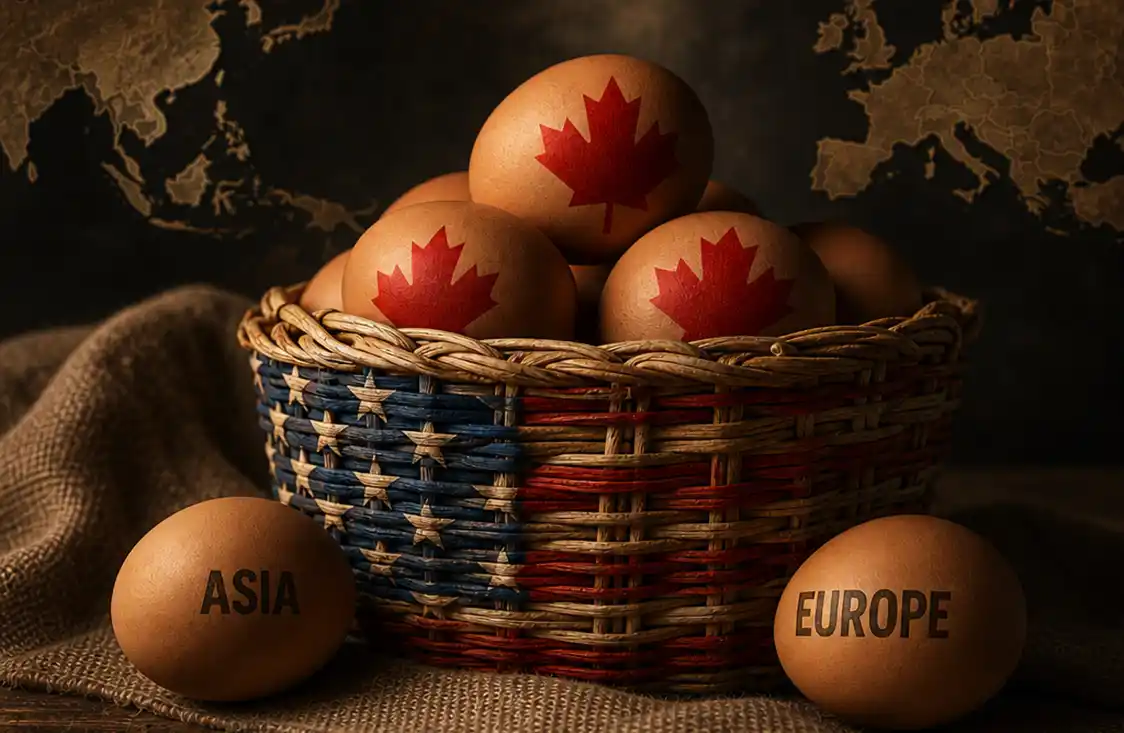
That is the distinction we need to understand today. The United States can and should remain Canada’s largest and most important economic partner without being the country upon which virtually our entire economic strategy depends. This isn’t an argument for less America. It is an argument for more world: more trade with Europe, Asia, India, Latin America, the Middle East and Africa, while continuing to trade as extensively as possible with the United States.

Independence does not mean isolation. It means having alternatives. If one customer changes the terms, you have another customer. If one route closes, you have another route. If one supplier becomes unreliable, you have another supplier. That optionality is what turns economic strength into sovereignty.

Canada’s extraordinary resource hand

This is where Heather Exner-Pirot’s argument becomes even more important. Canada isn’t approaching this new world empty-handed. Quite the opposite. Few countries possess a collection of strategic assets comparable to ours: oil, natural gas, uranium, potash, critical minerals, hydroelectricity, agricultural land and enormous reserves of other natural resources.

Heather has pointed in particular to Saskatchewan, which is almost a strategic resource platform in itself. It has oil, roughly half of Canada’s arable land, enormous potash reserves and some of the richest uranium deposits on Earth. In a world increasingly concerned with food security, energy security and secure supplies of strategic minerals, those assets matter enormously.

But Heather’s larger point is that possessing resources isn’t enough. We have to be willing to develop them and build the infrastructure required to get them to customers. Canada cannot call itself an energy superpower if it cannot efficiently move its energy to global markets. We cannot boast about critical minerals while allowing projects to spend years trapped in regulatory uncertainty. And we cannot maximize the value of our resources if we simply extract them and ship them somewhere else for somebody else to perform the high-value processing, manufacturing and technology development.

The world is also changing how it thinks about resources. Countries aren’t asking only, “What does this energy cost?” They increasingly ask where it comes from, whether the supplier is reliable, whether its institutions can be trusted and whether the supply will still be there during the next crisis. Canada has an opportunity to turn political stability and reliability into economic advantage.

A resource buried in the ground, however, is not geopolitical power. A barrel of oil you cannot get to a customer is not geopolitical power. A critical mineral shipped abroad unprocessed so somebody else can capture most of the value is not industrial strategy. Potential is not power. Execution is power.

What is Canada’s economic moat?

That leads to perhaps the most interesting question I heard during my recent interviews. Investor Wouter Germans asked: What does Canada have that the world cannot easily replace?

Warren Buffett famously describes a company’s durable competitive advantage as its economic “moat.” Germans argues that Canada should think about its economy in much the same way. Natural resources provide an obvious starting point, but possessing a resource doesn’t automatically create a moat. If somebody else can sell essentially the same commodity, we remain largely a price-taker.

Nature gave us extraordinary ingredients. The challenge is turning those ingredients into things competitors cannot easily reproduce. Germans reduced his prescription to three words: own it, build it, compound it. Don’t simply extract something and sell it. Own more of the intellectual property, build more of the finished product, control more of the value chain, capture more of the economic value and reinvest that wealth in capabilities that compound across generations.

Consider uranium. As Heather Exner-Pirot emphasizes, Canada has some of the richest deposits in the world. But we also have decades of nuclear expertise, CANDU technology, engineers, regulators, skilled trades, an established nuclear supply chain and emerging small modular reactor capability. Why should our ambition end with mining uranium and shipping it somewhere else? Why shouldn’t Canada own more of the entire stack: the resource, processing, engineering, reactor technology, servicing, intellectual property and customer relationship?

That is the difference between selling a commodity and building an industry. The same test should be applied to critical minerals, artificial intelligence, agriculture, advanced manufacturing, clean technology and digital infrastructure. Where does Canada possess a genuine advantage? Where can we create differentiated technology, own intellectual property, develop pricing power and build an ecosystem deep enough that competitors cannot easily replicate it?

As Germans put it memorably: “Keep selling the oil. Just stop selling only the oil.”

Stop playing economic whack-a-mole

Anne Fitz-Gerald offered another useful diagnosis during my interview with her. Canada, she argued, has a tendency to play economic “whack-a-mole.” A tariff appears, and we respond. A supply-chain problem appears, and we respond. A company threatens to leave, and we subsidize. Another crisis appears, and we announce something else.

That isn’t strategy. Strategy requires deciding what you actually want to become. Canada should choose a limited number of major national economic priorities and then align government, business, universities, researchers, capital and expertise around achieving them. Barry Appleton made a related point about rebuilding the structured industry expertise that once supported Canadian trade negotiators. Different disciplines, but essentially the same conclusion.

Canada doesn’t principally suffer from a shortage of assets. We suffer from an inability to connect them. We have uranium, critical minerals, oil and gas, hydroelectricity, agricultural land, great universities, researchers, engineers, skilled trades, enormous pools of pension capital and one of the world’s most educated populations.

The challenge is turning uranium into a nuclear industry, a mineral into a technology, research into intellectual property, intellectual property into a company, and that company into a global champion. We need to turn a talented Canadian graduate into an entrepreneur who believes the best place in the world to pursue an ambition is Canada.

Germans gave me a wonderfully Canadian analogy. Why does Canada produce so many exceptional hockey players? It isn’t simply because talented children happen to be born here. We built an ecosystem: arenas, coaches, minor hockey, competitive leagues, junior teams, scouts and organizations that identify talent, develop it and move the best players upward.

Innovation works the same way. Smart people aren’t enough. Great universities aren’t enough. World-class research isn’t enough. You need capital, entrepreneurs, experienced managers, customers, commercialization expertise, intellectual property and companies capable of scaling. Canada has been extraordinarily successful at creating knowledge. We have been considerably less successful at capturing its economic value.

Patriotism isn’t an economic strategy

The deterioration of the American relationship has generated a welcome resurgence of Canadian patriotism, but patriotism can also become performative. Author Dennis Dodo and I recently discussed the difference between the political performer and the problem solver. Canada needs problem solvers now.

Putting up a Canadian flag, boycotting an American product, giving an angry speech or posting something indignant on social media are relatively easy. Building a port isn’t. Building a mine isn’t. Getting a transmission line approved isn’t. Fixing interprovincial trade isn’t. Commercializing university research isn’t. Increasing business investment per worker isn’t. Creating globally competitive Canadian companies isn’t. Building enough housing for young Canadians isn’t.

Those things take years. They involve trade-offs. They require political courage and cooperation among people who disagree. But those are the things that actually create economic sovereignty.

Canada has become remarkably proficient at saying no: no to pipelines, mines, transmission, nuclear power, housing, infrastructure and development. Then we wonder why productivity stagnates, investment goes elsewhere, housing becomes unaffordable, and wages fall behind those in the United States. Perhaps the defining Canadian economic question needs to change from “What are we against?” to “What are we prepared to build?”

One Canadian economy

We also cannot build a more resilient Canada while behaving as ten provincial economies loosely connected by a flag. Alberta has energy. Saskatchewan has uranium, potash, agriculture and oil. British Columbia has Pacific ports. Ontario has manufacturing and finance. Quebec has hydroelectricity, aerospace and critical minerals. Atlantic Canada gives us Atlantic access and enormous energy potential. The North contains resources and strategic territory of growing geopolitical importance.

These aren’t competing economic stories. They are components of one national strategy. Freer internal trade, mutual recognition of credentials, labour mobility, national infrastructure corridors, better-connected electricity grids, railways and pipelines connecting resources to ports, and major projects developed in genuine partnership with Indigenous communities should all be pieces of that strategy.

That isn’t a left-wing agenda or a right-wing agenda. It is nation-building.

Build what compounds

There is also an important principle for deciding what we should build: prioritize assets and capabilities that compound. Knowledge compounds. Technology compounds. Infrastructure compounds. Intellectual property compounds. Human capital compounds. Successful companies compound. Productivity compounds.

A barrel of oil doesn’t. Sell the barrel—absolutely. Develop Canada’s resources and capture the enormous opportunity Heather Exner-Pirot rightly identifies. But use some of the wealth generated by those resources to build capabilities that will continue creating value long after an individual barrel, tonne or bushel has been sold.

Our economic action plan can therefore be surprisingly straightforward: develop what we have, build what we’re missing, own more of the value we create, improve productivity, commercialize our ideas, retain our talent, connect ourselves to world markets, trade with everybody, remain a reliable partner and depend excessively on nobody.

What is prosperity actually for?

There is one final test. Philip Kotler, one of the world’s most influential thinkers on marketing, reminded me of it in another conversation. What is all this prosperity ultimately for?

The objective isn’t a pipeline, mine, reactor, factory or GDP statistic. Those are means. The objective is better jobs, higher incomes, greater opportunity, economic security and the freedom for Canadians to make our own choices.

Canada can also become the country other countries increasingly want to deal with because we possess something becoming more valuable in an uncertain world: trust. Our institutions work. Contracts matter. The rule of law matters. When Canada makes a commitment, Canada honours it. When we promise supply, we deliver it. We don’t need to become the country that threatens to weaponize everything it sells. We can become something more valuable: the supplier the world trusts.

Anne Fitz-Gerald identified one final Canadian asset that doesn’t appear on any geological survey or corporate balance sheet: our social capital, our ability to cooperate. Government and business, universities and entrepreneurs, provinces and Ottawa, East and West, Indigenous and non-Indigenous Canadians—all sometimes disagree profoundly, but we still share a country and a future. Building difficult things requires cooperation, and national strategy requires choices.

For forty years, perhaps the easiest question in Canadian business was, “How do we sell more to the United States?” For the next forty years, our question needs to be much bigger: What can Canada build that the world cannot easily replace?

Few countries have been dealt a better hand. We have the resources, energy, talent, universities and capital. We have access to three oceans and trade agreements around the world. And despite everything happening today, we still live beside the richest market on Earth. We have the ingredients. Now we have to connect them.

Own more. Build more. Compound more.

Free trade wasn’t Canada’s mistake. Dependence was. The challenge now isn’t simply to survive Donald Trump or wait for the old relationship to return. It is to build a Canada strong enough that our prosperity never again depends overwhelmingly on what someone in Washington decides.

Sovereignty isn’t waving a flag. Sovereignty is having choices. And the best way to create choices is to build them.

Photo: iStock, edited by Copilot