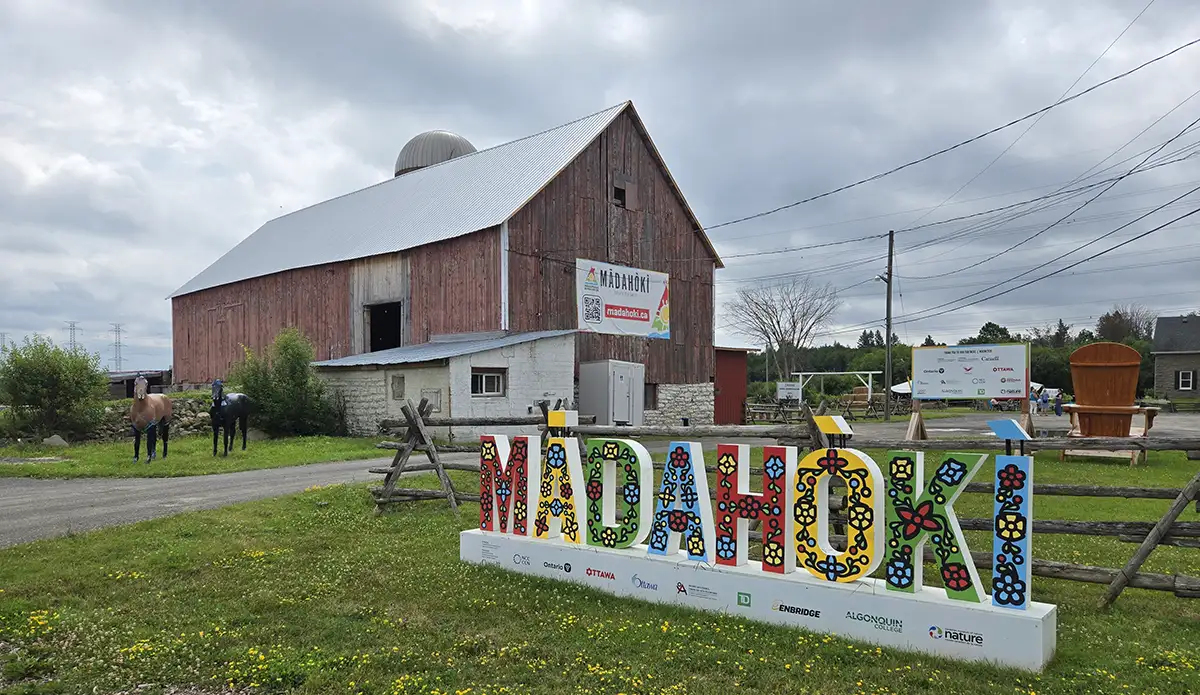
Located on unceded Algonquin territory in Ottawa’s Greenbelt (near Hunt Club and the 416), Mādahòkì Farm has expanded its cultural offerings and is eager to share them with both locals and visitors to the National Capital Region.
The farm welcomes the public from Thursday through Sunday, with free entry to explore the site. In addition to a host of friendly small animals—including bunnies and goats—a central part of the experience is meeting the four-legged ambassadors of the farm: the rare and resilient Ojibwe Spirit Horses.
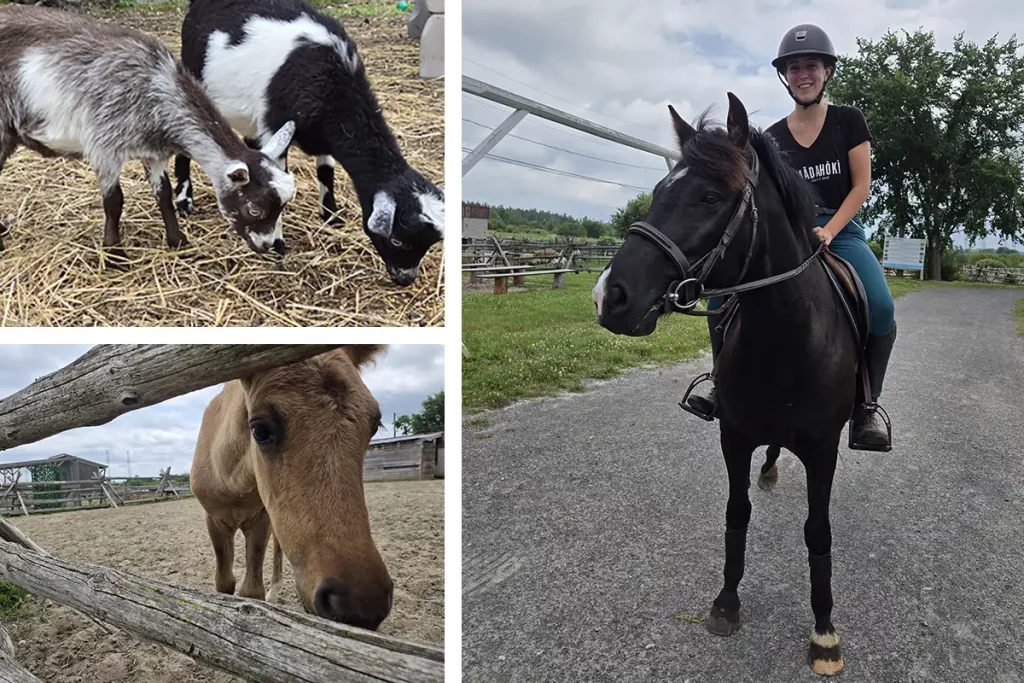
ABOVE (CLOCKWISE): Visitors to the farm can feed and interact with the goats. Kaya Simard is riding a Spirit Horse named Makwa, which means bear in Ojibwe. Neswin, meaning Air, is one of the two Spirit Horses born on the farm in May 2025.
Once nearly extinct, this Indigenous heritage breed was brought back from the brink in the 1970s when only four remained. Thanks to the efforts of the Ojibwe Spirit Horse Society, their numbers have slowly grown. Mādahòkì Farm is home to 13 of these majestic animals, and its team is committed to sharing them—with the public, with Indigenous youth, and with other breeders.
Trina Mather-Simard, CEO of Mādahòkì Farm, remembers discovering the horses with her daughters who are equestrian riders: “I couldn’t believe that they existed and we didn’t know and we just thought, this is such an important part of our culture.”
The Ojibwe Spirit Horse is uniquely suited to the northern climate, with thick ears to ward off frostbite and keep the bugs out in the warmer seasons. They also have a dark dorsal stripe from mane to tail, and a strong emotional sensitivity. Contrary to colonial narratives, these horses were bred by Indigenous Peoples long before Europeans arrived on this continent.
Mādahòkì began its journey in 2021 with just four Spirit Horses and has since shared four with other Indigenous breeders, embodying the farm’s mission of cultural regeneration and reciprocity. These horses play a powerful role in the farm’s cultural and educational programming, representing deep ties to the land and the enduring strength of Indigenous knowledge.
With support from the Trillium Foundation, the farm offers Equine Assisted Learning (EAL) programming. For the past two years, this initiative has welcomed vulnerable youth and community members to work closely with a horse and a trained coach in a therapeutic environment.
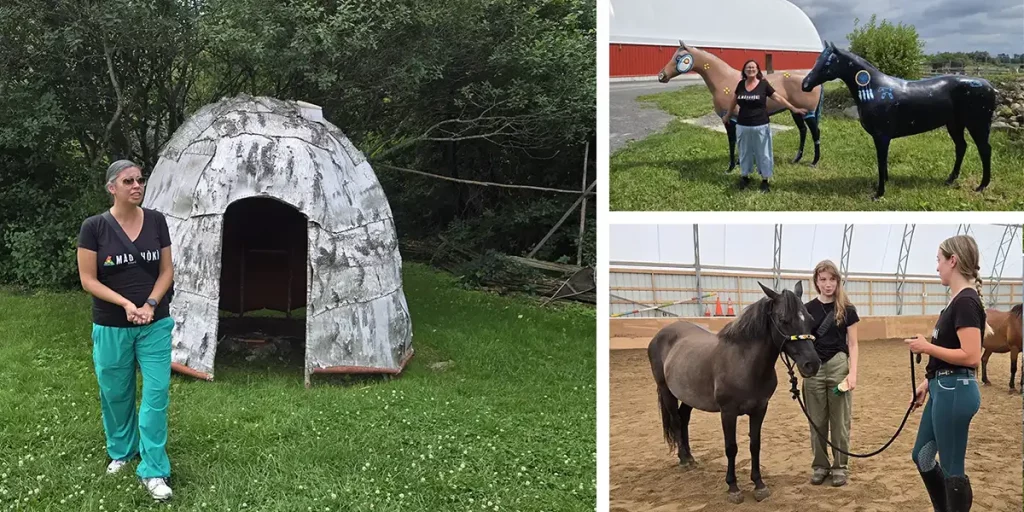
ABOVE (CLOCKWISE): Stephanie Sarazin guided us on an informative tour of the property, sharing insights and Indigenous history; Trina Mather-Simard is pictured in front of two painted spirit horses by the Anishinaabe artist Rhonda Snow; Kaya Simard, an equestrian and trained EAL wrangler, introduces a Spirit Horse to a member of the visiting media.
Certified EAL coach Lynn Surette explains that the program is about “learning through horses.” Rooted in the Seven Grandfather Teachings, core Anishinaabe principles that foster harmony with self, community, nature, and the Creator, each week introduces a new teaching in a guided, experiential way.
Mather-Simard is grateful for the support from the Ontario Trillium Foundation, which she says has been “instrumental in helping us expand our vision for Mādahòkì Farm. We’ve been able to bring the Mishtadim experience to life and add it to the new small-group programming for families and individuals. This is a major step forward in making Indigenous culture accessible, engaging, and welcoming to all visitors year-round.”
Through its Mishtadim program, the farm is now offering the public a chance to participate in this learning, with close-encounter sessions with the Spirit Horses every Thursday in July and August.
New and expanded programming at the farm, supported in part by the Government of Canada through FedDev Ontario, includes hands-on cultural experiences like the Creation Workshop on Fridays and Sundays, where guests are introduced to Indigenous culture and create their own traditional dreamcatcher. Saturdays feature Farm Play, a family-friendly session with animal encounters, a personal horse tour, and introductions to the newest foals—Nesewin (“air” in Anishinaabemowin) and Mashkodewashk (“sage”).

ABOVE (CLOCKWISE): The entrance to the Legacy Trail; an authentic tipi serves as a gathering space to share Indigenous culture; Signage highlights the summer programming at Mādahòkì Farm.
Visitors can also walk the Legacy Trail, a short educational path that highlights traditional plants and medicines while exploring the Seven Grandfather Teachings. The newly renovated Mamawii Lodge—“Phase A” of the farm’s expansion, according to Mather-Simard, provides a welcoming venue for events, adding to the peaceful, spiritual atmosphere created by the surrounding natural landscape and amphitheatre-style seating.
In addition to sharing space and stories, Mādahòkì also shares flavour. The on-site Indigenous Marketplace is open Thursday through Sunday, offering grab-and-go Indigenous food created by renowned Chef Billy Alexander. The boutique also features thoughtful gifts and artworks from more than 60 Indigenous makers. On the day of a recent visit, Chef Alexander and his team were preparing to cater a high-profile lunch for Prime Minister Mark Carney and Indigenous leadership, gathered in Ottawa to discuss major infrastructure and resource projects.
Looking ahead, the fall will bring even more opportunities to connect. In September, Mādahòkì will launch two new experiences: Trail of the Native Ponies, a self-guided tour exploring the Spirit Horses through augmented reality, historical stories, and Elder teachings; and Spirit Horse Connections, a 3.5-hour guided cultural journey featuring a Traditional Welcome, tea and bannock, a walk with the horses, and a deep dive into Indigenous worldview.
In every sense, Mādahòkì Farm is a place of sharing—of land, of stories, of healing, and of heritage. Whether you’re visiting to meet the Spirit Horses, walk the trails, experience Indigenous teachings, or simply enjoy a bannock and tea on the land, the farm offers something meaningful for everyone.
As its programs and partnerships continue to grow, so too does its impact—rooted firmly in respect, culture, and community.