
• By: Dan Donovan

Poll Shows Canadians Want Ottawa to Shrink Its Bloated Bureaucracy

A new Leger poll commissioned by the Canadian Taxpayers Federation (CTF) reveals growing frustration among Canadians over the federal government’s expanding bureaucracy, with a clear majority calling for cuts to both its size and cost.

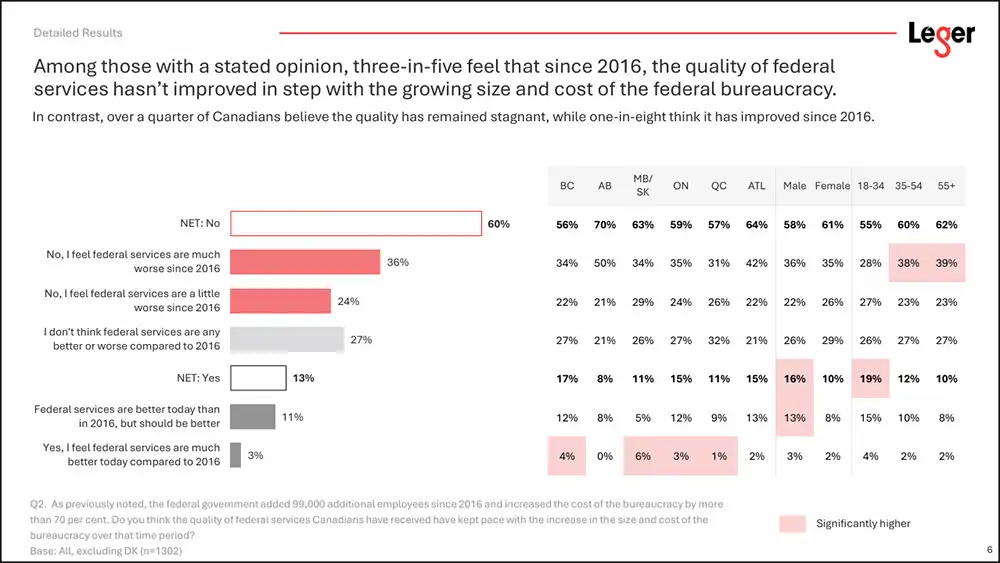
According to the poll, 54 per cent of Canadians believe the federal bureaucracy should be reduced, while only 4 percent support further expansion. Among those with a clear opinion, a striking 66 percent favour downsizing. The sentiment is even more pronounced when it comes to service delivery: 60 percent of decided respondents say federal services have worsened since 2016, despite a massive increase in staffing and spending.

“The poll shows Canadians know they’re paying for too many federal paper pushers and want the government to shrink its bureaucracy,” said Franco Terrazzano, Federal Director of the CTF. “It’s clear that adding more bureaucrats does not mean better services.”

Since 2016, the federal government has added 99,000 employees, ballooning the cost of the bureaucracy from $40.2 billion to $71.2 billion—a staggering 77 per cent increase, according to data from the Parliamentary Budget Officer.

Despite this surge in spending, only 11 per cent of Canadians believe services have improved. Half say they’ve gotten worse.

“The government ballooned the cost of its bureaucracy and added tens of thousands of extra bureaucrats, but Canadians aren’t getting better services,” Terrazzano added. “Prime Minister Mark Carney should listen to Canadians and cut the size and cost of government bureaucracy.”

Ottawa at the Crossroads: Expert-Backed Paths to Bureaucratic Reform

With tens of thousands of federal employees living and working in the National Capital Region, Ottawa is the epicentre of Canada’s public service—and any reform will have a direct impact on the city’s economy and workforce.

Early Retirement Buyouts

In June 2024, Treasury Board President Anita Anand announced legislation to expand early retirement eligibility for frontline federal workers, allowing retirement after 25 years of service without pension reductions.

“Public servants in critical frontline roles work hard every day to keep Canadians safe,” Anand said. “With early retirement measures, our government is making sure their service is recognized.”

While currently limited to safety and security roles, experts suggest similar buyout programs could be extended to administrative positions to reduce headcount without layoffs.

Cutting Contracted Work

Statistics Canada confirmed it will terminate 142 contracts by October 2025 as part of cost-cutting measures.

“Exceptions to the new measure will be made only where essential,” said spokesperson Jada Cormier.

This follows broader reductions across federal agencies, including the Canada Revenue Agency and Immigration, Refugees and Citizenship Canada, which have shed thousands of temporary workers in the past year.

Travel and Expense Reductions

The Carney government is expected to push for even more savings on public service expenses. The 2024 federal budget called for $4.2 billion in savings over four years, largely through reductions in travel, consulting, and operational expenses. Sahir Khan, executive vice-president of the University of Ottawa’s Institute of Fiscal Studies and Democracy, called this “the safest possible action” to reduce costs without triggering major disruptions.

Conservative Opposition’s Plan for Bureaucratic Reform

The Official Opposition is expected to continue its push for a more aggressive approach to downsizing the federal bureaucracy. In the run-up to the May election, Conservative Leader Pierre Poilievre told Canadian Press: “There are roughly 17,000 bureaucrats who voluntarily retire every single year.”

He argued that not all of them need to be replaced, and said the Conservatives would rely on “the powerful mathematics of attrition to reduce the morbidly obese back-office bureaucracy.”

Poilievre also called for deep cuts to federal consulting contracts, a reduction in the number of government buildings, and the redirection of savings toward frontline services such as border enforcement and public safety. Heading into the fall session of Parliament, the Tory position remains unchanged.

Wernick’s Reform Call: A Case of Bureaucratic Amnesia or Just Irony?

Former Privy Council Clerk Michael Wernick, who served from 2016 to 2019 during the early years of the Trudeau government, has recently called for a major overhaul of Canada’s public service. In a January 2025 article for Policy Options, Wernick criticized “bloated management” and “structures beyond their best before date,” urging a reorganization of departments and central agencies to restore public trust.

Wernick presided over one of the most expansive periods in Ottawa’s bureaucratic history, overseeing the addition of tens of thousands of public servants and a sharp rise in federal spending. His tenure helped shape the very machinery he now critiques.

In an interview last February, Wernick dismissed attrition-based downsizing as “the worst way to get to a smaller, leaner public service,” calling it “not a mindful way of pruning … It’s not strategic.” Because nothing says “strategic” like the guy who helped build the bloated system telling everyone else they’re pruning it wrong.

As Thomas Paine warned, “A body of men holding themselves accountable to nobody ought not to be trusted by anybody.” That sentiment lands squarely in today’s Ottawa, where unelected senior officials—Clerks, Deputy Ministers, and Assistant Deputy Ministers—exercise sweeping control over billions in taxpayer dollars with little public scrutiny.

Over the past decade, their approach to the public purse has resembled a game of Monopoly played with real money—reckless, consequence-free, and entirely disconnected from the realities faced by ordinary Canadians. The difference is that in Monopoly, at least someone eventually goes bankrupt. In Ottawa, the players just keep passing Go and collecting their bonuses.

Wernick’s late-stage conversion to reform is more than a little rich. It reflects a broader culture among senior public servants whose careers have been spent entirely on the public dime, yet who rarely face consequences for mismanagement or excess. That’s precisely why Prime Minister Carney’s decision to bring in Michael Sabia—a seasoned outsider with real-world business experience—is more than symbolic. It’s a necessary intervention to fix a federal public service whose “leadership” has become the problem.

Photo: Pixabay