


The Kids Are NOT Alright: Our Job Market is Crushing Canadian Young People

Following eight months of working in Banff/Jasper and backpacking in Europe, I landed back in Moncton, New Brunswick in the dead of winter 1982. Canada was in the throes of a major recession; unemployment exceeded 12 percent and mortgage rates hovered around 20 percent. Scanning the want-ads in the Times-Transcript was depressing. There were three jobs advertised: long-haul trucker, insurance sales representative and short-order cook/floor staff at a new restaurant, Crackers, located alongside Moncton’s hotspot, The Cosmo Club. I was desperate, so putting on a suit, and resumé in hand, I trudged through the snow on Main Street to meet with the owner Hilton Attis. He took one look at the suit and laughed, “you’ll never stay”! I did, until the new school year began in September. That job was revelatory: learning to cook, constant pressure to move, move, move; demanding boss – Hilton’s mother (or grandmother, I was never sure) was the kitchen boss; and portion and cost controls. So why this self-indulgent trip down memory lane?

Simply to say that this recession, like others before it, and the one that followed in the early ‘90s were transitory in nature, cyclical downturns in the business cycle. My period of underemployment was brief, I learned a great deal, and there was no career scarring. Young people today in contrast, face the Four Horsemen of the Apocalypse: near-recessionary economic conditions characterized by stagnant growth and wages, coupled with rising unemployment; conditions exacerbated by the Trump tariffs and resultant uncertainty; unprecedented competition from temporary foreign workers, and hundreds of thousands of foreign students for entry level jobs; and the pernicious creep of Artificial Intelligence (AI) displacing junior workers. Canada was a drive-by victim of the 1981-82 recession as the entire Western world struggled. But the immigration mess is entirely the fault of the Trudeau government, as is the lack of a growth agenda which Prime Minister Mark Carney seeks to develop.

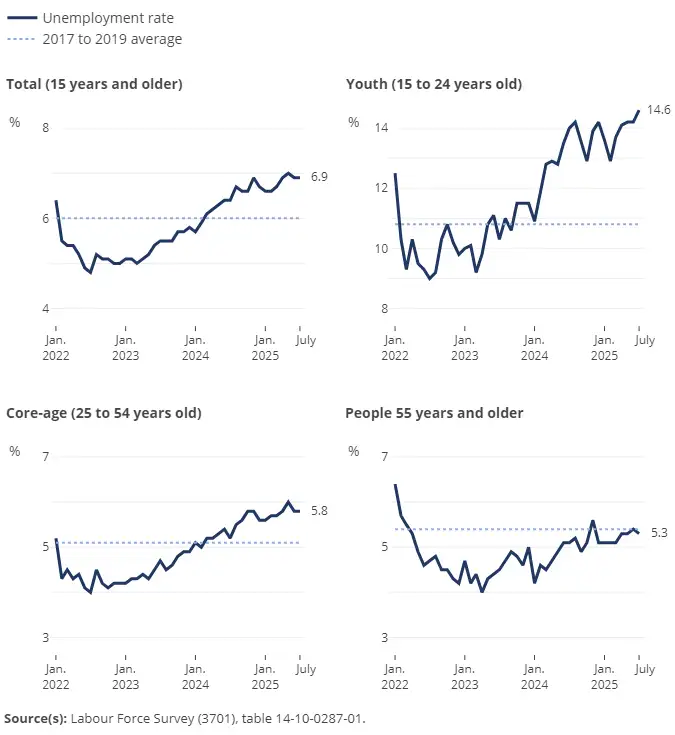
The July 2025 Labour Force Report from Statistics Canada portrays this disaster in stark terms. The Canadian economy lost 41,000 jobs and while the overall unemployment rate remained unchanged at 6.9 percent, those losses were concentrated among youth aged 15 to 24. The youth employment rate fell 0.7 percent to 53.6 percent, the lowest level since 1998, excluding two pandemic shutdown years. Traditionally, the summer months see the highest levels of youth employment. (See Chart 1)


ABOVE: Chart I — Unemployment Rate by Age Group (July 2025).


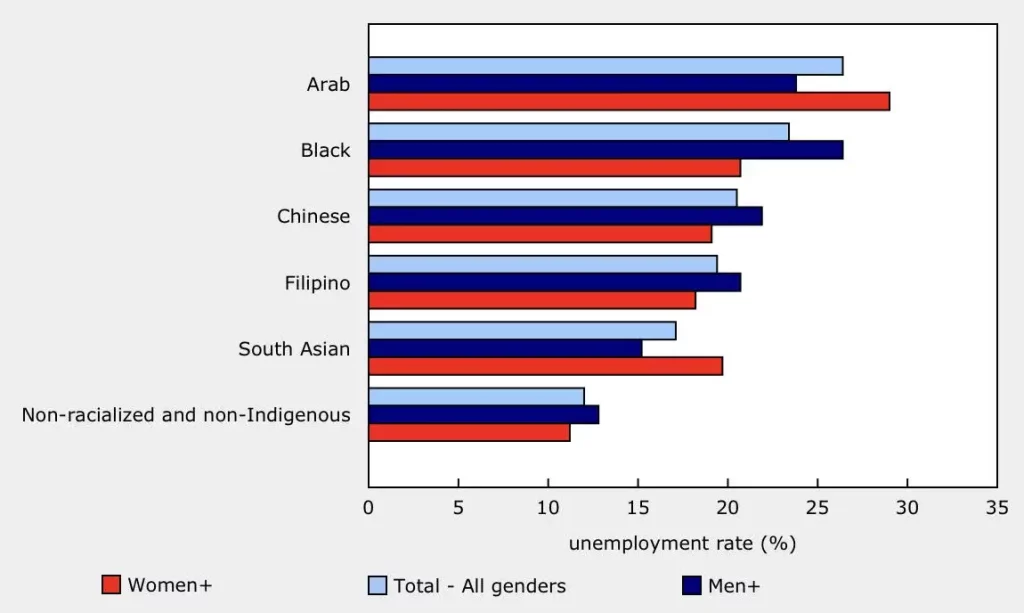
Overall, youth unemployment stood at 14.6 percent, nearly one in seven. For young men, it was even worse 16.2 percent. For Black and Arab youth, it stood at nearly 25 percent! All Canadians should be concerned about these numbers, particularly as July was not an aberration. The situation has been worsening month by month.(See Chart 2)

ABOVE: Chart 2 – Youth unemployment rate for the five largest racialized groups in Canada (July 2025).


Carleton University political management program director and professor Jennifer Robson, writing in Jennifer’s Substack, nails the problem: “The problem is that the decline in the rates of youth employment clearly pre-dates Trump. Something happened in the post-COVID reopening that generated a bit of a lock-in, where new entrants were less welcome and (look at the employment line for the 55-64) older workers held on to what they have. An aging set of decision-makers in office and those giving them advice is, sadly, unlikely to see this as a pressing problem. But for the youth experiencing it, and the families supporting them, it is a pressing problem and it could have longer term repercussions for us all”.

For a number of reasons, youth unemployment is generally higher than the norm. Seniority rules governing layoffs disadvantage them, as does the fact that their jobs tend to cluster in small businesses, those most susceptible to downturns. And at the beginning of their careers, workers tend to change jobs more frequently, seeking a better fit or higher wages.

The official statistics are borne out anecdotally. More than 50,000 applications were received for 5,000 positions at the Canadian National Exhibition, which is soon to open in Toronto. A Reddit post from 16-year-old seeking employment in Milton states in part, (original punctuation) “retail jobs they don’t even reply back to you and ghost you I was at McDonald’s last week and asked for the lady if their hiring she said they have 1411 application for a job in McDonald’s. The only way to get retail and fast-food jobs is knowing someone that works their…”. Another Reddit post from a 16-year-old female emphasizes the desperation, “I really need a job…need to support my family and myself. The job market sucks… I’ve done everything. Went to the local McDonald’s where I actually have connections…I applied to Starbucks, KFC, Harvey’s, Dollarama, Costco, mall stores, Subways, Tim Hortons…I’m trying really hard to not lose hope but every application after application, I get nowhere”.

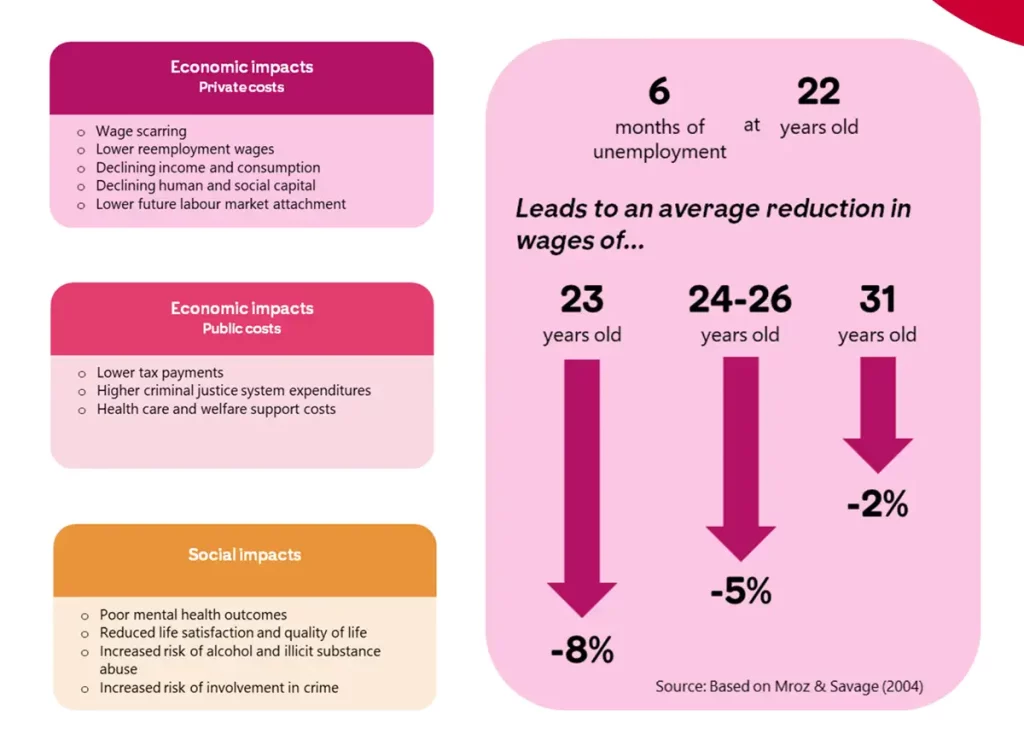
ABOVE: Economic and Social Costs of Youth Unemployment, King’s Trust Canada (November 2024).


Anecdotal for sure, but go into any Tim Horton’s, Canadian Tire or Home Depot to name just a few examples, and spend a couple of minutes talking to employees. Last winter, I had the pleasure of attending a grand-nephew’s minor hockey game in Bouctouche, New Brunswick, the birthplace of K.C. Irving. The rink is a throwback to the old days; fans huddled under the few working heaters. His team was shellacked by the local squad, but we still stopped at the nearby Tim’s for a post-game hot chocolate and apple fritter. I counted 11 staff behind the counter, one being an older white French-speaking lady. The remainder may well have been new Canadians (and I have no issue with immigration) but Bouctouche is not exactly ground zero for attracting immigrants. And you can’t tell me that, paid a decent wage, local folks do not want to work, particularly young people. If your eyes are telling you something, believe it.

If positions young Canadians might take are being filled by temporary foreign workers, and international students, their plight is worsened by the AI creep into a number of fields that hereto with provided solid entry-level positions: coding and software, junior engineers, marketing and content development, contract writing, real estate administrative tasks, and call centres where personnel are increasingly replaced by chatbots. Insurance companies are using AI to generate instantaneous premium quotes.

The job crunch is also evident in occupations sought by recent college and university graduates. A Canadian citizen with a Computer Science degree and two years of professional experience interviewed with a firm that ended up hiring an international student. He writes on Reddit, “I stalked their LinkedIn and their entire tech staff was filled with newcomer South Asians, with their average pay being around $50,000 for a software developer position. They’re being hired over Canadians because the company can get away with paying them so low”. The kicker – “I’m a fucking south asian (sic) Canadian myself – relax guys”. Two weeks ago, the New York Times ran a story entitled Goodbye, $165,000 Tech Jobs, which noted that recent computer science and computer engineering graduates face double the unemployment rate of their biology and art history classmates. One student indicated he had applied for 5,762 tech jobs, resulting in 13 interviews but no job offers. Another commented that he applied for a job at McDonald’s but was rejected for “lack of experience”. The culprit in these situations is often companies choosing to engage AI coding assistant tools, rather than hire junior coders or engineers. Canada is no different. Young coders will be quickly returning to school to enroll in new AI utilization courses in order to meet this technological pivot.

The use of Generative AI is now mandated by companies such as Shopify and Open Text, both of which will not permit new hires unless managers can prove that the task cannot be done by AI. The Royal Bank of Canada has partnered with software developer Cohere to build the North program, that will initially build and analyze financial data for wealth managers and financial advisors. Earlier this week, Cohere signed an MOU with the Government of Canada to advise the bureaucracy on how AI might improve productivity and cut operational costs. While the Carney government states that job cuts are not the objective, the reality is that ministerial mandate letters emphasize the technology in finding cost savings – and the largest single cost is salaries. You can bet no DM or ADM will fall victim to AI; the cuts will be to entry level positions.

Whatever the federal government is doing now to address youth unemployment is clearly not enough. Fortunately, there are a number of well-researched, practical solutions to be considered. For example, last November, the King’s Trust Canada released a report by Deloitte on the socio-economic impacts of this crisis. It identifies 850,000 youth between the ages of 15 and 29 who are unemployed or not engaged in training or an educational program, with serious consequences for both the individual and society. The research affirms every stark statistic presented earlier by Statistics Canada. The King’s Trust advocates a four-pronged approach: skills training, entrepreneurship promotion, employment services and subsidized employment. Specifically, they recommend targeted tax rebates to incentivize the hiring of young people, and that a ‘youth lens’ be applied to all policy and program decision-making—better funding of organizations that work at the coal face with youth on training and mentorship.

Build Canada, a movement created largely by tech moguls, called in April for a mandatory, national Canadian Civic Service program for those aged 18 to 30 years. Citing a decline in national pride – only 34 percent of us report being “very proud to be Canadian” down from 52 percent in 2016, and 13 percent would support annexation by the US, rising to shockingly 43 percent for those under age 35 – and the opportunity for young people to acquire new skills, such a program could have streams focusing on public health roles, environmental efforts or a military option including a cyber defence corps. Imagine how many of Justin Trudeau’s 2 billion trees might have been planted with an Environmental Youth Corp! Every community has an organization focused on young people; in Ottawa it’s the Youth Services Bureau offering a suite of services ranging from employment and educational, to housing and mental health supports. We need to strengthen these community outreach services.

The Angus Reid Institute released a poll earlier this month showing that more than 70 percent of Canadians supported a national year of service in the following four areas: public health support, the environment, youth services and civil protection (emergency and disaster response). Military service found just 43 percent support. National models currently abound – Germany, France, Norway and South Korea are frequently cited examples. Support is strong within the affected age group, and responses between males and females do not vary dramatically.

In May 2019, then-Prime Minister and Minister of Youth Justin Trudeau released Canada’s first-ever Youth Policy. While periodic updates were released, the policy, now barely six years old, has more dust on it than a fossil in a dinosaur dig in Drumheller. We can do more, and must do more for our young people. Not to go all right-wing, but we spend billions of dollars each year on settlement services and housing legitimate refugees and irregular migrants. We provide accommodations allowances, child tax benefits and in tens of thousands of cases, one-time start-up allowances of $8,326.14. Imagine if we provided a similar number of young Canadians with an $8,000 Career Liftoff grant – for training, to start a small business (coupled with entrepreneurship mentoring) or for their community college tuition. It’s not a lack of money that’s stopping us. It’s a lack of bureaucratic imagination, an entrenched immigration lobby, and those large employers who are now addicted to the drug of the Temporary Foreign Workers program, and a river of international students. It’s unfortunate that we cannot support every Canadian worker, but it’s criminal – in a societal sense – what is happening to young people. We will all pay the price.

The Who’s iconic song The Kids are Alright (and later album cover of band members huddled under a Union Jack) is an optimistic mid-60s pop rock melody to the casual listener. By 1971 though, songwriter and guitarist Pete Townsend had determined that the kids were, in fact, not alright, penning Baba O’Riley. Backed by Keith Moon’s ferocious drumming, Roger Daltrey’s soaring vocals informed us that the reality was a “teenage wasteland, it’s only teenage wasteland … they’re all wasted”. Canada’s governments, with the private sector, must elevate the issue of youth un- and underemployment to the highest priority. An economic jobs and growth agenda that puts an end to this waste of talent by placing young people at its centre, would be a nice start.

Photo: iStock