
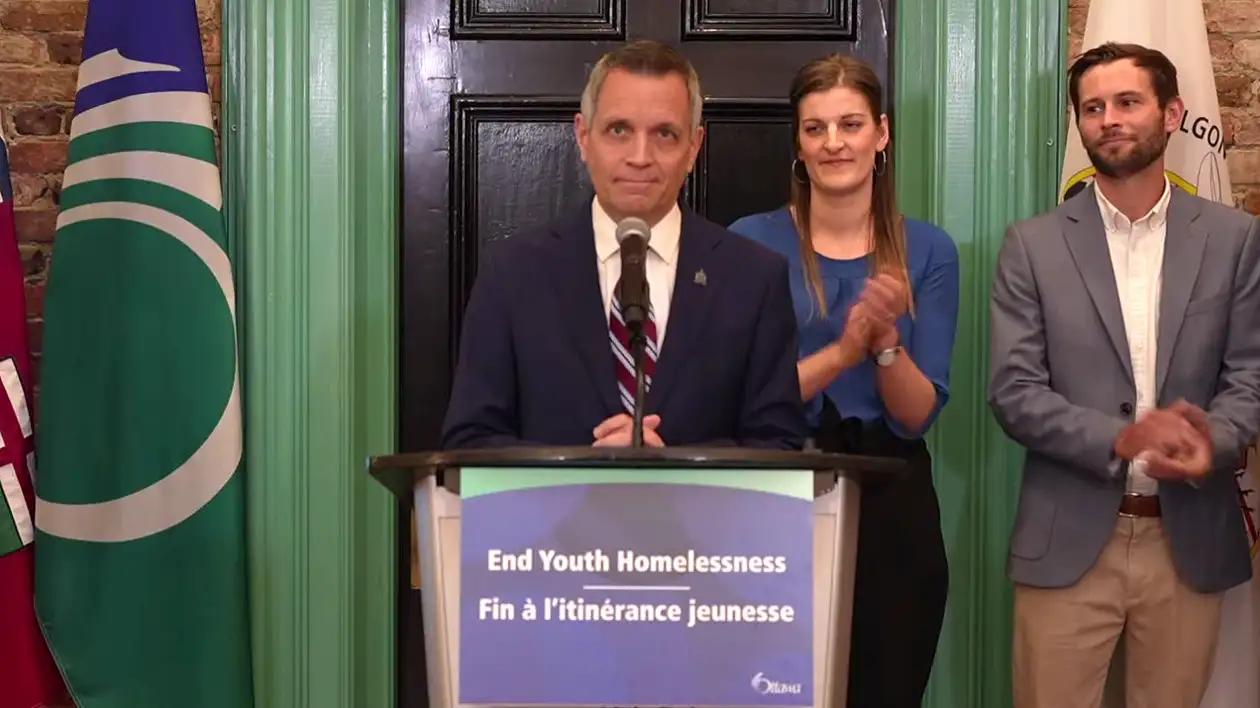
Ottawa Mayor Mark Sutcliffe held a press conference today announcing that the city has set an ambitious goal: to end youth homelessness by 2030. The mayor noted that while the figure is fluid, it is estimated that between 50 and 100 youth in Ottawa are currently homeless.
As part of the initiative, Sutcliffe pledged to run in the Alliance to End Homelessness’s new event, The Race to End Homelessness, and encouraged all Ottawa residents to participate. The October 4, 2025, event will raise funds for the 75 social service agencies.
The mayor also confirmed he will participate this fall as a judge in the University of Ottawa hack-a-thon, where students, faculty, community partners, and sector experts will come together to design creative solutions to prevent youth homelessness.
Sutcliffe said the effort to end youth homelessness is both urgent and deeply personal, pointing out that almost half of those who experience adult homelessness were first homeless before the age of 16. “Being a teenager is hard enough when you have a home to go to—it’s almost impossible when you don’t,” he said.
The mayor underscored that his broader goal as mayor is to make Ottawa safer, more reliable, and more affordable—priorities reflected in keeping tax increases low while investing in public transit, public safety, and infrastructure such as roads and sidewalks. He noted that while progress has been made, challenges remain, particularly around housing and homelessness, which have grown more acute in Ottawa and across Canada.
The mayor also detailed recent investments: $30 million in social service agencies, $2.1 million in youth supportive housing, and $1.5 million in shelters and transitional housing this past year. In total, Ottawa has invested $82 million in affordable housing this term, with plans to surpass $100 million in the 2026 budget—double the amount spent in the previous council term.
Sutcliffe reiterated that ending youth homelessness by 2030 is an ambitious but achievable target, one that will require a “Team Ottawa” approach, stronger funding from other levels of government, and a focus on prevention and permanent housing solutions.
The press conference closed with remarks from Katie Burkholder-Harris, executive director of the Alliance to End Homelessness and co-chair of the city’s Housing and Homelessness Leadership Table. She stressed that ending youth homelessness is not only possible but necessary to break the cycle that too often leads to chronic adult homelessness. Burkholder-Harris called the city’s new commitment a bold example of leadership, noting that success will depend on the collaboration of governments, community partners, and residents alike.
While the mayor’s announcement sounds ambitious, some will question whether it’s more symbolic than substantive. If Ottawa has between 50 and 100 homeless youth, how does it take 75 agencies and tens of millions in funding to address such a relatively small number?
With so many organizations already dedicated to this issue, launching another fundraiser and promising more funding may not “move the needle” as much as reforming how existing resources are used. Critics could argue that what’s needed is accountability—measuring outcomes, reducing duplication, and ensuring dollars are directly creating housing solutions—rather than another round of announcements.
Of course, even one homeless youth is a tragedy that no compassionate city should accept, but the question remains: is the problem really a lack of funding, or a lack of focus and coordination?