
The Helipad Hawk: How the Ottawa Hospital uses Falconry to Combat Crows
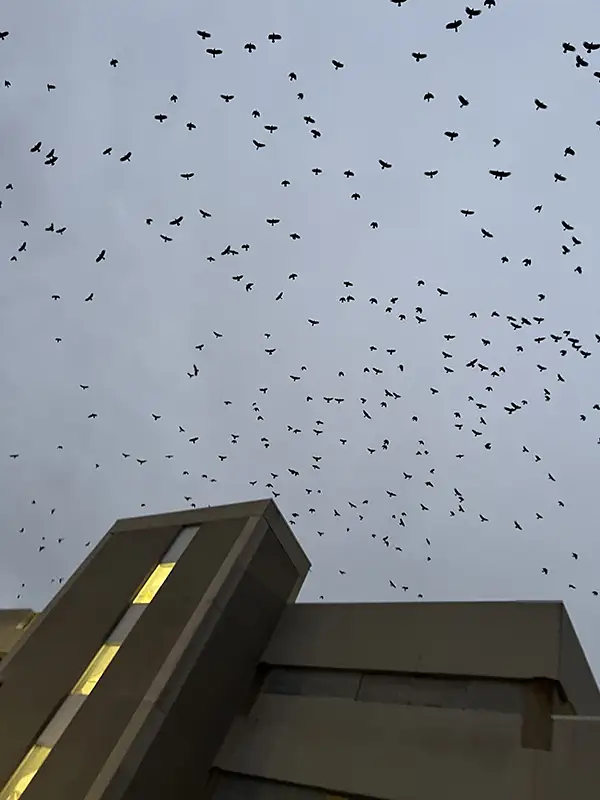
It’s dusk on an early-November day on the back lawn of the Ottawa General Hospital. All around, hidden in the trees surrounding the medical campus in Ottawa’s Alta Vista neighbourhood, are tens of thousands of crows. It only takes a dark brown blur, gliding through the air, to send the flock into a Hitchcockian frenzy — evacuating their roost in a thousand different directions, all at once.
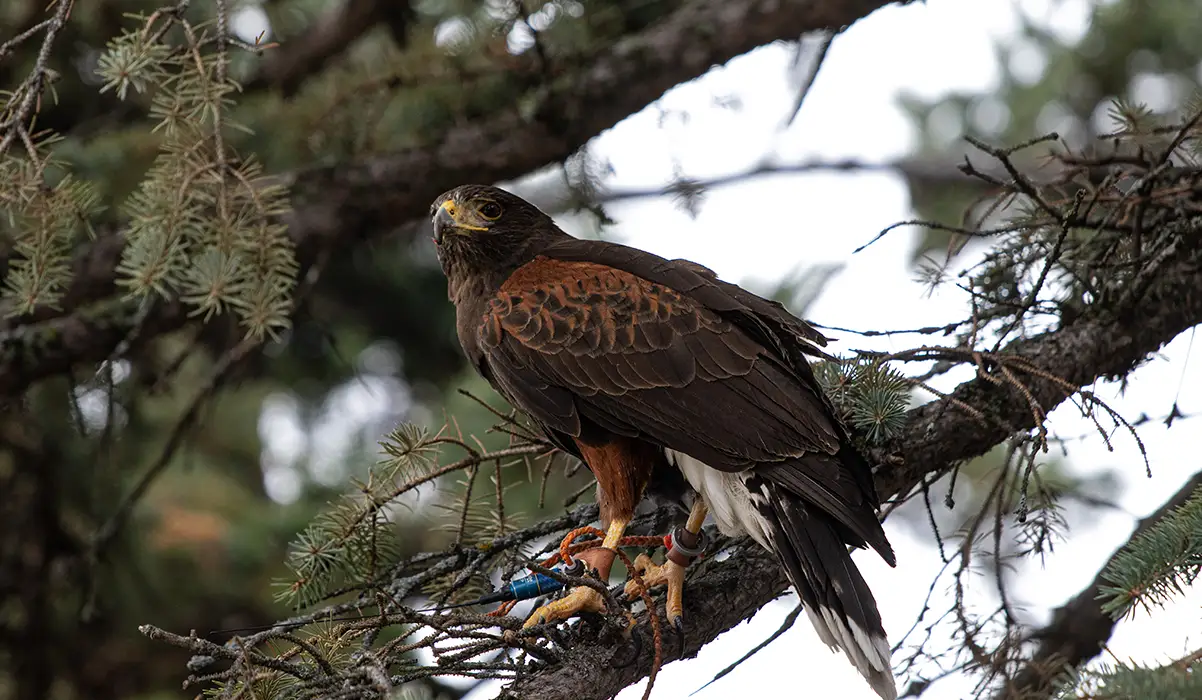
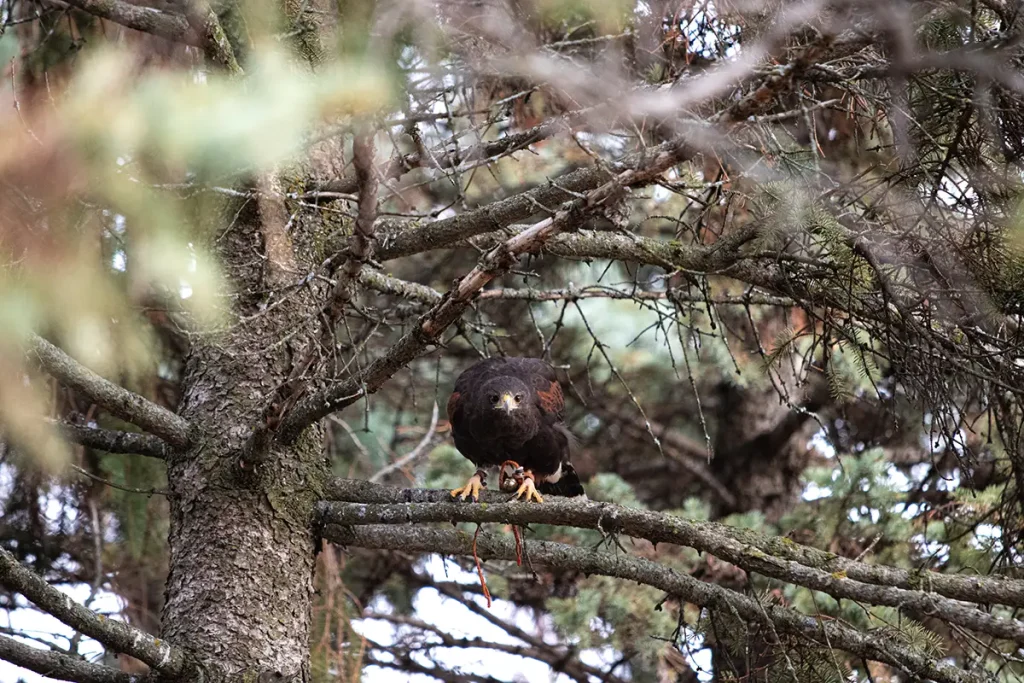
Monty, a six-year-old Harris hawk, is the source of the scatter. And with a wingspan of more than a metre, he is, by all accounts, the big bird on campus.

ABOVE: Crows scattering during a falconry session at the Ottawa Hospital. Photo courtesy of Liz Hall
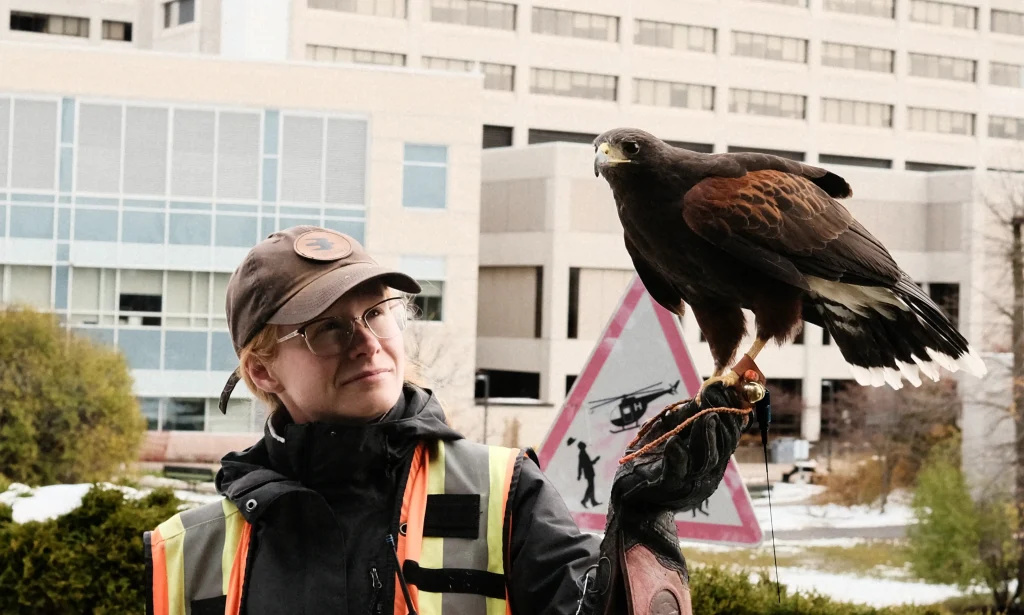
Standing in the middle of the field in a high-vis vest is Monty’s earthbound co-pilot and licensed falconer, Liz Hall. With a raised, leather-gloved hand, she calls the bird back to home base.
The 25-year-old bird handler has been working for Haliburton, Ont.-based Royal Canadian Falconry since last April – this is her second full season with the company – but she’s been around birds of prey her whole life.
“I grew up in a family of falconers,” she said. “We got our first bird when I was six years old. I have a picture somewhere of me, and the bird’s coming in to land, and I’m covering my face – kind of nervous – cause we’re the same size. It was my older brother and my dad who were into it.”

ABOVE: Liz Hall and her hawk, Monty, in front of a helicopter warning sign at the General campus of the Ottawa Hospital. Photo © Paris Healey
The discipline, some 4,000 years old, originated in China as a hunting method. But this year in Ottawa, Hall and Monty are working to ensure the safety of the hospital’s medevac helicopters. As it happens, the trees where the crows gather to sleep in epic numbers are located next to the hospital helipad.
“It’s a huge risk of bird strikes – especially crows in the dark, it’s really hard to see them, and they are afraid of the helicopters,” said Hall. “So, if (the aircraft) comes by, they all explode into the air in all directions, and it’s just too dangerous.”
Bird strike is the term given to collisions between avian species and aviation machines. The phenomenon can be deadly if the strike is severe enough, and its occurrence is surprisingly frequent – there were 1,689 bird strikes reported to Transport Canada in 2022, and the aircraft hazard has proven difficult for authorities to prevent.
In January 2009, a collision with a flock of Canada geese was famously blamed for knocking out both engines of U.S. Airways Flight 1549 over New York City and forcing the pilots to ditch the jet safely in the Hudson River — miraculously saving all 155 people on board.
But 179 passengers and crew died in South Korea last December when Jeju Air Flight 2216 struck a flock of Bakail teal ducks and crashed shortly after takeoff at Muan International Airport.
According to the hospital, there haven’t been any serious bird strikes with their medevac helicopters yet, but they’ve implemented falconry-based bird management out of an abundance of caution.

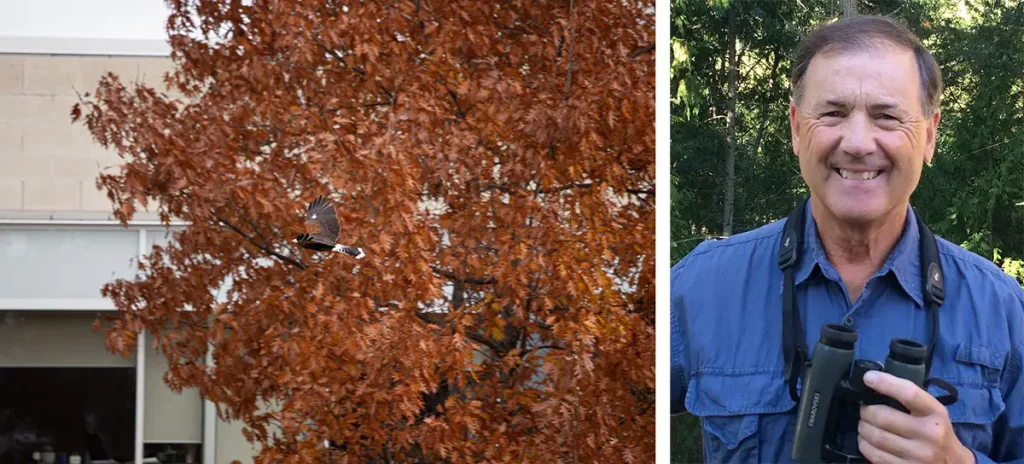
ABOVE: Dr. David Bird. Photo courtesy of David Bird. RIGHT: Monty in flight. According to Hall, Monty can reach speeds over 50km/hr while on the job. Photo © Paris Healey
Ornithologist Dr. David Bird, professor emeritus at McGill University, supports the program. In his view, using falconry to manage the wild crow population at the hospital is a “common-sense solution to a problem that’s threatening human safety.”
“In the sixties and seventies, Transport Canada and other airport authorities around the world began to realize that airports, with their wide-open fields, were attracting a lot of birds,” Bird said in an interview. “And they tried using flashing lights and guns and banger guns and so on. And then they also realized that – gee whiz – the number one enemy of some of these birds are birds of prey.”
He added: “Most (falconers) are not into nuisance animal control. Most are into just the sport of taking out a falcon or a hawk and going out in the woods and fields almost on a daily basis, often with a dog to scare up the prey.”
But to Bird, falconers are essentially engaging in a specialized form of birdwatching.
“By training a falcon or a hawk to chase after whatever target birds that they would normally go after, you get to enjoy watching a Peregrine falcon dive at a speed of 350 kilometres an hour – the fastest moving organism on the planet,” he said. “Or you get to watch a goshawk or a Cooper’s hawk launch off one’s fist and then do a rapid sprint after a grouse or a hare. So, you get to basically appreciate the beauty of birds of prey.”
And they are certainly beautiful. Every time Monty lands, whether on Hall’s raised hand or the limb of a tree, he pointedly wiggles his brown and white speckled tail. And when he flaps his wings in the air, the tips of his feathers brush against the wind like outstretched fingertips.
“Monty was just one of my personal hunting birds,” said Hall. “He was hunting cottontail rabbits with me for many years until we started here.”
She added: “We’ve been flying together for so long now, that we’re pretty good at reading each other.”
She has four birds she works with, including Monty’s two sisters, Ellie and Sadie, and a young peregrine falcon named Bug.
Peregrine falcons were nearly driven to extinction in the mid-20th century. According to Bird, “the humans on this planet that cared the most about bringing back the peregrine falcon from the brink of extinction were the falconers.” The species has since recovered, in part, due to their efforts.

ABOVE: An Ornge medevac helicopter flies over a wooded area. This Leonardo AW139 is the same model used by the Ottawa Hospital for their emergency air-lifts. Photo courtesy of Ornge Media Library
“They were among the first to notice that there were broken eggshells in the nest,” said Bird. “DDT (a pesticide) was causing that. And then they were also the first to say, ‘Hey, we can breed these birds in captivity and release them.’”
Bird is not a falconer. But his research as a scientist was in the captive breeding of birds of prey. He and other ornithologists have used a combination of falconry and artificial insemination techniques to restore falcon populations.
“So yes, falconry and the conservation of the birds of prey are synonymous in my book.”
Gary Mulcahey, the hospital employee who coordinates the crow-hazing program, said the use of falconry has been a great success. He noted that, in the past, the grounds department tried other methods, but to no avail.
“When they first started seeing an issue, they would actually shoot off blanks,” said Mulcahey, recalling previous attempts to clear out the crows. “And then that became bad for the project. They tried all different stuff and then we ended up hooking up with falconry – and it’s been great ever since.”
“That’s not surprising,” said Bird. Crows are “among the smartest birds in the world . . . but just the fact that a hawk is around is going to make the crows feel uncomfortable.”
The crows typically roost in high numbers on hospital property in October and November. During this peak season, Royal Canadian Falconry has a falconer patrolling as many as six nights a week.
Hall supplements her traditional falconry with a few high-tech gadgets, pointing to the GPS transmitter on Monty’s leg. She uses the device on the off chance she ever has to track down his location, though she hasn’t needed to yet.
Sometimes, falconer Liz Hall augments the use of her hawk, Monty, with a noise maker to scare away crows.
Video © Liz Hall
She also uses a long-range laser pointer, which tells Monty where to land. But the clever crows have caught on; now they’re even wary of the laser.
Video © Gary Mulcahey
But the best way to keep crows at bay, it seems, is sending Monty into the trees.

ABOVE: “He dutifully ignores all the squirrels here, which is really nice,” said falconer Liz Hall. “Five years ago, he killed one squirrel, and it gave him a really bad bite on his foot. He has not touched one since.” Photo © Paris Healey
HEADER IMAGE: Monty, a six-year-old Harris hawk, perched in a tree at the Ottawa Hospital’s General Campus during a recent crow-scaring session. Photo © Paris Healey