
VersaBank Bets Big on Canada’s New Stablecoin Rules — CEO David Taylor Says the Future of Money Is Already Here
When the federal government released its 2025 budget, the real headline wasn’t taxes or spending — it was a major shift in financial regulation. For the first time, Ottawa outlined a path to govern stablecoins, a fast‑growing class of digital assets designed to hold a steady value and move across blockchain networks like a faster, programmable form of money.
For most Canadians, this still feels abstract. But for VersaBank — the London, Ontario–based digital‑only institution that has quietly become one of North America’s most innovative banks — the move signals something bigger: the start of a new era in how money could work.
A Quiet Canadian Bank with Global Ambitions
VersaBank has no branches, no retail footprint, and no glossy marketing. What it does have is a long track record of being early — from digital deposits to cybersecurity to blockchain‑enabled banking. If Canada wants to lead the next wave of financial technology, institutions like VersaBank may be among its most important, and least understood, assets.
With stablecoin rules taking shape and tokenized deposits edging closer to reality, the future of money is no longer theoretical. It’s being built now — and Canada has a chance to lead it.
CEO David Taylor has long argued that Canada can set the global standard for secure, regulated digital assets. With VersaBank partnering with stablecoin issuers and preparing to commercialize its own Real Bank Deposit Tokens™ (RBDTs™), that moment is arriving.
To understand what this shift means for consumers, businesses, and the financial system, Ottawa Life Magazine Managing Editor Dan Donovan sat down with Taylor for an in‑depth conversation.
OLM: In the 2025 budget — the first under Prime Minister Mark Carney — we saw what appears to be a shift in financial regulation, including a clearer path for stablecoins and other digital assets. From your perspective, what do these new stablecoin rules mean, and how do they affect VersaBank’s confidence in pursuing this as a real business opportunity? And secondly, why is this important for Canadians?
David Taylor: It helps to put this in context by looking back at our history. I founded VersaBank in 1993 as a completely new model — a branchless, digital‑only bank. At the time, we built our own software, used telephone‑based modems and IBM PCs to create our network, and even developed our own smart router, the WebWeaver, to connect everyone simultaneously. When the internet arrived, we used that technology to accelerate deposit gathering across Canada and eventually convinced regulators to grant us a Schedule I Canadian bank license — the first in 18 years. That was a significant milestone, and credit goes to the federal leaders of the day who recognized the potential of a new approach to banking.
Fast‑forward to today, and blockchain is the next major evolution that fits naturally into the banking system. In 2018, I was fortunate to bring in Gurpreet Sahota from BlackBerry — he’s well‑known in cybersecurity — to build our Digital Vault. You may have seen our press releases about it. That vault was designed to support exactly the kinds of products we’re now bringing to market. We began building this long before it became a mainstream focus. A Bloomberg reporter asked me recently how we could claim to be first in the world with this, and I reminded her that they said that back in 2018. But as you know, in a regulated industry, moving early often means you’re explaining things before the rest of the market has caught up.
So, to your question: the 2025 budget did lay the groundwork for a Canadian regulatory framework for stablecoins. It appears it will mirror the U.S. approach under what they call the Genius Act. The Genius Act is now in place, though the detailed regulatory framework is still being finalized. In Canada, the budget sets out the intention to build a similar framework, and my understanding is that they’re working toward what may become the 2026 Stablecoin Act.
OLM: If you’re a federally licensed custodian for digital assets, what does that mean in terms of security? And for someone using a stablecoin or a digital wallet, how would that protection work in practical, everyday terms? Can you explain it in plain language?
David Taylor: That’s an extremely important question. The reason why it’s really important for Canada to have done this is that in the United States of America, there, they’re ahead of the game with stablecoins in U.S. denominations. And if there’s nothing to prevent Canadians, as the blockchain knows no borders, from buying USDC, for example, or using something in U.S. dollars. And that, in effect, is a drain of Canadian dollars being converted into U.S. dollars. So, you sort of want to get it together in Canada too, or again, Blockchain, no, no borders, there’ll be a mass exodus of Canadian dollars converting into U.S. dollars by popular, popular demand.
OLM: Is it in our own self-interest as a country and government to engage and to have a policy and process for this?
David Taylor: Absolutely — it is very much in Canada’s national interest for the government to engage and establish a clear policy and process around stablecoins. There is growing demand, especially among younger Canadians, for access to a reliable stablecoin. In fact, they will be able to opt for stablecoins or deposit tokens. Deposit tokens perform a similar function to stablecoins but are digital representations of an actual deposit in a bank. If Canada doesn’t offer one, people will simply turn to U.S. options like USDC or USDT. That creates a risk: large amounts of Canadian dollars could be converted into U.S.‑based stablecoins, which would weaken Canada’s currency and financial position. Prime Minister Mark Carney understands this risk well. Given his experience leading both the Bank of Canada and the Bank of England, he knows how important it is not to fall behind other countries in developing a national approach to stablecoins.
OLM: As we move further into a digital financial era with new instruments and technologies, how can Canada — including Parliament — strengthen its financial and digital literacy to take full advantage of these opportunities?
David Taylor: Yes, that is a good point, and I think Canada should take on this initiative, including through education in schools and elsewhere. The reason is that the risks in the digital financial world are extremely high — Canadians can lose their money instantly if they are not protected.
The core role of a bank has always been to safeguard depositors’ money. Banks are licensed and trusted to ensure customers don’t lose their funds. But in the digital world, many non‑banks are issuing coins, and many custodians are not regulated financial institutions. These entities do not have the same level of security or technology that VersaBank bank uses, which includes SOC 2 Type 1 standards and FIPS 140 Level 2 certified military‑grade facilities used by NATO.
Editor’s note: (SOC 2 Type 1 is an independent audit that confirms an organization has the right security controls in place to protect sensitive data at a given moment in time, while FIPS 140‑2 Level 2 is a government‑approved standard for cryptographic systems that ensures strong encryption and tamper‑evident protections suitable for regulated financial and government environments. When he refers to NATO‑grade facilities, he means the data‑security infrastructure meets military‑level requirements used in defense settings, providing the highest level of physical and cyber protection for digital assets).
There is strong public demand for stablecoins — and legitimate reasons for Canada to move in this direction — so the government must put strong guardrails in place. There are bad actors around the world, and without proper protections, Canadians could lose their money with no way to recover it in the cryptocurrency environment.
VersaBank is doing what banks have always done: protecting customer funds. We spent years working with regulators and the federal government on a pilot project involving a “deposit token,” which is very similar to a stablecoin. They are now updating that pilot. Stablecoin issuers must be held to strict standards. For example, USDT was sued in New York to prove that its tokens were backed by real deposits or liquid securities, and it could not do so, resulting in a significant fine. This highlights the importance of ensuring that stablecoins are backed by real, secure, dollar‑for‑dollar deposits.
Canadians need to know their stablecoin is backed and safeguarded by a federally regulated bank — not by an unregulated foreign entity. A federal bank can guarantee that the funds behind the coin are real, secure, and held in Canada.
OLM: Tokenized deposits are moving toward commercialization. What still needs to happen before Canadians can use them in everyday transactions?
David Taylor: VersaBank developed this technology years ago and completed an initial pilot with Canadian regulators. As government teams changed over time, many of the original contacts moved on, leaving new personnel less familiar with the project. We are now working with regulators to update that pilot — re‑introducing the system, walking them through how it works, and supporting the development of an appropriate framework for tokenized deposits. The technology itself is already complete. Once regulators in both Canada and the United States are comfortable, the bank is ready to launch commercially. VersaBank already has U.S.‑dollar and Canadian‑dollar tokenized deposits designed for cross‑border and foreign‑exchange transactions. When the regulatory and trade components align, this will provide a state‑of‑the‑art system for facilitating trade between the two countries.
OLM: You’ve touched on this already, but stablecoins and tokenized deposits are still relatively new concepts for the public. Given that VersaBank is CDIC‑insured — which is an important factor for Canadians transitioning into this space — what signs are you seeing that businesses and consumers are ready for, and want, these kinds of products?
David Taylor: I should clarify that stablecoins themselves are not FDIC- or CDIC‑insured. The U.S. “Genius Act” specifies that stablecoins are not FDIC insured, and Canada will likely adopt a similar approach. This means that anyone holding a stablecoin must be confident that the custodian has real, verifiable deposits backing it. Also, of importance to depositors, deposit tokens are eligible for interest payments. The American ‘Genius Act’ prohibits interest payments on stablecoins.
Tokenized deposits, however, are different. They are real bank deposits, and we emphasize that because they are — and as such, are eligible for FDIC and CDIC insurance, as are all bank deposits, subject to regulatory obligations as may apply. That alone will give Canadians a much higher level of comfort. Tokenized deposits can also pay interest, just like any traditional deposit. In that sense, they offer all the benefits people look for in a stablecoin, but with added advantages: interest, full bank regulation, and deposit insurance.
Both stablecoins and deposit tokens will have a role to play in the coming payments revolution. There is strong demand on both sides of the border for stablecoins, and as a bank, this fits naturally with what we already do — providing custodial and trustee services. To your question about why these products are gaining traction: look at USDC. Roughly $75 billion is currently held in reserve with BlackRock to back USDC, which shows that many people see real value in this model.
In Canada, our intention is to provide the same kind of service. When someone buys a stablecoin, we would hold the corresponding deposit in our bank so customers know that if they want to redeem it, the funds are there — just as BlackRock does for USDC, which can be converted back to cash within a stated three‑day window.
OLM: You’ve talked about opportunities in both Canada and the U.S. How does the American regulatory environment shape your plans for digital assets and tokenized deposits? As a bank operating in both systems, how do you navigate the two regulatory landscapes, and how might that dual presence give Canadians added confidence?
David Taylor: We were the first bank in roughly 30 years to receive a U.S. national banking license, which we obtained last year — a significant milestone. As a national bank, we’re permitted to provide custodial services, and the OCC has issued guidance confirming that national banks can do this.
The U.S. is a bit ahead of Canada on stablecoin regulation. The industry grew quickly there, which led to the Genius Act and a large base of consumers already using stablecoins. As a result, the U.S. regulatory environment is probably two or three years ahead of Canada’s.
We’re working closely with regulators in both countries. Much of that work is educational — walking them through how the technology functions and how we protect customer funds. Canada’s system is broadly similar to the U.S.: CDIC mirrors FDIC, and OSFI mirrors the OCC. One difference is that the Bank of Canada has been designated as the stablecoin regulator, while in the U.S. that role appears to remain with the OCC. But the goals are the same on both sides of the border: ensuring consumers aren’t misled, their money is safe, and that banks put the proper guardrails in place so customers can redeem their funds whenever they need them.
OLM: You’ve been in this industry a long time, and VersaBank is one of the more forward‑leaning banks in Canada. The prime minister also comes from a banking background. From your vantage point, what have you observed about his approach to this file, and how do you see the government’s direction evolving over the next year or two?
David Taylor: Well, I think we should be thankful to have Mark Carney as prime minister on this front. This is a highly technical area with real implications for currency and financial stability. If you haven’t come through the Department of Finance, the federal government, or the Bank of Canada, it’s extremely complex. We’re fortunate in Canada to have someone who understands this space so well. I have a lot of confidence that under his leadership, they’ll build a regulatory framework that is both robust and practical — one that protects consumers while allowing innovation like ours to move forward responsibly.
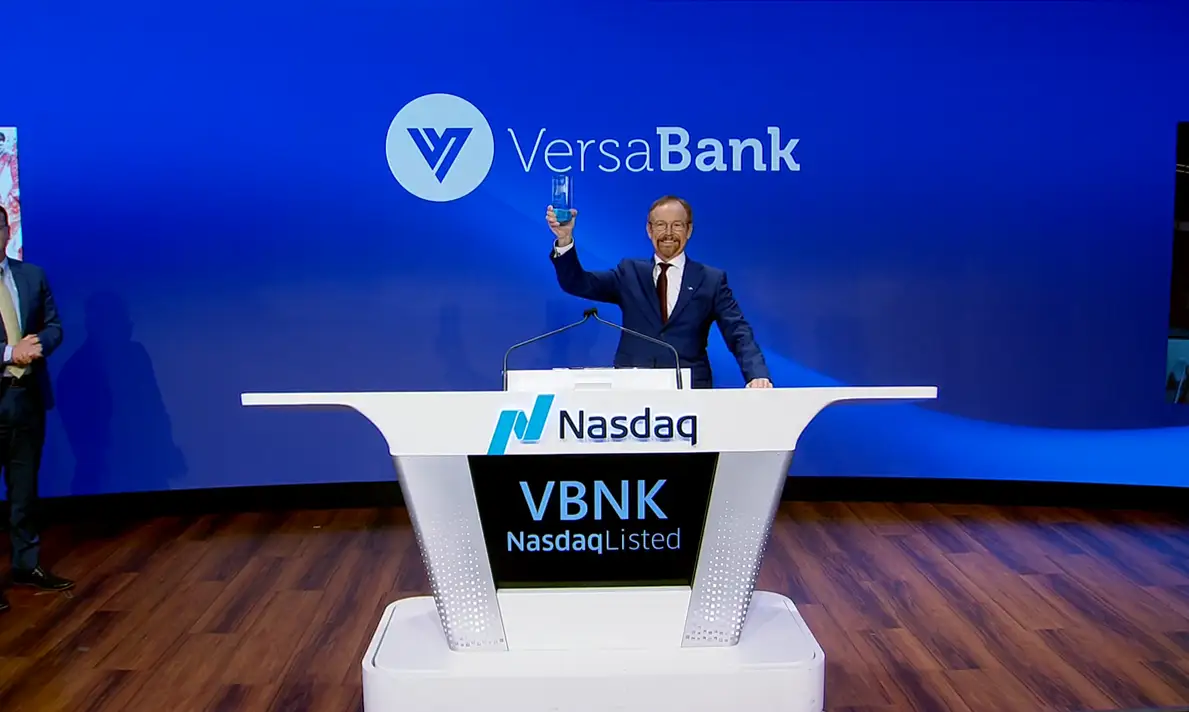
Header image: VersaBank CEO David Taylor at Nasdaq MarketSite. Photo: Courtesy VersaBank