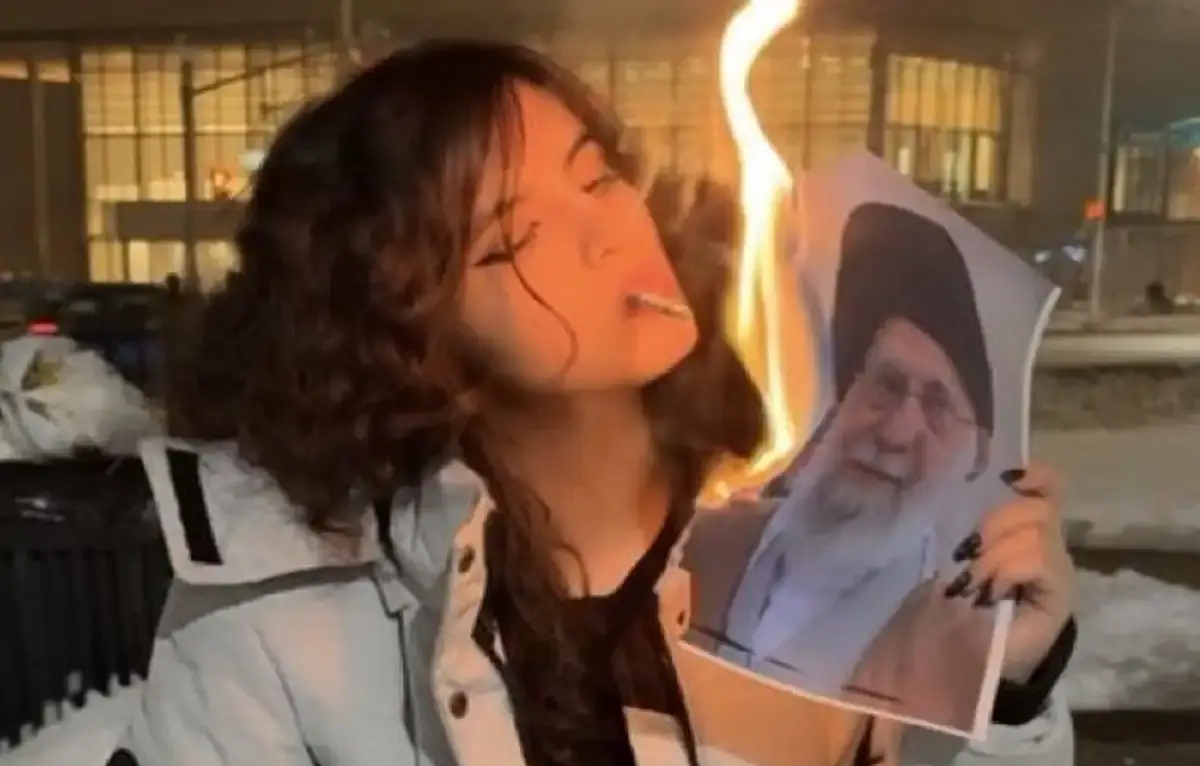
Iran’s Mass Killings Demand a Response — and Canada Has a Direct Stake in This Fight
Iran is in the midst of the most violent and widespread uprising since the Islamic Republic seized power in 1979. For more than two weeks, the country has been convulsed by protests that began with economic frustration and quickly escalated into a national revolt against the theocracy itself. The regime’s response has been catastrophic.
Human‑rights monitors have confirmed more than two thousand protesters killed in the first weeks alone, with the U.S.-based Human Rights Activists News Agency reporting at least 2,003 deaths as of mid‑January. Other tallies suggest the real number is far higher, with activists warning that the death toll could reach into the five‑figure range.
Videos smuggled out of the country show bodies piled in makeshift morgues, families searching for missing loved ones, and security forces firing directly into crowds. Entire cities have been sealed off as the regime shuts down the internet to hide the scale of its violence. What is happening in Iran is not a crackdown. It is a massacre.
Canada’s Direct Stake
For Canada, this is not a distant geopolitical crisis. It is a tragedy that reaches directly into our national life. The Islamic Republic has killed, tortured, and targeted Canadians for decades. The torture and killing of Iranian‑Canadian photojournalist Zahra Kazemi in 2003 remains one of the most brutal examples of state violence against a Canadian citizen. The suspicious death of Iranian‑Canadian academic Kavous Seyed‑Emami in Evin Prison in 2018 followed the same pattern of abuse and impunity. In 2020, the IRGC (Islamic Revolutionary Guard Corps) shot down Flight PS752, murdering 176 people, including dozens of Canadian citizens, permanent residents, and students. This week, Foreign Affairs Minister Anita Anand confirmed that a Canadian citizen had died “at the hands of the Iranian authorities” during the protests.
Canada is also home to one of the largest Iranian diasporas in the world, numbering well over 200,000 people. Many fled the Islamic Republic’s repression, war, and economic collapse. They built new lives here because Canada represented the freedoms their homeland denied them. Today, they are watching the uprising with a mixture of hope and terror, knowing that friends and relatives are among the dead, detained, or disappeared. Their grief and their demands for justice must shape Canada’s response.
Ottawa’s Voice
Prime Minister Mark Carney has described the reports of killings, arbitrary arrests, and intimidation as “profoundly concerning,” urging Iran to respect the rights of peaceful protesters and allow the world to see what is happening. Anand, in a joint statement with Australia and the European Union, condemned the regime’s “lethal force” and praised the “bravery of peaceful protesters” who continue to march despite the risk of death. These statements matter. But statements alone will not stop a regime that has already shown it is willing to kill thousands to cling to power.
The Silence of Selective Outrage
What’s most striking in Canada right now isn’t the noise of protest over the massacre of thousands of innocent, freedom‑seeking Iranians — most of them young people — murdered by a brutal theocratic regime. It’s the absence of the very campus organizations, activist networks, unions, and political movements that spent the past two years mobilizing a relentless campaign of antisemitic agitation. These groups pushed hostile narratives, harassed Jewish students, disrupted synagogues, and marched through Jewish neighbourhoods with their faces covered and their keffiyehs pulled tight, insisting that Israel — and by extension, Jews — are the source of all wrongdoing.
Over the past decade — and especially since the October 7 massacres in Israel — this agitation has intensified. Student groups, unions, activist networks, and political voices in the NDP and Green Party have embraced narratives shaped by ideological extremists and their Hamas and Hezbollah sympathizers. They have marched and disrupted public life with a certainty that comes only from never questioning the ideology driving them.
But if you want to understand how selectively this outrage is deployed, look at the reaction — or the lack of one — as thousands of Iranians are murdered by a violent theocracy. The same keffiyeh‑clad, face‑covered activists who claimed to stand against oppression have vanished. The crowds that filled downtown cores week after week suddenly have nothing to say when the victims are Iranians and the perpetrators are Islamist enforcers rather than their preferred political villains — the Jewish people and the democratic state of Israel.
The contrast is unmistakable. When a crisis reinforces their ideological script, the outrage is immediate and theatrical. When it challenges that script, the moral fervour evaporates.
And this is where the satire writes itself. The self‑styled revolutionaries who spent years lecturing Canadians about justice and human rights cannot bring themselves to support a free Iran because the regime doing the killing mirrors their worldview. Tehran’s theocrats — the same cult that has crushed democracy, strangled dissent, and stripped women of their rights since 1979 — are, ideologically, a little too familiar. So the placards stay boxed, the megaphones gather dust, and the masks remain in the drawer. Nothing derails a protest quite like having to condemn the very ideas you’ve been championing.
This is the real irony: the same NDP, Green Party, and activist circles that spent the past two years flooding Canadian streets with rage fall mute when the victims are Iranians and the oppressors are Islamist hard‑liners. Their refusal to speak is not a lapse. It is a choice — one that reveals an alignment they would rather not acknowledge.
Meanwhile, Iranians are being gunned down in the streets. Children are among the dead. Even a Canadian citizen has been killed by Iranian authorities. Yet many of the groups that claim to champion human rights offer little more than a passing remark. It exposes a troubling pattern: human rights are defended loudly when they flatter a preferred narrative, and quietly abandoned when they do not.
But human rights are not a menu from which one selects only the causes that reinforce one’s worldview. The Iranian people deserve the same solidarity that so many Canadian groups have extended elsewhere. Their suffering is no less real, no less urgent, and no less deserving of moral clarity.
This selective outrage has deep roots. In 1979, much of the Western left misread the Iranian Revolution as a liberation movement, mistaking a theocratic coup for a popular uprising. The result was catastrophic: decades of brutality, the destruction of women’s rights, the execution of dissidents, and the export of extremism across the region. That history should have been a permanent warning. Instead, parts of the Canadian left — including political parties, unions, and activist networks — have repeated the same mistake, romanticizing movements whose values are fundamentally incompatible with the freedoms they claim to defend.
The inconsistency is glaring. Groups that proclaim their commitment to women’s rights, LGBTQ+ rights, and minority protections have aligned themselves with ideologies that openly reject those principles. They have found endless energy to denounce Israel and amplify rhetoric that has fuelled a surge in antisemitism in Canada, yet show almost no concern for Iranians risking their lives for the very freedoms Canadians take for granted.
The Iranian people are not asking for ideological loyalty. They are asking for recognition of their humanity — the same recognition Canadian activists have extended to countless other causes. To ignore them now is not merely an oversight; it is a failure of moral consistency.
The UN: Mastering the Art of Meaningless Concern
And then there is the United Nations, that grand institution where moral urgency goes to be gently euthanized. As Iranians are shot in the streets, the UN has responded with its familiar choreography: a press release expressing “deep concern,” a special rapporteur issuing “grave alarm,” and a closed‑door meeting to discuss the possibility of discussing a meeting. If the UN moved any slower, it would be going backwards. The Iranian people are not dying for “grave concern.” They are dying for freedom.
What Comes Next
For the first time in decades, the fall of the Islamic Republic is not unthinkable. It is plausible. Protesters across Iran are openly calling for regime change. Many carry the lion‑and‑sun flag, the symbol of Iran before the 1979 revolution. Many chant the name of Reza Pahlavi, the exiled Crown Prince, who has emerged as a unifying figure for Iranians seeking a secular, democratic future. Pahlavi has repeatedly said he does not seek absolute power. He advocates a transitional constitutional monarchy leading to a democratic referendum, a model that could stabilize the country during the dangerous period after the regime’s collapse. Whether he ultimately leads or simply catalyzes a transition, his message resonates with Iranians who fear that without a unifying figure, the country could descend into chaos.
Canada’s Responsibility
Canada cannot topple the Islamic Republic. But it can do far more than issue statements. It can expand sanctions against regime officials and their families. It can target IRGC assets globally. It can support internet access for Iranians cut off by the regime. It can back international investigations into crimes against humanity. And it can recognize that the Iranian people, not the regime, are Canada’s true partners.
The Iranian people are risking everything. They are facing bullets with their bare hands. They are burying their children at night to avoid the regime’s security forces. They are demanding a future free from theocracy, corruption, and fear. Canada has a choice: stand with them in more than words, or stand aside and watch history judge us. Because when a regime that has killed Canadians, murdered our students, tortured our journalists, and terrorized our diaspora begins to fall, Canada does not get to pretend it has no stake in the outcome. We do. And the world is watching what we do next.
Header image: With one spark, an Iranian refugee in Toronto turns a portrait of Ayatollah Ali Khamenei into a beacon of defiance — a fleeting moment now etched into the global protest movement. Photo X screengrab