Recommended Articles

Movin’ On Summit offers glimpse of future mobility

Canadians are staring into a debt abyss

Ottawa’s new kid on the icon block



A trillion‑dollar capital exodus, collapsing productivity, and a country losing confidence in itself, yet Carney insists Canada is ready for a geopolitical renaissance.
Mark Carney speaks with the confidence of a man who has spent years being applauded in rooms where applause is cheap. Davos loves him. International panels love him. The global financial class loves him. And why wouldn’t they? Carney is fluent in the language of elite reassurance, the soothing cadence of “values‑based realism,” “strategic autonomy,” and “mobilizing a trillion dollars in investment.”
But Canada is not Davos. And Canadians are not looking for another performance. They are looking for results.
This is where the Carney conundrum begins
Carney keeps talking about mobilizing a trillion dollars in new investment as if Canada were a disciplined, high‑performance economy waiting for a conductor to raise the baton. Meanwhile, the country is hemorrhaging capital like a team that can’t keep the puck in its own zone.
Over the past decade, Canadian money has been leaving the country at a far faster pace than foreign investment has been coming in — a gap approaching one trillion dollars. Canadian banks, pension funds, insurers, private equity firms, and major corporations have voted with their feet, pouring capital into the U.S., Europe, South America, and Asia.
Carney’s own Brookfield shift to the U.S. is just one example among hundreds.
This isn’t “diversification.” It’s escape.
Before we fantasize about attracting a trillion dollars, we might try convincing our own investors to stop sprinting for the exits.
Almost a year into Carney’s tenure as prime minister, the gap between what he says abroad and what Canadians experience at home has become impossible to ignore. The country is not on the cusp of a renaissance, it is struggling through a period of deep economic and social strain.
And to understand why, you have to look at the nine‑year Trudeau era that preceded Carney, a period defined by runaway spending, suffocating regulation, and a federal bureaucracy more focused on internal ideological projects than on serving Canadians.
Canada’s federal debt now sits at $1.3 trillion, with over $60 billion a year in interest payments, roughly equivalent to every dollar of GST revenue. The federal sales tax Canadians pay on groceries, clothing, fuel, and basic goods is now effectively consumed just to service the debt, not to build anything, fix anything, or improve anything.
The Trudeau government layered on new taxes at every turn, carbon taxes, payroll taxes, luxury taxes, digital taxes, while expanding regulation to the point where major projects became nearly impossible to build. The federal public service ballooned in size and cost, yet delivered less, consumed more, and increasingly prioritized DEI‑driven internal agendas over the needs of the public it was meant to serve.
Billions were lost to procurement failures, contracting scandals, and administrative waste, all while productivity flatlined and business investment per worker collapsed.
And here is the part that matters most for Carney’s credibility:
• He has not repealed, amended, or replaced a single piece of the legislation that is driving investment out of Canada.
• Not C‑69, the Impact Assessment Act, which turned project approvals into a multi‑year bureaucratic obstacle course.
• Not C‑48, the tanker moratorium that effectively landlocked Western Canadian energy.
• Not C‑50, the “just transition” bill that injected uncertainty into the energy workforce.
• Not the carbon‑pricing framework that has raised costs across every sector.
• Not the regulatory expansions that have made Canada one of the slowest jurisdictions in the OECD to build anything.
The result is predictable: the same laws that kept investors out of Canada for nine years are still in place — and they are still pushing existing investors to leave.
Nothing has changed. And so the economic indicators continue to deteriorate.
Unemployment remains elevated, and youth unemployment has surged to 14.7 percent, the highest in a decade.
Food‑bank usage has exploded. In March 2025, Canadians made nearly 2.2 million food‑bank visits — the highest in history. Usage has doubled since 2019, and one‑third of all clients are children, amounting to over 700,000 visits a month by minors alone.
The health‑care system remains broken. Emergency rooms are closing overnight. Surgical backlogs persist. Provinces openly warn the system is “unsustainable.”
The immigration system is still dysfunctional, with processing delays stretching into years, mismatches between admissions and housing capacity, and international students arriving to find no housing, no jobs, and no support.
And housing? The country is nowhere near the level of construction required to meet demand. Housing starts remain far below the 3.5 million homes the federal government itself says are needed. Developers are stalled, municipalities overwhelmed, and young Canadians locked out of ownership entirely.
These are not abstract policy failures. They are the daily reality of a country becoming less productive, less competitive, and less livable.
And this is the context in which Carney continues to promise a “strategic renaissance.”
When Colin Robertson, one of Canada’s most respected foreign‑policy strategists and a former diplomat with decades of experience in global affairs, warns that Canada must “grow up strategically,” he is not offering a slogan — he is diagnosing a country that has confused aspiration with capacity.
Conrad Black, historian, author, and former newspaper publisher, brings a different but equally serious critique. He calls Carney’s comparison of U.S.–Canada relations to Soviet domination “an outrage,” and he’s right. Black’s point is historical, not ideological: the United States is not our oppressor. It is our largest market, our most important partner, and the primary reason Canada has enjoyed decades of prosperity and security.
Together, Robertson and Black form a rare pairing in Canadian commentary: two people who understand how power is built, how it is lost, and how easily it can be squandered.
Pierre Poilievre’s strength is discipline and clarity. His message is grounded in the economic anxieties Canadians live with every day: affordability, productivity, and national capacity. But Poilievre’s challenge is different: he must now shift from the relentless prosecutorial tone of an opposition leader to the steadier, more composed authority of a prime minister‑in‑waiting.
He doesn’t need to bark louder; he needs to project the confidence of someone who already knows the country is his to govern. The voters who hesitated last time weren’t rejecting his ideas, they were waiting to see whether he could rise above the combativeness and show the calm, steady leadership Canadians instinctively trust in a prime minister.
If he makes that shift, the contrast with Carney becomes even sharper.
Carney’s Davos performance once again showcased his greatest strength and his greatest weakness: he is a world‑class communicator who often speaks as if the performance itself were the achievement. Canadians like him, he is intelligent, articulate, and globally respected. They want him to succeed.
But there is a growing suspicion that Carney’s vision is less a plan than a mirage of virtue signalling, a polished narrative designed to reassure international elites that Canada is still a model middle power, even as the country’s economic fundamentals deteriorate.
Why does he do it?
Because Carney has spent most of his professional life in institutions where the performance is the product. Central banks, global forums, international panels — these are arenas where the right language, the right framing, and the right posture can move markets and shape narratives. In those worlds, the speech is the action.
But governing a country is not Davos. You don’t win games by looking good in warm‑ups.
Carney is starting to look like the political equivalent of Auston Matthews in a must‑win playoff game — dazzling in practice, brilliant on paper, unstoppable in theory, but nowhere to be found when the puck drops and the team needs a finisher.
Canada doesn’t need another smooth skater. It needs a Connor McDavid‑level closer, someone who can take the hit, drive the play, and put the puck in the net when it matters.
Right now, Carney is all controlled zone entries and no goals.
Despite all of this, Canadians are not rooting against Mark Carney. Quite the opposite. They are hoping, in some cases praying, that he turns out to be more McDavid than Matthews when the real pressure hits. After all, the man has deep roots in Edmonton, and if there’s one thing Oilers fans understand, it’s the difference between a superstar who shows up when it counts and a superstar who racks up points in November. Leafs Nation knows the other side of that story all too well.
Canadians don’t need Carney to be perfect; they just need him to stop playing like it’s warm‑ups and start scoring when it matters. If he can do that, the country will follow him. If he can’t, well… we’ve all seen how the Leafs’ season usually ends.
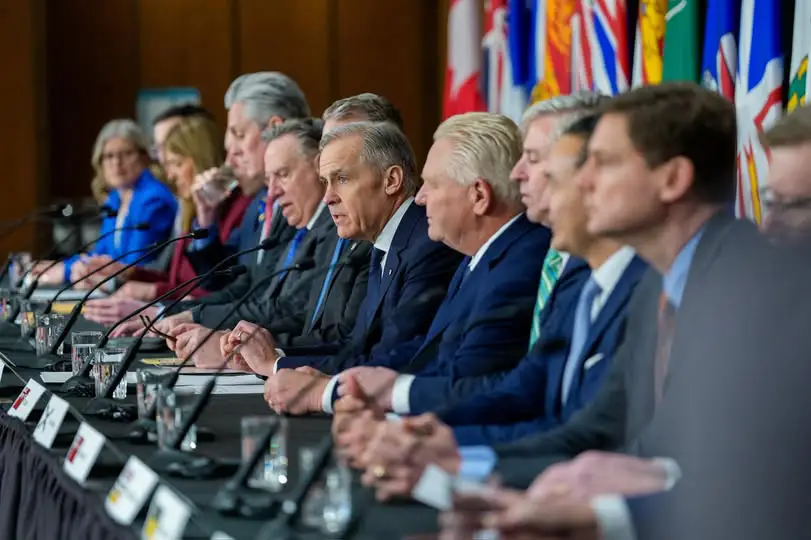
Header Image: On January 29, 2026, Prime Minister Mark Carney gathered with provincial and territorial leaders for a First Ministers’ Meeting in Ottawa.
Photo: www.facebook.com/MarkJCarney2025