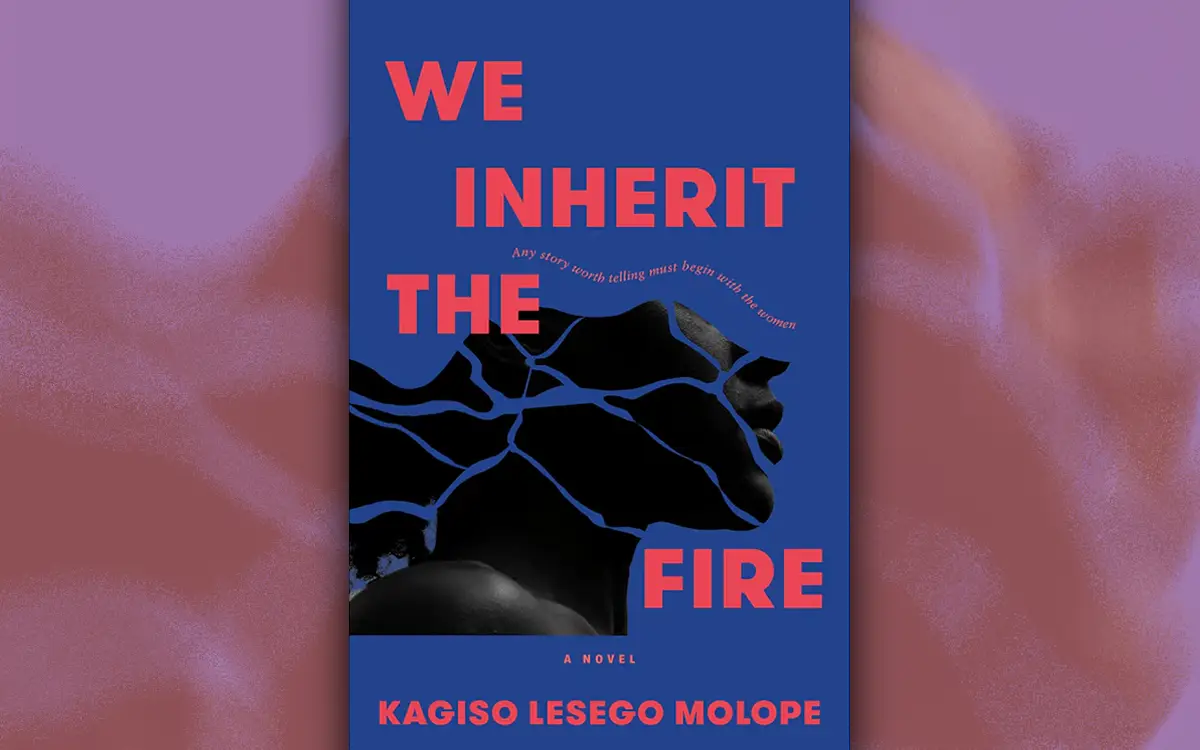
From Apartheid to America: The Unsettling Relevance of ‘We Inherit the Fire’
Kagiso Lesego Molope’s novel about South Africa during apartheid has eery and uncomfortable parallels with the current political moment.
A picture, as the saying goes, says a thousand words. And sometimes, that is not all. A picture can also outrage and galvanize. It can be the proverbial straw that breaks the camel’s back. Or to choose a more apt metaphor and one with a little more heat: it can be the spark that generates the flame.
Kagiso Lesego Molope’s We Inherit The Fire begins with one of the novel’s two narrators describing a photo with precisely this sort of power. It is of her when just an infant being held by her mother as she confronts a soldier pointing a rifle at her. The mother and baby are black and the soldier is white. The place and approximate time is South Africa during apartheid. The mother’s name is Kewane and the daughter’s Kelelo. Kewane is the novel’s other narrator. The photo, the reader immediately learns, is one of the reasons Kewane is at once famous and infamous in her native country, depending on one’s perspective. For it captures, in one still image, a mother’s love, courage and defiance and a child’s vulnerability in the face of raw and racist state power. The unexpected alchemy occurs when the photo is made public in a newspaper article. The circulating image galvanizes the country’s black community. Protests ensue. The photo is of such power and significance that Kewane ultimately becomes a mother figure for the entire country or at least the black majority.
Yet the photo in question conceals as much as it reveals. For it captures but a single moment in time and therefore nothing of what came before or after. In a crucial sense, Molope’s aim is to create a more complete picture of the novel’s two protagonists; to explore not only the relationship between mother and daughter but also the larger forces that shape their lives and who they become. In so doing, Molope introduces Kewane’s mother and grandmother. The reason seems clear: in South Africa during apartheid the vital chain of connection among the generations could be crucial to a black person’s survival. A long line of mother daughter relationships acts as a sort of refuge and defence against a world in which one’s humanity is constantly challenged or denied. For this is how it was for the black majority. They were a majority without rights, segregated into ‘townships’ and forced to live with the constant threat of violence. As a way of rationalizing such material conditions, blacks were told that it is the white European colonizers who are the bearers of civilization; that Black South Africans are not yet worthy or ready for full citizenship and equality; that they are inherently violent and thus any decision to grant them full citizenship is a recipe for anarchy and upheaval. This is the world our two protagonists must navigate.
Kewane’s notoriety has come with a cost. She is often exhausted and spends much of her free time alone in her bedroom. It’s as though she expended too much energy when she was a younger woman fighting injustice and now has little left to spare. She is depleted and withdrawn. Her marriage has become more of a burden than a source of strength or joy. As for Kelelo, there is the strain of having to live up to the example set by a mother with more courage and readiness to speak out than you fear you possess. Kelelo lives her young life persuaded that she is her mom’s least favourite among the four sisters. She is too quiet and introspective. She is conflict averse while living in a country where blacks have been forced to fight for even the most basic of rights. So Kelelo is afraid she will disappoint her mother. Perhaps this is the source of the divide between them, of which both are aware. When Kelelo sifts through her earliest childhood memories, it his her great grandmother Oumama who she most fondly recalls.
We Inherit The Fire is a novel worth reading, not only because of Molope’s sensitive depiction of a young black girl’s struggle to live in such a racist and unjust place, nor simply because of the light it sheds on an era from which South Africa is not that long removed. Unexpectedly its power also lies elsewhere. For there is something also eerily, distressingly, prescient about the world Molope has conjured. America under Trump is sometimes compared to Nazi Germany, with good reason. Elements of Molope’s story suggest South Africa under apartheid is an equally apt comparison. It’s as though in creating a fictional story set during apartheid, Molope is highlighting what’s at stake in present day America.
The winds of change eventually blow in a more hopeful direction in Molope’s novel. Schools, hitherto strictly segregated, now allow for the mixing of black and white students. Blacks can now ride on buses that were not long ago reserved for whites only. There are a few references to Nelson Mandela and the promise he represents to not only Black South Africans, but indeed all of South Africa and the rest of the world. Molope is subtly anticipating the model of leadership as well as the icon of defiance and peace he will become. These changes, among others, contribute to a sense of impending liberation in the novel’s late stages. Indeed, for black South Africans the ending of apartheid must have felt like emerging into daylight after decades of being forcibly consigned to the darkness; and that having now emerged into the daylight there is no likelihood of ever again being forced back into that darkness, for people like Kewane would never allow that to occur and, besides, the rest of the world has, at last, understood that ideas of white superiority and black inferiority are tragic and dangerous relics of an unenlightened past that no one, certainly no one in their right mind, would dare to attempt to resurrect.
Yet consider some of the parallels between Molope’s novel and what is happening south of the border in a country hellbent, it would appear, on plunging itself back into the dark ages. In one pivotal scene in We Inherit The Fire, three young black girls are threatened with violence by a young white nationalist ruffian for daring to ride on a bus that, until recently, had been reserved for whites only. The boy is all bellicosity and dangerous bravado. Like others of his ilk, he mistakes his racism and cowardice for strength. The girls stand their ground, despite their well-placed fear and despite one being punched in the face and another having her head pressed against the window, to the point of great pain. The scene is one of the novel’s finest. Molope skillfully ratchets up the tension in the service of an important idea: the boy is like a conduit securing the generational transfer of the toxic ideas that had sustained a crumbling social order. Such ideas, the boy’s readiness to do violence serves to indicate, will not be so easily relegated to the dustbin of history.
One obvious inspiration for this scene is with someone from the not so distant past: Rosa Parks who, while riding on a bus in Montgomery Alabama in 1955, refused to give up her seat on a bus to a white man, in defiance of the segregation laws of the time. Park’s courage led to a bus boycott among
Montgomery’s black communities and, eventually, to the repeal of the state’s segregationist bus laws. Like Kewane in Molope’s novel, Parks became a central, catalytic figure in America’s civil rights movement.
Alas, the current American administration’s approach to governing constitutes an attempt to reverse the progress made possible by the civil rights movement, especially. (This is MAGA’s true intent.) Consider how armed and masked federal agents roam the country like roving gangs of thugs, many openly and proudly racist, questioning and rounding up individuals, many with black or brown skin, who they have determined have no right to be there. Once rounded up, they are deported to states like Texas or distant lands like El Salvador where, to add another layer of ruthless indignity, they are imprisoned. How many buses have these masked agents entered so that they might threaten, detain and potentially deport passengers who they have deemed suspicious? It’s unclear. What is clear, however, is that the American federal government is animated by the same cruel and cowardly impulses that propels the young white boy in Molope’s novel to terrorize three young black girls for riding a bus. In both cases, their aim is to violently and shamelessly turn back the clock of progress.
Or consider another parallel, this one involving the past and how it should be broached and ultimately understood. There is a moment in We Inherit The Fire in which Kelelo is forced to contend with a failing or near failing grade in History, the subject that had been her favourite and at which she had excelled at her previous school. The class is taught by a white nun who still adheres to a harebrained understanding of the past. For the nun, history is without nuance and is instead a mere big collection of unassailable facts, all of which point to Europe’s strength and wisdom and Africa’s backwardness. Kelelo knows otherwise. For her, the past is constantly, often painfully, seeping into the present. Only by studying the past can she understand, for example, why so many black communities have been internally displaced and why so many indigenous languages are under threat of being lost. So in the spirit of quiet protest, her answers to questions posed on class tests challenge the orthodoxies the nun expects her to merely regurgitate. The nun reacts with a mix of bewilderment and anger to Kelelo’s tactics: is this black student—who she thought had considerable promise—actually dimwitted or is she so impertinent as to dare to challenge my authority and, in so doing, risk her own academic advancement?
In America, the prospect of reassessing the past and its dominant narratives is enough to cause a furor among, let’s call them, the reactionary class. How dare any scholar—black or white, but especially black—suggest, for example, that slavery was foundational to America’s economic dominance or that racism and inequality have always been and remain inextricably linked. One might be able to say it, but one should not be allowed to teach it. Indeed, all types of learning institutions, from elementary schools all the way up to and including America’s most prestigious universities and museums, have become battlegrounds over this very theme. For the reactionary class, slavery is but a footnote, a mere blemish on the country’s otherwise admirable record of promoting liberty at home and abroad. To suggest otherwise is to ascribe greater importance to the institution of slavery than it’s due. It is, in other words, to cast a dangerous pall on the country’s glorious past and, in so doing, undercut its promising future. For the reactionary class, this is almost a treasonous offence.
One last parallel. Protest shapes not only the trajectory of Kewane’s life but that of her country’s, too. University protests eventually spill over into the streets, becoming something much bigger and harder for state forces to contain. The protests were meant to pull South Africa, at considerable human cost, out of a type of dark age. In America, the recent protests in Minneapolis and elsewhere, are meant to prevent the country from being dragged back: to a time when rights were systematically and routinely denied; to a time when the president can be openly racist and flagrantly defy the country’s laws and constitution; to a time when the president and the rest of his administration will not be held accountable, no matter how diabolical, regressive or criminal their actions. In Molope’s novel, a photograph becomes a catalyst for protest. In present day America, as elsewhere, the smartphone video has assumed this role. Consider Renee Good, the mother of three shot in the face three times by an ICE agent as she attempted to drive away from a fraught gathering of citizens and ICE Agents. Days later Alex Pretti, a young man and emergency room nurse, was thrown to the ground and then shot in the back ten times by other ICE agents. Videos of the murders exposed the ugliest and most obscene lies. The administration referred to both Good and Pretti as ‘domestic terrorists’ intent on doing harm to ICE agents who were only attempting to do their necessary work. In reality, they were guilty of nothing more than having the courage to bear witness and of helping those at risk of harm. In other words, like Kewane, they were heroes in the never ending struggle to create a better world. The videos of their murders prompted thousands of ordinary citizens to take to the streets in protest. In Molope’s novel, such protests eventually lead to necessary social and political change. Can we say the same for present day America? Only time will tell.
We Inherit The Fire
Author: Kagiso Lesego Molope
Publisher: Penguin Random House
Pages: 336 pages
ISBN-10: 0771019858
ISBN-13: 978-0771019852