The NDP Chooses the Whackos, Whackadoos, and Wingnuts — and Marches Proudly Into Obscurity

The NDP had a chance to matter again. With Canadians being squeezed by food inflation, rent spikes, mortgage stress, and a cost‑of‑living crisis that has turned daily life into a financial obstacle course, the party could have stepped forward as the voice of working people. Instead, it staged a political séance, summoning every fringe idea, activist slogan, and academic grievance it could find. What unfolded wasn’t a vision for Canada but a kind of ideological theatre — a place where the loudest voices weren’t workers or families or anyone living in the real world, but activists auditioning for the role of Most Righteous Person Alive. It was less a political gathering than a live demonstration of how to squander relevance in real time.

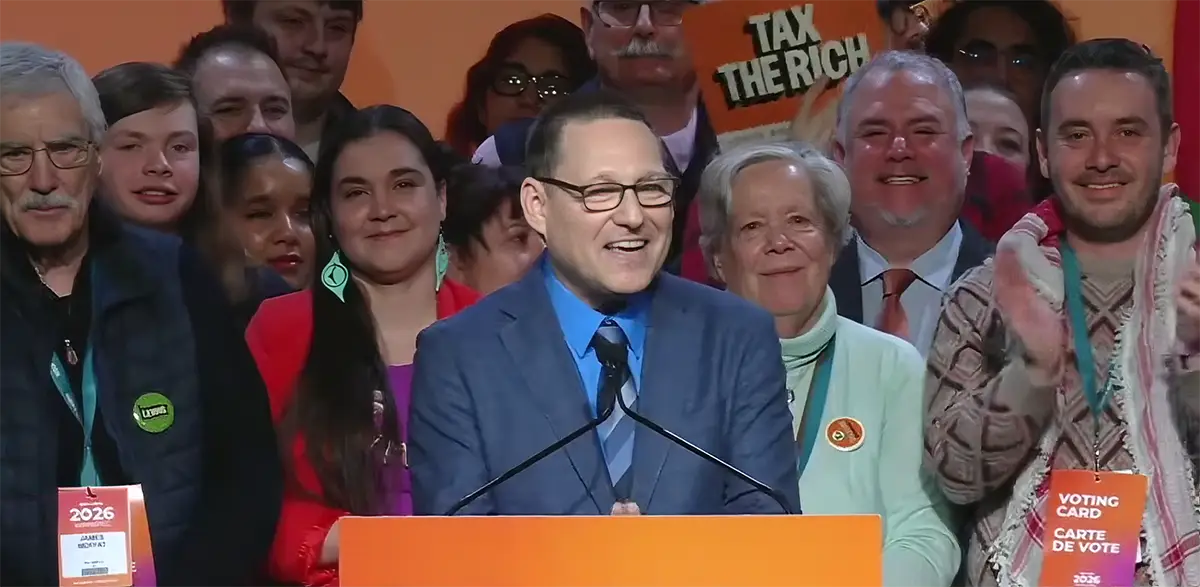
And then, in a flourish of political self‑harm, the delegates elected Avi Lewis.

Lewis is not the bold, transformative figure his supporters imagine. He is, by any conventional political measure, a fringe actor. Even within Canada’s Jewish community — a community with no shortage of strong opinions — Lewis is seen by many observers as firmly planted on the ideological fringe. When the people who know your politics best describe them as “not remotely representative,” it’s not an eccentricity. It’s a warning flare. Yet this is precisely the kind of leader the modern NDP now elevates: someone whose worldview thrills the hyper‑online activist class and leaves ordinary Canadians blinking in confusion.


Media coverage of the convention made one thing painfully clear: the NDP’s fixation on identity politics has now fully eclipsed its interest in the material concerns of Canadians. Every issue was reframed through a moral hierarchy that treated lived experience as currency and grievance as governance. Housing wasn’t a supply crisis; it was a structural injustice. Economic anxiety wasn’t about wages or affordability; it was a symptom of oppressive systems. Crime and disorder weren’t public‑safety concerns; they were reinterpreted as responses to systemic harm. It’s not that inequality or discrimination aren’t real — they are — but the party now speaks about them in a dialect that sounds like it was developed in a faculty lounge and tested on Instagram.

Meanwhile, Canadians are standing in grocery aisles calculating whether they can afford both rent and food in the same month. The NDP’s response is to refine its identity‑politics catechism, as though the country’s economic crisis can be solved by perfecting the language of moral positioning.

The foreign‑policy portion of the convention was even more surreal. Critics argue that delegates, many adorned in lanyards, pronouns, and layers of performative profundity, worked themselves into an ecstatic frenzy denouncing the United States at every opportunity. Their fixation on Gaza after October 7 became so total and so consuming that the atrocities of that day seemed to vanish from their moral vocabulary, replaced by a narrative in which Jewish suffering was minimized, rationalized, or simply ignored. This unfolded in a climate where antisemitic incidents in Canada have sharply increased, as documented by police services and Jewish community organizations, yet the delegates’ outrage appeared to flow in only one direction.


The irony, as observers see it, was almost too rich: a hall full of activists obsessed with gender identities and pronouns, people who would face persecution, imprisonment, or far worse under Hamas, under Palestinian Authority security forces, or under Iran’s theocratic regime, directing all their fury at Western democracies while sparing none for the regimes that would erase them first.

The same voices who filled the streets for Gaza could not summon a word for the young Iranian women beaten for showing their hair, the hundreds of protesters killed during the 2022–2023 uprising, or the 176 innocent people, including dozens of Canadians, killed when Iran’s Revolutionary Guard shot down Flight PS752. To many, it seemed that the suffering of Jews on October 7 and the suffering of Iranians under their own theocracy occupied the same blind spot, both inconvenient to the ideological script.

The hypocrisy, critics contend, bordered on operatic, with a hall fluent in the language of oppression yet somehow blind to the most brutal oppressors of all.

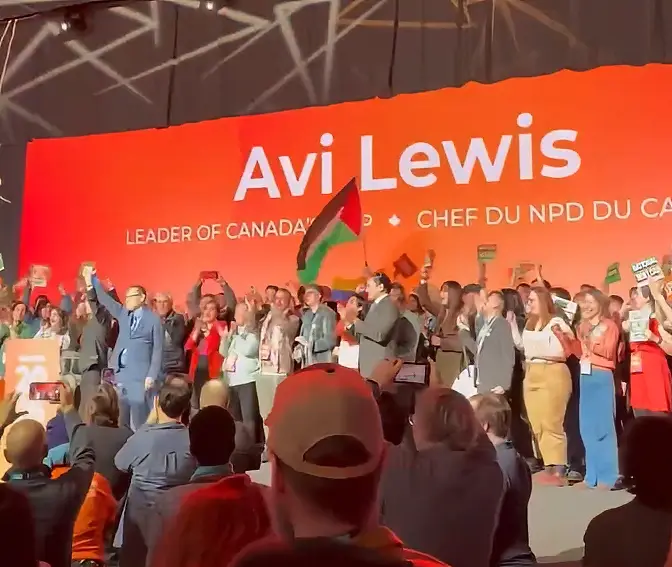
The lowest point of the convention was the symbolism the NDP chose to display onstage during the leadership announcement, where a Palestinian flag appeared prominently while no Canadian flag was visible in the shot. Ironically, this image more than any speech or resolution captured the party’s ideological drift into irrelevance. The scene was almost self‑satirizing, a national party elevating its new leader under a foreign banner while the Canadian flag was nowhere to be found. It served as the final flourish in a convention that was more invested in symbolic defiance and a trip to stupidville than in any coherent vision for Canada.

The NDP’s approach to the energy file, the beating heart of Canada’s economy, is where its ideological rigidity hardens into outright political delusion. The party’s long‑standing policy direction is clear: no new oil and gas projects, a rapid phase‑out of fossil fuels, an immediate end to subsidies, and a “just transition” for workers into a green future that remains largely theoretical.

This is presented as moral clarity. In practice, it reads like a plan to saw off the economic branch the country is sitting on.

Canada’s prosperity is still heavily underpinned by natural resource exports, including oil, gas, minerals and forestry. These industries fund hospitals, schools, social programs and the very climate initiatives the NDP champions.

The party’s answer is to treat the sector that keeps the lights on as a moral stain to be scrubbed out of existence. It is a kind of national self‑castration in which the energy sector is crippled, the economy is shrunk, everyone is made poorer, and the solution offered is to tax the rich, and perhaps open government-run grocery stores. It is economic policy as performance art, redistribution without wealth creation, transition without a bridge and sacrifice without a plan.

The tragedy is that Canada genuinely needs a serious, modern, left‑of‑centre party that can talk about wages, productivity, housing, and national capacity without disappearing into ideological cosplay.

Instead, the NDP seems determined to vacate that space entirely. What we are witnessing now is the early stage of a political realignment: the Liberals will continue to occupy the centre‑left, woke‑progressive lane, while the Conservatives increasingly plant themselves in the centre and centre‑right, economic‑competence lane. And the NDP? It now self-identifies as a national joke—a boutique protest brand loud on social media, invisible at the cabinet table.


It would be hilarious if it weren’t so sad. A party that once spoke for workers and the vulnerable has turned itself into a caricature of activist politics, hoisted neatly on its own petard.

The Whackos, Whackadoos, and Wingnuts may have won the convention. But they’ve likely lost the country.

Photo: Via cbc.ca