

• By: Allen Brown

Smart Players Are Quietly Earning Full Salaries Playing Online

A specific subset of online players across poker, daily fantasy sports and sports betting exchanges treat their activity as a quantitative performance operation rather than a gambling hobby. They track expected value per decision, monitor rakeback accumulation and measure line value capture the same way a portfolio manager tracks return on capital. The income these players generate is not luck-dependent — it is volume-dependent and process-dependent.

Rakeback as a Salary Floor Before Results Are Counted

Rakeback income functions as a guaranteed monthly return that exists before session win or loss figures are calculated. High-volume online poker sites return between 20% and 40% of gross rake paid back to the player monthly through structured rakeback deals and loyalty program tiers. A player paying $2,000 in rake per month on a 30% rakeback deal receives $600 back regardless of whether they ran above or below expected value in that period. Platforms with a casino bonus deposit $1 and get $20 promo build these loyalty return structures into their VIP programs as player retention tools — professionals exploit them as income infrastructure.

The loyalty program components that contribute to a professional’s baseline monthly income include:

• Direct rakeback percentage paid on gross rake generated
• Milestone bonuses triggered by reaching monthly volume thresholds
• Cashback on net losses applied weekly or monthly depending on platform terms
• Leaderboard prize pools distributed to high-volume players at the end of each period
• Reload bonus offers accessible exclusively to players above specific loyalty tiers

This layered return structure means a professional poker player’s actual monthly income calculation starts with rakeback before a single session result is added. At 40% rakeback on $3,000 in monthly rake, the floor income is $1,200 — independent of game outcomes entirely.

Volume Targets and What They Actually Mean for Income

Mid-stakes online poker professionals target a minimum of 50,000 to 100,000 hands per month to generate statistically significant win rate data. Below that volume threshold, variance renders any win rate figure unreliable as a predictor of sustained profitability. Volume is not ambition — it is the mechanism that converts a mathematically positive expected value into a number that behaves like a paycheck.

A 2bb/100 win rate at $200NL online poker translates to approximately $4 earned per 100 hands. At 100,000 hands per month that produces $4,000 in session income before rakeback is added. Hitting that volume requires a structured daily schedule built around table availability, player pool quality and session length management.

The daily operational structure most volume-focused professionals use to hit monthly hand targets includes:

1. Set a fixed daily hand target based on monthly volume goal divided by active playing days
2. Identify peak soft-field hours for the target stake level on each platform
3. Open the maximum viable number of tables that maintain decision quality without cognitive overload
4. Run a HUD to track opponent statistics in real time and avoid automatic play patterns
5. Log session results, hands played and rake paid immediately after each session closes
6. Review bankroll spreadsheet weekly to confirm win rate and rakeback trajectory against monthly income target

Daily Fantasy Sports and the Edge in Large Field Tournaments

Top DFS players in large-field tournaments maintain a return on investment between 10% and 20% over samples of 1,000 or more contests. That ROI is not generated through superior player knowledge alone — it is generated through identifying and exploiting opponent lineup construction errors at scale.

Where Opponent Errors Create Exploitable Edges

Recreational DFS players cluster ownership on high-profile athletes, producing lineups with correlated exposure to the same performance outcomes. When those high-ownership players underperform, large portions of the field collapse simultaneously. Professionals build contrarian lineups that deviate from public ownership concentrations, capturing disproportionate prize shares when chalk fails. In large-field tournaments with thousands of entries, a 5% ownership differential on a single player produces measurable edge across the prize distribution structure.

Volume and Contest Selection as Income Drivers

DFS professionals do not enter a single contest per slate. They enter multiple optimized lineups across a range of contest types — large guaranteed prize pools, single-entry formats and multiplier contests — to distribute edge exposure across different payout structures. Income consistency in DFS comes from contest selection discipline as much as lineup construction quality. A 15% ROI player entering $500 per slate across 200 slates generates $15,000 in net profit at that sample size.

Sports Betting Line Value and the Multi Book Process

Sports bettors capturing closing line value of +3 to +5 cents consistently are operating at a professionally viable edge. Closing line value — the difference between the odds a bettor secured and the odds available at market close — is the most reliable proxy for long-term profitability in sports betting. It requires speed, access and simultaneous account activity across multiple licensed sportsbooks.

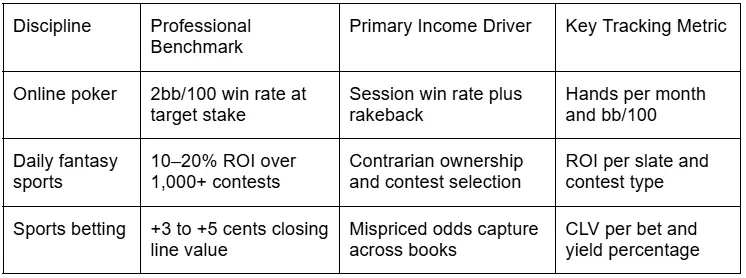
The following table compares the three primary online income disciplines across the performance benchmarks that define professional-level operation:

Multi-book line shopping requires active accounts across a minimum of five to eight sportsbooks to access sufficient line variation. When one book posts a mispriced line before sharper books adjust, the window to place a bet at positive expected value is measured in minutes. Professionals monitor odds movement tools and alert systems to identify these windows without manually checking each book in sequence.

Software Layer Behind Consistent Online Income

Bankroll spreadsheet tracking is the primary management tool separating income-generating players from break-even grinders. Without session-level data, a player cannot calculate true win rate, identify leak patterns or verify whether rakeback returns are sufficient to produce net positive monthly income.

The core software tools professionals use across the three disciplines include:

• Heads-up display software for real-time opponent statistics at the poker table
GTO solver programs for off-table study and hand history review
• DFS optimizer tools that generate lineup combinations based on projection inputs and ownership targets
• Odds comparison platforms that display live line movements across multiple sportsbooks simultaneously
• Dedicated bankroll spreadsheets logging every session, contest or bet with date, stake and result

What Separates a Salary Earner From a Losing Player

The gap between a consistent online income earner and a break-even grinder is not talent — it is process adherence, volume discipline and data tracking. A 2bb/100 poker win rate requires 100,000 monthly hands to produce $4,000 in session income. A 15% DFS ROI requires 1,000 contest entries to become statistically real.