

United States Ambassador Pete Hoekstra Says Canada–U.S. Cooperation Is “Full of Untapped Potential”
Ottawa Life Magazine Exclusive
Ottawa Life Magazine sat down with U.S. Ambassador Pete Hoekstra at a moment of extraordinary geopolitical pressure: a widening conflict involving Iran, renewed tensions within NATO, rising global instability, and the looming USMCA review — all carrying major implications for Canada. At the same time, reports in Ottawa point to quiet discussions about a potential “Grand Bargain could reshape the bilateral relationship for a generation. Against this backdrop, Ottawa Life Magazine Managing Editor Dan Donovan sat down with Ambassador Hoekstra for a candid and comprehensive discussion about the next chapter in Canada–U.S. relations.
Ambassador Hoekstra brings to this conversation a distinguished record in public service, diplomacy, and national security. Before his appointment to Canada, he served as Chairman of the Michigan Republican Party during the pivotal 2024 elections, where his leadership was widely credited with delivering a Republican victory in the state. He previously served as U.S. Ambassador to the Netherlands during the first Trump Administration and represented Michigan’s 2nd District in Congress from 1993 to 2011, including a term as Chairman of the House Permanent Select Committee on Intelligence. His career has also included senior roles in the private sector, fellowships at the Heritage Foundation and the Investigative Project on Terrorism, and board positions in both industry and finance. A graduate of Hope College and the University of Michigan, Hoekstra has been recognized with honors including the CIA’s Agency Seal Medal and the DNI National Intelligence Distinguished Public Service Medal.
With decades of experience at the intersection of security, diplomacy, and economic policy, Ambassador Hoekstra offers a forward‑looking and substantive perspective on the opportunities and challenges shaping the future of the Canada–U.S. relationship.
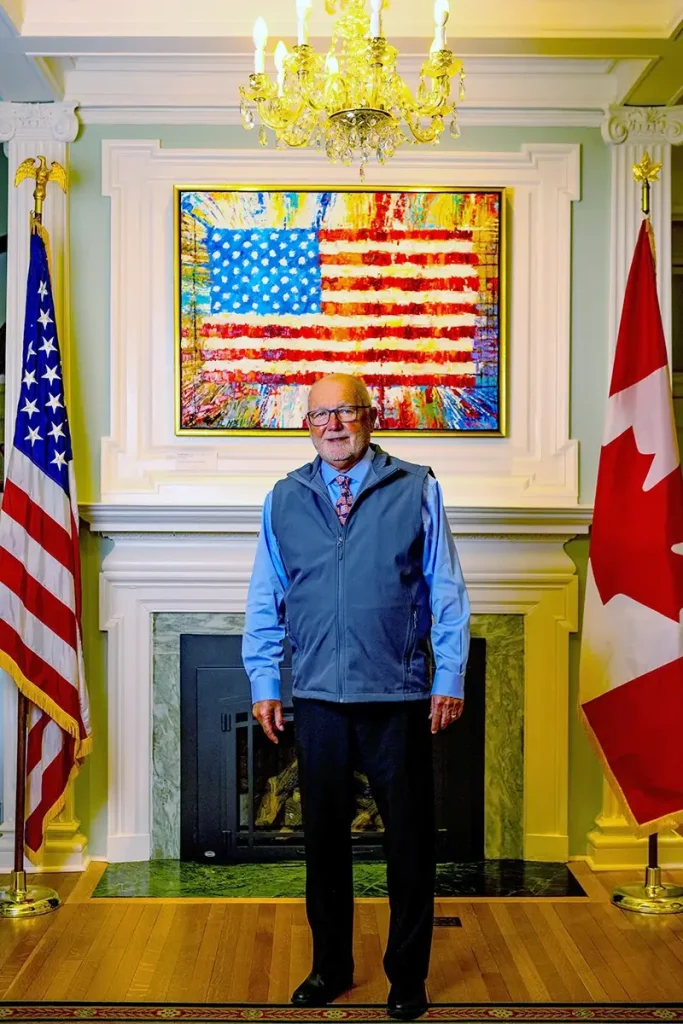
Photo: Sean Sisk Photography
USMCA, Competitiveness, and Tariff Pressures
OLM/Donovan: I want to start with the USMCA (United States–Mexico–Canada) review that’s coming up. How does Washington assess Canada’s current economic posture, particularly on competitiveness, supply chains, and regulatory predictability? And the second part of that question is, how likely is it that Canada could face new tariffs, and what would Washington need to see to avoid that outcome?
Ambassador Hoekstra: Let’s start off with number one. Canada is our second‑largest trading partner; Mexico is our first. So, USMCA is absolutely critical to the United States. You’ve got our two largest trade partners. And especially with Canada, there are several places where we’ve created ecosystems. Automotive is one great example. There’s a great trade in the automobile industry and parts and unfinished products. We talk about parts crossing the border four, five, and six times before they ever make it to a dealer or showroom or before they ever make it in a customer’s garage.
You’ve got automobiles, you’ve got energy — just go down the list. We’ve got a lot of places where we think we’re integrated. We’ve got good supply chains; we’ve got common standards — not identical. If you look at your labor standards versus the United States’ labor standards — worker safety or minimum wage — you go right down the list, and while they’re not identical, there are lots of similarities. So, it can be a very integrated, coherent economic system. I think what we look at for the renewal of USMCA is an opportunity to take a very, very good relationship — a long‑enduring relationship — and make it even better.
There were certain things that we also wanted to accomplish, that we needed to accomplish as a country in terms of where we’ve been with trade. We’ve hollowed out some of our industries. I come from Michigan. There’s a reason they call us the Rust Belt. It’s a place that used to have thriving industries. Thriving factories are now a shell of themselves. As a matter of fact, they’re just shells — they’re just buildings with nothing in them. Industries that were critical to our national security, critical to our prosperity — all of those types of things. So, we had to address those issues. We also have to address some financial issues. I mean, you know we’re in debt. We’ve got a fairly significant deficit. We’ve got a fairly significant debt. We need to address some of those issues.
The president outlined an economic platform to restore some prosperity and security back into the United States. We’re going to deal with some of our financial issues. We’re going to build a strong North America. We’re going to build a strong United States of America. And President Trump has said this often: it’s America first. I’m the president of the United States. I’m negotiating for America. I’m going to get the best deal I can get. But he also expects that in the case of Canada, he would say, I expect that the person sitting across the desk from him or the table from him is doing the same thing for their country. I wouldn’t expect them to do anything else.
So, let’s get a good deal for America. And in that negotiation, I expect that the demand from Canada is going to be to get a good deal for Canada as well. That’s the kind of outcome we’re looking for.
Negotiating Friction and Transparency
OLM/Donovan: You’ve expressed during this process some frustration with Canada in terms of doing that. Is that simply part of the to‑and‑fro of the deal‑making, in your view, or is it more than that?
Ambassador Hoekstra: Yes — when I was in the private sector, I worked on product development. You want to talk about frustrations? You think you’ve got this beautiful product out there. The engineers put it in the test lab, drop a 50‑pound weight on it, and the thing shatters — so frustration, okay? When I was in politics, where you’re working on legislation, you’re negotiating with your good friends on the other side of the aisle. You think you’ve got a deal, and all of a sudden it falls apart.
There are frustrations, and you see the same thing between countries. I’m fairly open and transparent with who I am. And so sometimes, you know, by being open and transparent, you make yourself vulnerable. People see an opportunity and say, “Oh, now we can get that guy.” That’s okay. You just deal with it.
The “Grand Bargain” and Continental Integration
OLM/Donovan: You’ve spoken with leaders like Tom d’Aquino, the former head of the Business Council of Canada and one of Canada’s most respected business voices, who played a key role in advancing the original Canada–U.S. Free Trade Agreement with Prime Minister Mulroney and President Reagan, as well as Goldy Hyder, who now leads its successor, the Business Council on National Issues and who has been deeply involved in USMCA discussions. Both have been raising the possibility that, as North America works through these difficult USMCA negotiations, there may be growing momentum for a “grand bargain” — a broader continental economic and security pact or treaty that would integrate defence supply chains, border security, and economic policy in a more predictable and durable way. Is that something that Washington is exploring or something that’s potentially on the table?
Ambassador Hoekstra: I think the president has all along highlighted an interest in doing a grand bargain. But that was 10, 11 months ago, and he was always laying out the possibility. I think every meeting that I’ve been in with the president and with the prime minister, it’s kind of like, “Make me an offer — make it as big as you want.” So that’s on the table.
OLM/Donovan: President Trump has been very vocal about strengthening North American defence, including the strategic importance of the Arctic and Greenland. When you look at this idea of a broader “grand bargain,” do you get the sense that a treaty of that kind is something the president is leaning towards?
Ambassador Hoekstra: Treaties imply all kinds of legal requirements and need to be confirmed by the Senate and all of that. So, I think the president has been very, very open to doing a broad‑based agreement and framework that would define our trading relationship. The president has raised a lot of issues — Arctic security, NORAD, defense spending, critical minerals, uranium, nuclear, oil. There have been Canadians who have talked about the same types of things — you know, a fortress North America when dealing with steel, autos, aluminum — and all of those things are or were a potential basis for a grand bargain. I think that in the last 10 or 11 months, even though that possibility of a grand bargain has been out there, it hasn’t been seized upon.
And you’re absolutely right, there are individuals in the private sector, the business sector, who have latched onto that. But at the same time, there’s a different vision on the Canadian side. The prime minister has been very open about talking about diversifying who he — and who Canada — is doing business with and finding other countries to do business with.
He’s made multiple trips outside of the country, including at least three of them to the United States, and he’s welcome, but you know he’s also been out there. So, in some ways, you almost look at it as, you know, Canada — the Canadians have to address how much they are moving outside of doing business with the United States. It’s a relationship we like; it’s a relationship we see plenty of potential in growing. But you know, to negotiate or whatever, you always have to have somebody else sitting at the other side of the table.
Diversification, Trade Realities, and Canada’s Choices
OLM/Donovan: Even with the diversification tariffs in place, the United States still accounts for the overwhelming majority of our trade. Despite this, Prime Minister Carney has described the situation as a rupture and is pushing to diversify Canada’s trading relationships. Yet even with diversification, 84 percent of our trade will continue to be with the United States. So, what would you say to Canadians—or to the government—about that reality? Is it a fly in the ointment?
Ambassador Hoekstra: I’d say that’s for you guys to figure out. It’s not for me to tell Canadians. We value the relationship. I think Premier Ford was just down in Texas and saying, you know, the Americans love us. And you know what? He’s right. We’re not talking about a rupture with Canada. The president’s not talking about going to do business with other countries around the world; we’re not satisfied with the trade with Canada. We can do better. We can grow it. We can bring more prosperity and security to both sides of the border. And so that’s where we are. But you know, Canada has to get there, but that’s a debate that has to take place within Canada. America can put its best sales foot forward, and Canada can decide whether they want to buy, whether they want to negotiate, or whether they want to walk away. That’s a Canadian decision. That’s not an American decision.
Economic Strength and Continental Security
OLM/Donovan: To what extent does Washington view a strong and growing Canadian economy as essential to North American security? Does the United States see Canada’s economic strength and its ability to sustain healthy GDP as directly linked to Canada’s capacity to invest in defense and meet its spending commitments?
Ambassador Hoekstra: We want a strong Canada. We want a strong economy in Canada because a strong Canadian economy helps build the U.S. economy. A strong Canadian economy enables it to do the things that countries are expected to do. In this case, contribute to what we would like to see as continental security. There’s no doubt that for the last significant period of time, Canada has under‑invested in national security. And I think Canadians have been very, very willing to admit that they now need to catch up. They’re making investments in defence in a very complicated world. That will make America safer, that will make Canada safer, that will make the continent safer.
F‑35s, NORAD, and Interoperability
OLM/Donovan: I’m going to jump over to the defense and security file because you raise a really relevant point, which is the truism that Canada has not met its defense commitments, both to NORAD and to NATO, for some time — decades. So, this brings up the issue of continental defense, which the Americans were carrying the burden on — carrying our water, if you will. We have a long relationship with the United States military. We fought together in wars. We’ve helped arm each other’s countries during those difficult periods. Previously, while we were not meeting these funding commitments, Canada had committed to acquiring eighty‑eight F‑35s as part of NORAD modernization and interoperability obligations. This is part of our continental defence. Since the government changed with the ascent of PM Carney, there have been these other discussions about Arctic defense and European and NATO defence and so forth. The fighter jet issue came into it.
How essential is that F‑35 commitment in terms of Canada maintaining a credible continental defense posture with the United States? And how would Washington interpret any delay, reduction, or reconsideration of that procurement? I ask that from the perspective of the fifth‑generation F‑35 being the most sophisticated fighter jet in the world. It’s been proven in the recent Iranian conflict, and before that those jets have been used successfully. So, is that a problem if we don’t move forward with that F-35 procurement?
Ambassador Hoekstra: It’s a phenomenal plane. Canadians helped us develop it. Canada was one of the first countries to sign up when we developed an international coalition to develop the world’s best state‑of‑the‑art fighter. The Canadians were right there with us. And everybody in that coalition has now bought those planes. Canadians have now started to acquire the eighty‑eight or somewhere around that. Canadians have the right and the opportunity to go back and evaluate that as they go through this process. But they signed on as part of this international coalition early on because they recognized that one of the strengths of NORAD in continental security has been the interchangeability and interoperability of our defense components.
If NORAD gets a request or finds out about a threat — I’ve been to NORAD in Winnipeg, I’ve been to NORAD in Colorado Springs — and you’ve got Americans and Canadians sitting next to each other, interchangeable, interoperable. You can take a Canadian out; you can put an American behind the same computer. And NORAD functions perfectly. When they make a decision about sending up a plane to intercept somebody, they don’t ask, “Do we send an American plane, or do we send a Canadian plane?” They say, “What plane is available?” And if it’s a Canadian plane, they’ll send Canadians; if it’s Americans, they’ll send Americans.
As you know, American planes are flying through Canadian airspace. Canadian planes are flying through American airspace because that’s how NORAD is set up. In the future, if America’s flying one plane in NORAD and Canada’s flying another plane, they would have to make a decision about what plane is the most appropriate to send up. Then it might become an American or Canadian plane. And then if it’s a Canadian plane flying through American airspace — which is exactly the way it’s supposed to work — and it malfunctions and has to land at an American military base, you know, it may land and we may have to literally put it on a truck and truck it back to Canada because we can’t fix it. If it’s an F‑35, we’ll fix it and get it back in the air and it will be working.
The hallmark of this (F‑35) has been interchangeability and interoperability, and that’s across the whole broad spectrum. If you have plane A and another plane that has the exact same capabilities, then that capability is awesome. Can another plane (other than the F‑35) function in the same airspace? Sure. They’re smart planes. But can they do the same things (as the F‑35)? There’s not a plane that even comes close to what the F‑35 does. It has what we call “flying SCIFS;” Secret Compartmentalized Information Facilities that go into these planes, which means they’re secret components and computer capabilities on these planes. Anything else that flies, I’m sorry, will not be able to communicate in the same way that two F-35s will.
OLM/Donovan: So, it’s important?
Ambassador Hoekstra: We think it’s important.
Expectations for Canada’s Future Force Structure
OLM/Donovan: I want to stay on the military and the force‑structure issues. Looking ahead to the next decade, what would you say are the minimum expectations the United States has for Canada as a continental defense partner — in terms of capability, readiness, and investment? And beyond the aircraft, what does Washington consider the minimum acceptable force structure across the air, maritime, cyber, and Arctic domains for Canada to remain a credible contributor to North American defense?
As you know, recently there have been a lot of discussions about the Arctic and Canadian officials meeting with the Norwegians and the Danes, as the Arctic is our backyard. In terms of expectations as a continental partner, what is the expectation from Washington for Canada regarding the Arctic?
Ambassador Hoekstra: That it be a fully integrated partner. What we would like, and what we believe would be best for continental security, is a fully integrated partner.
As you know, Canada recently took unspent defense dollars from previous years and reallocated those for investment in the Arctic. At the same time, they indicated that they were going to operate in the Arctic more on their own than relying on any one partner. We’re not quite sure what that means. But I would just encourage everyone to look at the map. We’re not quite sure what that means. Okay? The Arctic is big — it is huge — and we’ve already got an infrastructure that we can build off of to protect the Arctic, which is NORAD. Take the model — expand it — a huge U.S. investment, more significant Canadian investment. That might be a model to move forward, but it appears that might be under question by Canada.
The United States is going to defend its northern border. Whether we’re going to do that as a continental effort, a joint effort, or whether Canada is going to protect its northern border and we’re going to protect our northern border — our northern border is going to be protected one way or another. The only question is who’s going to partner with us on that and where the lines are going to be drawn in terms of how far you can see out. We’d like to see out as far as we can because of where technology is going with missiles, space‑based advances and all these kinds of things. We’ve done it very effectively with NORAD. It’s a model that the president has clearly indicated that he would like us to continue and to expand with Canada.
So that’s on the table — the whole discussion about the Golden architecture (Golden Dome). The prime minister at one time indicated an interest in joining that. Obviously, the president was serious in the invitation. So, it’s kind of like, okay, well, from our perspective, let’s get it done.
OLM/Donovan: Would it be fair to say that the Golden Dome is an extension of what we’re already doing under NORAD to further enhance continental security?
Ambassador Hoekstra: Yes, I think so, but I think you could say it’s much more important. It’s unbelievable, the technology, all of it, the satellites, everything.
Arctic Sovereignty and NORAD’s Future
OLM/Donovan: The Arctic, interestingly, has become this hinge issue in this country in recent times because of the defense issues and related matters. Canada and the United States are in a partnership (NORAD) to mutually protect our countries.
Does the United States formally recognize our territorial boundaries in the Arctic as part of that security framework? I ask that with some context in two ways: one is on the defense and security side, and the other is trade, business, and economics. Our NORAD partnership has been a success for almost 70 years. My question is really about the economic side — especially with the Northwest Passage opening and shipping patterns changing. Even with NORAD and all the joint defence cooperation we have, does the United States fully recognize Canada’s Arctic territorial boundaries, particularly in the North?
Ambassador Hoekstra: I have not heard any discussion where we’re calling into question any of Canada’s borders anywhere. I guess there are a couple of little pieces off Maine or whatever — I’ve got to be careful here — but you know that there are discussions about some islands and some fishing issues, and sure, there’s some small territory. But the United States is not calling into question the territorial integrity of Canada.
The Auto Sector, EV Transition, and Chinese Investment
OLM/Donovan: I want to pivot back to something in your backyard in your home state of Michigan, and it’s in the auto sector again, which as you noted earlier has been the backbone of a lot of economic prosperity between our countries. The sector is changing as rules of origin, electronic vehicle transition, and new investment patterns reshape the auto industry.
What does the United States believe is needed to ensure the auto supply chain remains competitive, predictable, and resilient for all three auto sector partners (USMCA)?
Is there a ‘win‑win‑win’ possible for the three countries in the auto sector?
Ambassador Hoekstra: I mean, it has been a win. For a number of years, the ecosystem in automotive has been very, very good. Again, parts are crossing the borders. I think Canada, depending on the year, ships about 200,000 to 400,000 more cars to the United States than what they buy from the United States, so I think it’s worked out well for both countries.
I think the automotive industry is an opportunity for the U.S. and Canada depending on where Canada goes. As you know, Canada’s having the discussion about inviting the Chinese to come into Canada. That’s a decision that Canada can make. I’ve made the statement that has been misinterpreted by some, saying Chinese cars are really not welcome in the United States. If Canada is making Chinese cars and they’re here in Canada, sure, come across the border. We’ll let a Chinese car come across the border, full of Canadians — enjoy it, you know, drive, enjoy our national parks, you know, enjoy our hockey teams, enjoy our baseball teams and those types of things — but you know, have a great vacation. But at the end of the vacation, take your Chinese car and come back to Canada.
What we’re not open to — and ultimately the president will decide — but you know, I think the president and our trade negotiations have made it clear: what we’re not open to is Canada or Mexico establishing these automotive plants that are going to be building Chinese vehicles and then exporting those vehicles to be sold in the United States. That’s a whole different ball game. Yeah, you want to turn your industry over to the Chinese in Canada — that’s your business. You’re more than welcome to use them as transportation in the U.S., but the U.S. isn’t going to open our doors and have you build your Chinese cars in Canada and then export them to the United States.
OLM/Donovan: There’s no back door into the States.
Ambassador Hoekstra: Yes, correct.
Tariffs, Countermeasures, and Missed Opportunities
OLM/Donovan: I’m sure you’ve heard this from others when they say our government is trying to leverage our way because of the American tariffs that have affected the auto sector in Canada. And I understand — you said at the beginning — the president of the United States is to look out for the best interests of the United States.
Canadian business leaders I talk with say these tariffs that are having a negative impact on our sector require a countermeasures response (against the USA). However, even with the tariffs, Canada still has 84% of our trade and commerce with the United States. We still are a country that has incredible access. So, is there a win for the Canadian auto sector that can also work for the Americans?
Ambassador Hoekstra: Yes, of course. We recognize that we have changed our trading rules. You want to trade with the United States — we had to do certain things that changed the trade rules for countries doing business with the United States. Do we expect them to do everything the same even though we’ve changed? No — we expect that they will respond.
And Canada had a great opportunity to respond by going to the U.S. and saying, “We have 30 or 40 years of experience in increasing the relationship between the U.S. auto industry and the Canadian auto industry — we built an ecosystem.” If you need to bring a few more cars into the United States, then what you make is the best place in the world for America to buy those cars from — ‘we in Canada’ — we are going to make the case to the United States that those cars should come from Canada. We’ve got similar labor standards, high U.S. content. Canada is totally integrated with the U.S. industry — much more than what you will see in any other major supplier of autos to the United States, whether it’s Korea, Japan, or Mexico. Canada is the most integrated car place. I think that would have been a phenomenal approach that could have led to a very, very positive outcome.
OLM/Donovan: That makes sense to me. So why didn’t that happen?
Ambassador Hoekstra: That was the offer that was put on the table, or you know, the approach that Canada had an opportunity to take advantage of — to make that pitch to the United States. And they didn’t. But that’s not for me to answer, okay? That’s for the Canadians to answer.
What we faced was banning American alcohol — now that’s been going on for more than a year — banning American companies from competing on government procurement projects. Folks saying don’t travel to America. That’s what we faced. And other folks who engaged with us got trade deals, and in some cases, they actually right now have better trade deals and lower tariffs on cars than what Canada does.
Canada had — and it still has, because we don’t believe it’s ruptured — it still has the opportunity to make very, very compelling cases across a wide range of industries as to why they are the best place for America to turn to for goods and services. You’re in a phenomenal place.
Is the Moment for a Deal Still Alive?
OLM/Donovan: President Trump has been to Canada before he was president many times and has done a lot of business here.
Ambassador Hoekstra: His kids come here and hunt.
OLM/Donovan: Sure — I mean, he knows the country well. Does the president still believe that there’s a deal to be done here — have we missed this opportunity, or is it still on the table? Pierre Poilievre, the Conservative Leader of the Official Opposition, rejects Prime Minister Carney’s rupture narrative. He has been telling Canadians in recent weeks that he believes there’s a deal to be made by leaning into Canada’s long relationship with the United States — our shared history of trade, economic ties, and people‑to‑people connections. In his view, that’s the real sweet spot, and that’s where Canada should be focusing its efforts.
But has that moment passed us by?
Ambassador Hoekstra: We’re always ready to make a deal, okay. I’m personally thrilled that there’s now actually a debate in the political sector in Canada about their future economic direction and whether America is part of the economic future of Canada or not. I think there is a great—like I said, Canada still has a huge opportunity to sell its energy, whether it is oil, whether it’s nuclear, uranium, or natural gas.
Canada has a great opportunity for critical minerals — it has a great opportunity to coordinate with us on AI. It has a great opportunity to coordinate with us on defense. Some people talk about Canada as if it doesn’t have much of a defense infrastructure. You know, people talk about Canada doesn’t have much of a defense infrastructure. You’ve got a huge defense infrastructure.
The problem some people have is that, from the outside, it looks like too many of these companies are simply American firms because of the logo on the building. But if you go to General Dynamics Land Systems, for example, it employs more than 2,000 Canadian workers and it’s all Canadian management. The products coming out of that facility are Canadian‑designed, and Canadians are the ones selling them globally.
So, my question is this: when we talk about General Dynamics, is this an American company, or is this Canadian division effectively a Canadian company? Or is it really an international company? Because to me, it looks like an international company that has chosen to do business in the United States and has also chosen to invest significant capital resources to provide high quality jobs, high quality investment and technology here in Canada.
OLM/Donovan: You reference the debate in Parliament. Prime Minister Carney’s and the Liberals’ vision for the country seems to be to negotiate with the Americans, try to get the best USMCA, while diversifying our trade relations at the same time. Mr. Poilievre rejects the rupture narrative and wants a laser focus on the Canada–USA bonds to guide us out.
This seems to be the narrative and the discussion driving the political tension. And I get when you talk about the elbows up and the response, well, we’re banning American. I mean who doesn’t like Kentucky bourbon? I don’t know anybody, but the point is, it’s not here. I get the impression sometimes when I talk to many Canadians that they have this impression that the Americans don’t want to do business with Canadians and they’re upset with us, and vice versa. Many Canadians have this view that President Trump wants it his way or the highway. When I reflect on some of these things, I think he just wants to get the best deal he can for America. It’s a negotiating thing. And we shouldn’t be so easily offended. Would that be fair to say?
Ambassador Hoekstra: I will not get into saying whether Canadians should or should not be offended. What I will say is that for all the terrible things they have said about the president — the president, I believe, according to the folks in Canada, believes Canada has the second‑best trade deal of any country in the world, and that is not a bad place to be for Canada right now. And I don’t think that is reflective of all the nasty things that people have said about Donald Trump — that he’s trying to gut the Canadian economy and make Canada poor and all those types of things. I think the president has been more than willing to talk about the opportunities where we can work together — on defense, on the Arctic.
Our Secretary of State just had a major meeting in Washington inviting primarily countries from the hemisphere to talk about critical minerals, and a bunch of countries signed on. There was a notable exception. The offer was presented, and there was a country that walked away and said, “Not now.” And I think we know who that was.
OLM/Donovan: And what would the thinking of the Americans be about that response — it’s problematic, obviously.
Ambassador Hoekstra: It’s a recognition that, at that time and in that context, if we want to meet what we see as absolutely essential for U.S. national security, for our economy, and for everything tied to critical minerals, we need partners to help develop them. So, for the countries that stepped up and decided that partnering with the United States made sense, we’re now in negotiations with them on how we move forward — whether that means signing a mining agreement, a pricing arrangement, or other forms of cooperation.
Critical Minerals and the PDAC Moment
A few weeks ago, we were at the Prospectors & Developers Association of Canada (PDAC) convention in Toronto — the major global mining conference. We held a seminar where the White House was represented, the Commerce Department was represented, the Department of Energy was represented, and several other U.S. departments were there as well. And the question is: why were they at PDAC?
OLM/Donovan: Priorities?
Ambassador Hoekstra: Yes, and they came with offers for investments. So, we came to Canada and obviously, Canada was very well represented, but so were other countries.
One of the things you’ve got to recognize about the President is that when he sees an issue or a problem, he’s going to fix it, and he’s not going to wait around for, you know, months or years to get moving. And he’s moving on it now. It’s kind of like we’re focused on the issue, and we’re doing more than just critical minerals. But you know what the focus is, and you see it — the President’s working on it, the Secretary of State is working on it. Other departments are working on it. And we’re working with those countries and with those companies that are stepping up. And what we’re doing is we are investing and partnering with them on technology and capabilities to get to the critical minerals that we need. And the door is wide open for Canada to be a part of that process. We’re already investing in mines in Canada and have been. And Canada has been a great partner. And we have a need for more, and we’re stepping up and we’re signing agreements with folks that want to work with us.
Partnership or Pause? Canada’s Decision Point
OLM/Donovan: So, would it be accurate to say that it might not be the time to press the pause button on that? For Canada?
Ambassador Hoekstra: Canada has to decide whether they want to press the pause button in terms of whether they want to partner with the United States or not.
We haven’t pressed the pause button on Canada. If Canada wants to continue working with us — again, Canada is close. They have a legal system that we totally trust — we speak the same business language and these types of things. We would love to do business with Canada.
OLM/Donovan: What I take from this is that the United States, under President Trump, is taking a fully integrated approach — whether we’re talking about critical minerals, mining, energy, defense, security, or even tariffs. You’re treating all these as connected pieces of one strategy and saying, very clearly, “This is what we’re doing,” and you are inviting participants to take part in it. And if Canada, as one of the invited participants, is saying, “Well, we’re going to wait,” how is that message received in Washington?
Ambassador Hoekstra: The President and his team will respond to the offers that they get. and the advice that they get at the door. Like I said, the door is wide open for Canada. Our trade team understands the strength of the relationship that we have with Canada. The President understands the strength of the relationship that we have with Canada. There’s no hesitancy on our part in terms of strengthening that relationship in areas that we deem to be critical.
What Washington Wants from Canada
OLM/Donovan: I spoke recently with Tom D’Aquino, who made a similar point from the Canadian side — that despite all the noise, there is still a great deal we can accomplish together. I know your role is to advise the President and your government, and you’ve met with the BCNI and many others in Canada to communicate the U.S. position on these issues.
If you were speaking directly to Canadian policymakers, what would you say is the single most important step Canada needs to take — in trade policy, industrial strategy, or regulatory reform — from the American perspective, given that these are the areas the United States is emphasizing to secure its place in the future North American supply chain?
Ambassador Hoekstra: Make their case — from which they have a very strong case. Canada has a lot to offer — a tremendous amount to offer. Don’t be shy, you know, sell yourself.
Iran, NATO, and the Lessons of Operation Epic Fury
OLM/Donovan: David McGuinty, as Canada’s Defence Minister, has been leading the government’s defence initiatives under the direction of the Prime Minister. Over the past month, we’ve watched the situation unfold in Iran, including the American and Israeli strikes aimed at ending a 47‑year regime that has oppressed the Iranian people. I watched the briefing yesterday with U.S. Defense Secretary Pete Hegseth and General Dan Caine, and the data showed the incredible scale of the damage inflicted on Iran’s military capabilities.
When that situation developed, the United States reached out to its allies. Prime Minister Carney moved quickly to express support, and Minister McGuinty made clear that while Canada would not put troops on the ground or participate directly in the operation, we would support our allies where we could, consistent with our obligations.
That’s the context for my question. President Trump has spoken openly about NATO members that, in his view, did not step up, and about the scale of American investment in NATO. At the start of our conversation, we discussed Canada’s long‑standing challenges in meeting its defence, NATO, and NORAD commitments — challenges that go back decades — and the rapid effort now underway to correct that.
One detail from General Caine’s briefing stood out: the United States flew eighteen 30‑hour sorties from the U.S. to the Gulf and back. Partly because they could — but also because some NATO allies, including Britain, France, and Spain, did not permit U.S. aircraft to land at NATO bases in their countries during Operation Epic Fury.
The President has said there will be consequences for allies who don’t carry their share of the burden. From your perspective, is there a lesson here for countries that have not consistently met their commitments?
Ambassador Hoekstra: The President’s team is going to have to look at this. From my background, it’s one thing for countries to step aside and say we’re not going to participate. From my perspective, it is another thing when a country says you can’t use your military facilities in our country. Woah, woah. Well, that means we can only go to war when you say it’s okay for us to go to war. That’s a straitjacket that I’m not sure the President of the United States can be put into.
I know that during my time in Congress we had the wars in Iraq and Afghanistan. And as you saw with the rescue of our pilots, America will go to the ends of the earth to protect our people. I saw it in some of the field hospitals in Iraq, in Afghanistan — when a vehicle got hit by an IED, the heroic efforts that we would go through to get these folks to some of the best emergency rooms in the world.
OLM/Donovan: No one left behind.
Ambassador Hoekstra: No one left behind — but you know, they might have been in a field hospital in Iraq for 6 or 8 hours. And then the next thing, they were on a plane to Ramstein in Germany to get some of the best quality care in the world to increase the odds that they were going to be alive and not a statistic.
What would have happened in Iran? Would Germany, Spain, or Italy allow an American medical plane to land at those bases or not, because they weren’t — that’s part of the operation. This is where it gets to be life and death. You’ve got seriously wounded Americans on a plane, and they may or may not be able to land because these countries have said, “Sorry, you can’t use these military facilities.” Would they have denied entry to a medical evacuation flight of wounded Americans?
Reading what they said, they would not have. Maybe in the fine print, there was an exception. I don’t know, and I wouldn’t be in a position to know.
I know what this President would say: we’re going to make sure that we put ourselves in places where we do everything we can to make sure that we put our best military foot forward so that, number one — our soldiers are not injured — but in the cases they are, we’re going to have our military facilities and hospital facilities in places where we can take them if they’re injured. The protection of American life is absolutely critical to the President of the United States. He and his team have shown that in heroic ways in the last two weeks.
Shared History, Shared Interests
OLM/Donovan: There’s a long history of Canadians and Americans working together, and there’s a lot of good that has come out of it.
Ambassador Hoekstra: There’s a lot more good in this relationship than what people are recognizing. There’s a lot of emotion that is hurting the relationship. But there should be a lot more emotion between the two countries that celebrates all the things that we’ve done together over the last number of years.
OLM/Donovan: On that note, sir, thank you very much.

Photo: Sean Sisk Photography