

• By: Allen Brown

How Canadian Provinces Are Competing for Online Casino Revenue in 2026

Canada’s online gambling market is experiencing explosive growth, with provinces racing to establish regulated frameworks that capture an increasingly valuable revenue stream. After Ontario’s successful 2022 launch generated far higher revenues than anticipated, other provinces like Alberta are now moving aggressively to launch their own competitive markets and secure their share of the billions in annual gambling proceeds. As multiple provinces implement different regulatory models and revenue-sharing structures, a complex competitive landscape is emerging where each jurisdiction’s approach to licensing, taxation, and consumer protection will determine its ability to attract operators and players.

Ontario has emerged as the undisputed leader in Canada’s online casino market since opening its doors to private operators in April 2022, creating a competitive landscape that other provinces are now racing to emulate. This shift from government monopolies to a regulated private sector has generated staggering revenues, with iGaming Ontario reporting a record $9.5 billion in total cash wagers for January 2026 alone, marking a 21.4 percent year-over-year increase. Provincial scorecards, including comparison sites such as bonus.com Canada, now let observers compare licensing pace, tax treatment, and product mix between Ontario and the provinces currently drafting their own rulebooks. Online casino activity has dominated the numbers from day one, routinely accounting for the majority of Ontario’s regulated gaming handle and underscoring how quickly players adopted the new licensed options. The cumulative effect has been to convert what was once a gray-market leakage problem into a measurable, taxable industry that peer provinces now openly want to replicate.

Ontario’s iGaming Dominance Sets the Pace for Provincial Competition

This dominance stems from Ontario’s bold regulatory framework, managed by iGaming Ontario, which allows licensed private operators to offer a wide array of casino games, slots, and live dealer experiences. By February 2026, the market had matured into a powerhouse, with non-adjusted gross gaming revenue reaching $402 million in January, driven largely by casino verticals that command an 84 percent share of total revenues in competitive segments. Operators benefit from high player engagement, as evidenced by the shift toward safer, regulated platforms that attract millions of users seeking quality games and robust consumer protections. Provinces watching from the sidelines, such as Alberta and British Columbia, have taken note of how Ontario’s model balances operator incentives with public revenue, fostering innovation in game development and marketing while enforcing responsible gambling standards.

The ripple effects of Ontario’s performance are felt nationwide, as total Canadian iGaming revenues soared to $19.31 billion across casino and sports betting in 2025, setting the stage for even greater competition in 2026. Audits since 2022 have consistently shown revenues exceeding predictions, leading to inter-provincial clashes over distribution formulas, with governments arguing over equitable shares from this windfall. Ontario’s monthly highs, like the $406.2 million gross gambling revenue record, demonstrate scalability, encouraging others to liberalize their markets rather than cling to outdated lottery corporation monopolies. This competitive pressure is reshaping policy discussions, as provinces weigh the trade-offs between retaining control and unlocking private sector dynamism.

For players and affiliates, Ontario’s market offers a blueprint for what’s possible: diverse licensing, transparent reporting, and payment innovations that drive affiliate growth. As other regions prepare launches, Ontario’s data serves as a benchmark, projecting the national online casino market to more than double to USD 8.72 billion by 2030. This leadership position strengthens Ontario’s negotiating power in federal-provincial talks on revenue sharing, positioning it to influence how the pie is sliced amid rising demands for infrastructure and social programs funded by gaming proceeds. The province’s ongoing refinements, including player protection summits and leader tracks at industry events, further solidify its edge.

In essence, Ontario’s trajectory illustrates the high stakes of 2026’s provincial rivalry, where early movers reap outsized rewards. With revenues consistently smashing records, the province not only funds essential services but also sets competitive standards that force laggards to accelerate their timelines. This dynamic ensures that Canada’s iGaming evolution remains player-centric, operator-friendly, and revenue-rich, paving the way for a fragmented yet thriving national market.

Alberta’s 2026 iGaming Launch Fuels Revenue Revenue Race

Alberta is positioning itself as the next frontier in Canada’s online casino competition with its regulated iGaming market launch slated for 2026, promising to challenge Ontario’s supremacy and inject fresh revenue streams into provincial budgets. The government has established the Alberta iGaming Corporation (AiGC) to oversee this private-sector framework, projecting $75 million in revenue for the 2026-27 fiscal year, rising to $109 million by 2028-29 as digital channels expand. This move follows observations of Ontario’s explosive growth, where private operators have turned iGaming into a revenue juggernaut, prompting Alberta to allocate 80 percent of net revenues to operators while retaining 20 percent after deductions for First Nations and responsible gambling initiatives. Such a structure aims to attract top-tier operators, mirroring the competitive dynamics that propelled Ontario to $8.9 billion in market revenue by late 2025.

The launch’s significance cannot be overstated, as Alberta’s legal framework is already in place, signaling a mid-2026 rollout that could reshape national competition. Government budgets confirm the AiGC’s role in regulating platforms, managing funds, and enhancing consumer protections, all while capturing revenue from an expanding market estimated to rival Ontario’s scale. Projections bonus.com Canada may even prove conservative, given Ontario’s history of surpassing forecasts by 40 percent, with Alberta’s oil-rich economy and tech-savvy population poised to drive high engagement in casino games and sports betting. This development has sparked interest among affiliates and players, who anticipate more licensed sites offering localized promotions and safer play options.

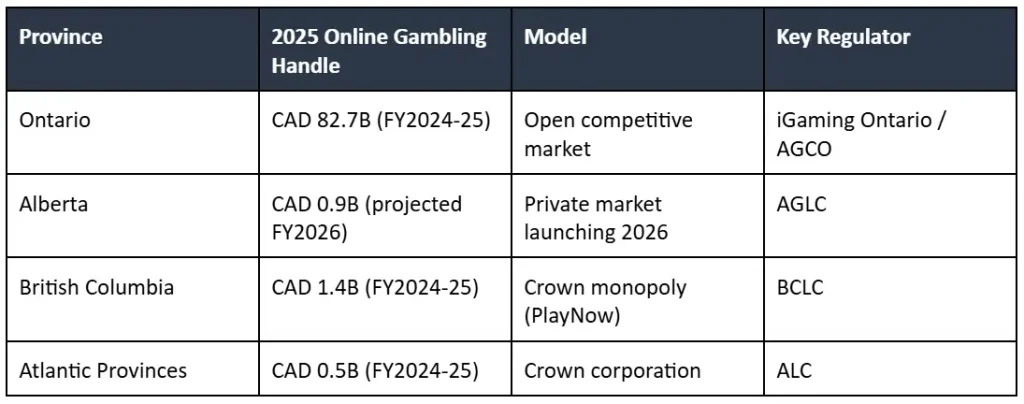
To illustrate the competitive landscape, consider the following table comparing key revenue projections and market shares across leading provinces:

This table highlights Alberta’s aggressive projections against Ontario’s established baseline and the more conservative crown corporation models elsewhere, underscoring the revenue potential of privatization. British Columbia and Atlantic regions, while trailing, face internal pressures to adapt as online casino games capture 84 percent of private market revenues in competitive areas.

Alberta’s strategy also addresses broader industry trends, such as the need for anti-money laundering compliance and player safeguards, aligning with global standards discussed at Canadian Gaming Association events. By modernizing systems and introducing digital channels, the province aims to boost participation rates, potentially exceeding initial forecasts as seen in national audits. Operators stand to gain from clear commercial terms, fostering a marketplace where affiliates can capitalize on launch hype through content on licensing and promotions.

As 2026 unfolds, Alberta’s entry will intensify provincial rivalries, with revenue projections fueling debates on national distribution. The AiGC’s oversight promises transparency, drawing players from unregulated grey markets and bolstering public funds for healthcare and infrastructure. This calculated push positions Alberta not just as a competitor but as a catalyst for wider deregulation.

Other Provinces Push Back with Reforms and Revenue Strategies

While Ontario and Alberta grab headlines, provinces like British Columbia, Quebec, and the Atlantic regions are crafting their own strategies to compete for online casino revenue in 2026, refusing to cede ground in this lucrative arena. British Columbia, long reliant on its government monopoly, is actively reconsidering its model after witnessing Ontario’s $402 million monthly highs and Alberta’s impending launch, with internal discussions focusing on private operator integration to capture untapped growth. Quebec faces mounting calls to open its market, mirroring the shift toward regulated competition that has driven national revenues to $19.31 billion in 2025, as provinces grapple with audits revealing consistent overperformance.

Atlantic Canada’s crown corporations exemplify the tension between monopolies and emerging competition, with the Atlantic Lottery Corporation reporting $498.7 million in profits for 2024-25, up $11.7 million year-over-year, largely from online casino dominance that mirrors private sector trends at 84 percent revenue share. Distributed as $165.1 million to Nova Scotia, $154.6 million to New Brunswick, $153.1 million to Newfoundland and Labrador, and $25.9 million to Prince Edward Island, these funds underscore the stakes, yet spokespeople note further casino growth potential, hinting at reforms to match privatized markets. This regional powerhouse demonstrates how even government platforms are pivoting toward casino verticals, pressured by Ontario’s scale.

Inter-provincial clashes over revenue distribution have intensified, as higher-than-expected hauls from 2023’s $4.8 billion total spark debates on fair splits, with provinces like Manitoba and Saskatchewan monitoring peers for optimal models. Forecasts predict the national online casino market doubling to USD 8.72 billion by 2030, incentivizing reforms that enhance player safety and operator appeal without fully relinquishing control. Quebec’s advocacy for private entry, alongside British Columbia’s deliberations, signals a domino effect, where success stories compel action to fund essential services amid economic pressures.

These strategies blend caution with ambition: Atlantic provinces leverage existing infrastructure for steady gains, while others eye hybrid models blending public oversight with private innovation. Industry events highlight player protection as a unifier, ensuring reforms prioritize responsible gaming amid revenue pursuits. Affiliates and operators benefit from this fragmentation, targeting province-specific opportunities as markets mature.

Ultimately, 2026 marks a pivotal year where these provinces’ responses determine their slice of the expanding iGaming pie, fostering a diverse ecosystem that elevates Canada’s global standing. With Ontario leading and challengers rising, the competition promises innovation, higher revenues, and enhanced choices for players nationwide.