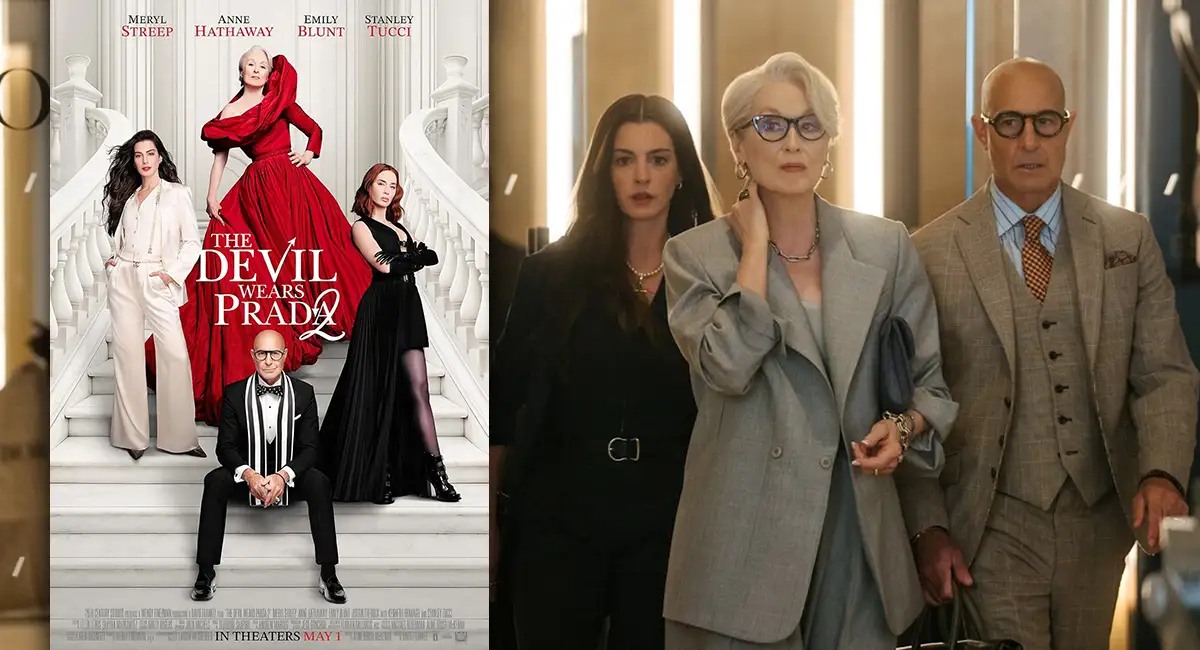
“The Devil Wears Prada 2”: Still Fierce, Still Fashion, But is That Enough?
Synopsis: As Miranda Priestly nears retirement, she reunites with Andy Sachs to face off against her former assistant turned rival: Emily Charlton.
Director: David Frankel
Stars: Meryl Streep, Anne Hathaway, Emily Blunt, Stanley Tucci
Few films define a moment in pop culture the way The Devil Wears Prada did when it debuted in 2006. Stylish, sharp, and endlessly quotable, it turned the fashion world into a cinematic battleground and gave audiences one of the most iconic performances of the modern era courtesy of Meryl Streep. The film went on to gross over $300 million worldwide and earned widespread acclaim, cementing its place as a modern classic. So, the idea of a sequel arriving nearly two decades later feels both surprising and, in some ways, perfectly timed.
Returning audiences to the high-stakes world of Runway Magazine, The Devil Wears Prada 2 reunites its powerhouse creative team, with director David Frankel and screenwriter Aline Brosh McKenna back at the helm. That continuity matters. Too often, long-delayed sequels lose the tone and rhythm that made the original work. Here, there’s an immediate familiarity, not just in the aesthetic, but in the pacing, the humour, and the biting commentary that once made the original so compelling.
The original film followed aspiring journalist Andy Sachs, played by Anne Hathaway, as she stepped into the lion’s den working as the assistant to Miranda Priestly, the formidable editor-in-chief of Runway. Alongside her were Emily, the razor-sharp senior assistant brought to life by Emily Blunt, and Nigel, the endlessly charismatic fashion director played by Stanley Tucci. The dynamic between these characters, equal parts ambition, survival, and reluctant respect, was the heartbeat of the film.
The sequel wisely leans into that foundation. Set roughly twenty years later, we find Miranda still presiding over Runway, though not without challenges. The magazine industry has shifted dramatically, and the film doesn’t shy away from acknowledging that reality. Print is struggling, digital dominates, and the looming presence of artificial intelligence is beginning to reshape not just journalism, but fashion itself. This layer of commentary gives the film a modern edge, grounding its story in the realities of today’s media landscape.
Andy, now an award-winning journalist, finds herself drawn back into the world she once escaped. There’s a poetic irony to her return. In the original, she was desperate to get out; here, circumstances, and perhaps unfinished business, pull her back in. Miranda, in classic fashion, barely remembers her, a detail that feels both humorous and entirely in character. Yet, as the story unfolds, their relationship becomes one of the film’s strongest threads.
Stanley Tucci’s Nigel remains the emotional anchor. He’s still quick with a line, still impeccably dressed, and still the one person who provides Andy with a sense of stability amid the chaos. It’s almost surreal that Tucci, given performances like this across his career, remains without an Academy Award. His presence here is a reminder of just how much warmth and wit he brings to every role.
Emily Blunt’s Emily, meanwhile, has evolved in fascinating ways. Now a powerful executive at Dior, she represents the new guard of fashion leadership, sharp, strategic, and fully aware of her worth. Her connection to Runway, particularly through advertising dollars, adds an interesting layer of tension to the story. She’s no longer chasing Miranda’s approval; in many ways, the power dynamic has shifted.
And then there’s Meryl Streep. Effortless is the only word that truly applies. As Miranda Priestly, she doesn’t just revisit the character; she inhabits her once again with such precision that it feels like no time has passed at all. The quiet pauses, the cutting remarks, the subtle expressions, they’re all still there, reminding us why this role became so iconic in the first place.
One of the more entertaining aspects of the film is Andy, who is still seeking validation but, at the same time, is more confident. Andy’s wardrobe becomes a showcase in itself, almost turning the film into a runway of its own. Each outfit feels deliberate, reflecting both her growth and her lingering connection to a world she once tried to leave behind. It’s a subtle but effective way of showing how much she has changed, and how much of that world still lives within her.
Beyond the glamour, the film explores deeper themes of loyalty and acceptance. Andy’s relationship with Miranda is no longer defined purely by fear or ambition. Instead, it’s layered with history. There’s a sense of loyalty that Andy can’t quite shake, even as she remains fully aware of how she was treated in the past. That tension gives their interactions weight, elevating the film beyond a simple return to familiar territory.
The film also touches on broader societal themes, particularly the expectations placed on women in high-powered industries. It highlights the relentless work ethic required to succeed and the scrutiny that often accompanies it. While these ideas aren’t always explored as deeply as they could be, their presence adds another dimension to the story.
Of course, no discussion of a Devil Wears Prada film would be complete without acknowledging the commentary on fashion itself. The sequel reflects an industry that has evolved, more inclusive, more digital, but still driven by image and influence. The integration of technology, particularly AI, into this world feels timely, even if the film only scratches the surface of its implications.
From a theatrical perspective, this film feels like an event. Packed theatres, themed drinks, even red carpets, it’s a reminder of how certain films can still create a sense of occasion. And with a cast that includes Oscar winners and nominees across the board, it’s no surprise audiences are anxious to show up.
That said, the film isn’t without its limitations. It doesn’t quite reach the heights of the original. The first film had the advantage of novelty; it introduced us to this world, these characters, and their dynamics. The sequel, by nature, builds on what’s already been established. While it does so effectively, it rarely surprises in the same way.
Andy is given a love interest of sorts, which doesn’t really add anything to the film. Not sure why this arc was necessary. Ironically, in another part of the film, one character says to another, ‘You don’t need a man.’ You don’t say.
Still, The Devil Wears Prada 2 succeeds in what many legacy sequels aim to do but fail: it complements the original rather than trying to outdo it. It revisits beloved characters, updates their world for a new era, and delivers a story that feels both nostalgic and relevant.
In the end, this is a stylish, engaging return to a world that audiences clearly weren’t ready to leave behind. It may not redefine the genre, but it doesn’t need to. Sometimes, it’s enough to simply remind us why we fell in love with it in the first place.
Grade: B-
Watch the movie trailer: