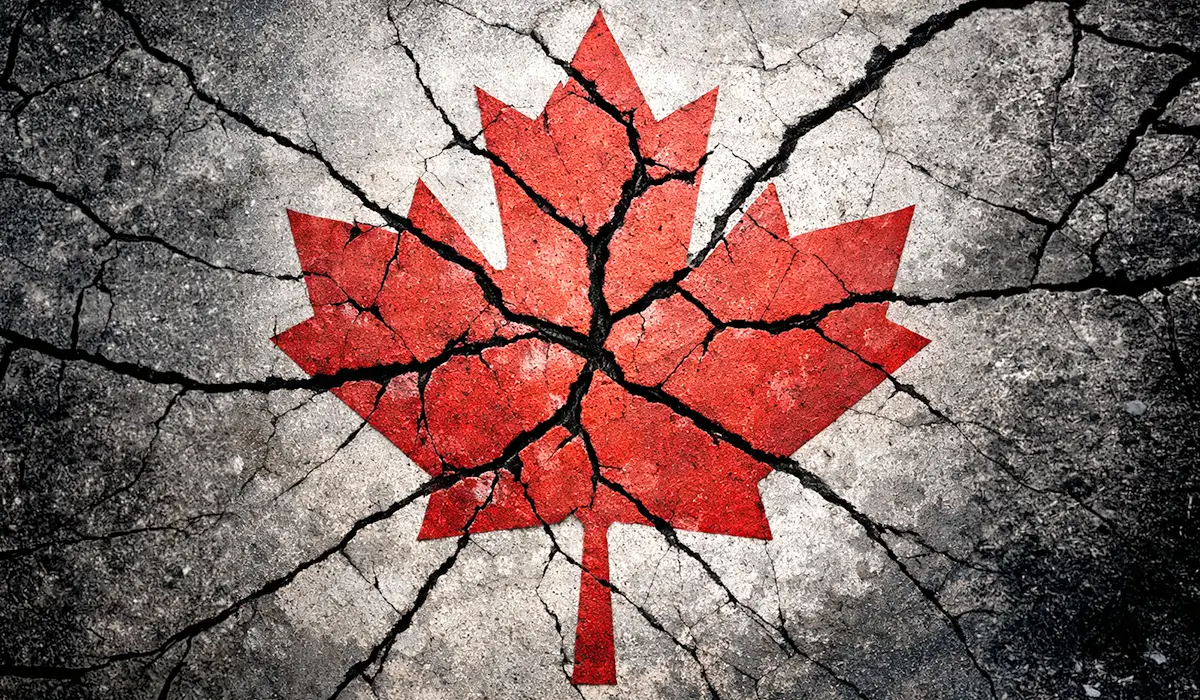
Cracked red maple leaf symbolizing division within Canada

Canada’s Antisemitism Crisis: How the Liberal Government Failed Jewish Canadians

Canada’s moral collapse on antisemitism is not a past failure — it is a choice unfolding in real time.


Canada’s antisemitism crisis is no longer abstract or anecdotal. It is measurable, escalating, and unfolding in plain sight.

In 2024, Canada recorded 6,219 antisemitic incidents — the highest number ever documented by B’nai Brith Canada since national tracking began in 1982. In 2025, that figure rose again to approximately 6,800 incidents, averaging nearly seventeen antisemitic acts every day in a country that defines itself by tolerance and pluralism.

Synagogues have been firebombed. Jewish schools in Toronto have been shot at. Community centres have received bomb threats. Quebec has seen a 215 percent increase in incidents, and Alberta more than 160 percent. Police have disrupted ISIS-inspired plots targeting Jewish institutions. Increasingly, many Jewish Canadians report feeling safer concealing their identity than expressing it openly.

This surge is not the product of hesitation. It stems from an ideology that has taken root inside the Liberal Party and across key institutions — an ideology so warped that it treats antisemitic tropes and hostile falsehoods as acceptable expressions of “rights.” Protesters have learned to weaponize the Charter, twisting its protections into a licence for intimidation and hate. Instead of stopping this perversion of the law, governments and police have responded with accommodation, allowing demonstrations that routinely cross into open hostility to proceed unchallenged. The result is a system where the Charter is twisted against Jewish Canadians and the institutions responsible for enforcing the law simply choose not to enforce it. They are not doing their job, and they know it. 

In May 2025, Ottawa Life Magazine published “Silence Is Complicity,” documenting rising alarm within Jewish communities. Five months later, “Two Years After October 7” showed conditions had worsened despite repeated warnings from security experts and civil society leaders. These were not predictions, they were early records of an accelerating crisis.

What makes this development significant is not only its scale, but its normalization across institutions that would ordinarily be expected to resist it.

Normalization and Institutional Drift

The most dangerous development is not simply rising antisemitism, but its increasing normalization within segments of Western society, especially in Canada. Hostility toward Jews is increasingly minimized, reframed, or excused in ways that would be unthinkable if directed at most other minorities.

As commentator Bill Maher has noted, a double standard has taken hold in which antisemitism is frequently recast as activism, allowing rhetoric that crosses into intimidation or dehumanization to evade scrutiny.

This is not about suppressing legitimate criticism of Israel. Democracies depend on open debate. The problem arises when criticism becomes collective blame, when activism becomes intimidation, and when prejudice becomes socially acceptable under the cover of political expression.

History shows societies rarely collapse into moral failure in a single moment. They deteriorate through incremental normalization—small permissions, institutional silence, and repeated refusal to enforce boundaries.

That pattern is now visible in parts of Canada’s institutional life, where confirmation bias increasingly shapes discourse on Jews and Israel across universities, unions, activist networks, and segments of public debate.

Intellectual Inconsistency and Historical Illiteracy

The contradiction becomes especially clear when viewed through Canada’s own framework of Indigenous recognition. Canadian public life rightly affirms the ancestral connection of Indigenous peoples to this land. Yet the same intellectual standards are often abandoned when discussing Jewish historical claims to Israel and the broader region of Judea.

The inconsistency reflects a selective application of principle, in which continuity is accepted in one context and dismissed in another, depending on political framing.

If this logic were applied at home, it would be dismissed instantly: no government that acknowledges unceded Algonquin territory would deny Indigenous peoples their ancestral connection to that land. Yet that same contradiction is tolerated when applied to Jewish history. The double standard is not accidental. It is chosen. This is not a minor analytical error. It reflects an abandonment of intellectual discipline, where standards applied consistently elsewhere are ignored when the subject is Jewish people in Canada or Israel.

That same ignorance now shapes the broader public discourse, where people with credentials and titles speak with an authority that collapses the moment it is tested. Basic distinctions between Hamas, Islamic Jihad, and the Palestinian Authority disappear. The origins of Zionism, the Oslo Accords, and the region’s political realities are invoked without the slightest engagement with what they actually mean. This is not informed disagreement. It is the certainty of people who mistake slogans for knowledge. What stands out is not the ignorance but the stature of those expressing it: senior bureaucrats, academics, media commentators, union leaders, and business elites who abandon the standards they demand everywhere else. 

Media, Unions, and Institutional Credibility

Nowhere is this imbalance more visible than at the Canadian Broadcasting Corporation, a publicly funded broadcaster that receives over $1.4 billion annually and is mandated to uphold accuracy and impartiality.

For years, independent media monitors and research groups, including HonestReporting Canada, have documented a clear pattern at CBC. The record shows selective framing, omission of essential facts, distorted context, and the repeated use of antisemitic tropes in coverage of Jewish Canadians and in reporting on Gaza and Israel. This is not a series of mistakes. It is a sustained pattern across thousands of stories.

The conclusion is unavoidable. CBC applies standards to this subject that it would never relax in any other conflict. That double standard has destroyed public confidence in its credibility, accuracy, and impartiality, and the collapse in its audience reflects that loss of trust.

What makes this failure morally severe is that Canadians are compelled to fund it. A publicly financed broadcaster has allowed an ideological hostility toward Jews to take root and shape its reporting. This is not a lapse in judgment. It is an institutional failure that uses taxpayer money to legitimize narratives that would be condemned outright in any other context. A public institution entrusted with fairness has instead permitted a culture that corrodes it.

A similar disease has infected Canada’s major unions, including CUPE, PSAC, OSSTF, CUPW, and Unifor. These organizations have embraced positions on Israel and Gaza that have nothing to do with representing workers and everything to do with importing a hostile, ideologically driven narrative about Jews.

The problem is not that unions have opinions. The problem is that they have allowed hate-filled rhetoric echoing long‑standing antisemitic tropes to become routine. Their leaders have abandoned balance, evidence, and basic intellectual discipline on the altar of a falsely propagated ideology. 

Worse still, many members have been conditioned to believe that repeating these distortions is an act of moral courage. They have been taught that slogans are history, that hostility is principle, and that adopting these narratives signals ethical clarity rather than a basic failure to understand the facts.

The result is an institutional culture that treats misinformation as virtue and hostility toward Jews as a legitimate political stance. Leadership has either looked away or joined in. What remains is a set of public institutions that have traded their mandate for a grievance script they barely understand.

International Institutional Distortion

This domestic pattern is reinforced internationally through institutions that apply uneven standards to Israel compared with other states.

Between 2015 and 2023, the United Nations General Assembly passed more resolutions condemning Israel than those directed at many authoritarian regimes combined. This imbalance has led critics across ideological lines to question whether parts of the UN system have developed a structural bias that undermines its credibility as a neutral arbiter.

The result is not disagreement. It is a culture that treats a double standard as normal and sees no shame in it. 

Against this backdrop, countries like Singapore stand out for taking a fundamentally different approach. Prime Minister Lawrence Wong has been explicit that recognition of a Palestinian state must rest on two non‑negotiable conditions: recognition of Israel’s right to exist and the rejection of terrorism. Germany, Japan, and South Korea have taken similarly disciplined positions, grounding their policies in security realities rather than symbolic posturing. Their consistency shows that principled clarity is still possible, even if it has become unfashionable across much of the Western political class. 

Government Failure and Political Choices

The Carney government’s handling of antisemitism cannot be explained as administrative delay. It reflects a pattern of policy choices that have failed to match the scale of the crisis.

Canada’s Anti-Racism Strategy expired in 2022; at the same time, antisemitic incidents were rising sharply. Despite acknowledging that Jews are the most targeted religious minority in the country, the government did not replace it with a dedicated national plan addressing antisemitism. This was not oversight. It was omission. Policy frameworks do not expire without decision. Their absence reflects prioritization—and therefore responsibility.

The question is no longer whether the government is aware of the problem. It clearly is. The question is why awareness has not produced proportional action.

As Elie Wiesel warned, neutrality in the face of injustice is not neutral; it empowers the oppressor and abandons the victim.

That warning applies directly to institutions that acknowledge rising antisemitism while responding with fragmented or symbolic measures.

Security, Extremism, and Enforcement Gaps

This failure becomes more serious when viewed through the lens of national security. Canadian intelligence agencies, including the Canadian Security Intelligence Service, have repeatedly warned of foreign influence operations, extremist networks, and radicalization risks operating within Western democracies.

Recent arrests involving alleged IRGC-linked operatives highlight the continued presence of transnational threat actors operating across jurisdictions. Yet responses have often been cautious and fragmented rather than comprehensive.

At the same time, enforcement inconsistencies persist domestically. Legal tools under the Criminal Code already exist to address hate propaganda and intimidation targeting religious communities. The issue is not the absence of law, but uneven application.

When antisemitic intimidation is met with hesitation or inconsistency, it signals that certain forms of hate are treated as less urgent than others.

Public Safety Canada’s slower pace on terrorist designations compared to allied democracies has reinforced perceptions of inconsistency.

Municipal authorities have often mirrored this pattern. In Ottawa, Toronto and Montreal, demonstrations near Jewish neighbourhoods and institutions have proceeded despite documented intimidation, with officials frequently framing them as general protests even when rhetoric crosses into targeted hostility.

The Broader National Security Context

The refusal to confront antisemitism reflects a wider weakening of institutional confidence across Canada’s security environment.

Warnings regarding extremist activity, foreign interference, cyber vulnerabilities, and infrastructure risks continue to accumulate. Yet policy responses often lag behind threat assessments.

The result is a widening gap between identified risk and political action.

A society that cannot consistently protect a vulnerable minority from escalating hate is unlikely to project strength in broader national-security domains.

Security begins with the protection of citizens. On that measure, Canada is failing.

The Case They Cannot Make

The trajectory from May 2025 to October 2025 to May 2026 is not random. It reflects a consistent pattern of hesitation, institutional avoidance, and political caution in the face of escalating antisemitism. The evidence is public. The warnings have been issued repeatedly. The consequences are visible. A country that cannot protect its Jewish citizens cannot credibly claim to be a defender of pluralism, democracy, or human rights.

Canada’s leaders are not acting without information. They are acting without resolve. And that distinction defines everything. Because what is unfolding is not confusion, and not incapacity—but choice. And it is that choice, repeated over time, that will determine how this moment in Canadian public life is ultimately remembered.

Image: Copilot