In this production of ‘Fiddler on the Roof,’ Tevye speaks in Yiddish, but the warning is universal
What: Fiddler on the Roof in Yiddish
Where: The Elgin Theatre, 189 Yonge St.
When: Mon., May 25 until Sun., Jun. 7
Why you should go: Because the sheer fact of its existence carries weight. Because it’s necessary. And because, in the absence of anything better, showing up is the least we can do.
Review by Lori Ossip
Harold Green Jewish Theatre Company’s production of Fiddler on the Roof in Yiddish officially opened on May 28 and offers Toronto a little slice of matchmaking, bottle-dancing, and (of course) tradition. But it also comes with a less mirthful shadow.
In the spirit of traditional Yiddish literature — unfiltered and unflinching — I must begin with an uncomfortable truth. Antisemitism in the West is on the rise in a way that feels unprecedented in this century, albeit eerily familiar. When this production was first staged in New York, it was 2018, a year marked by the Pittsburgh Tree of Life synagogue massacre. The Toronto production arrives on the heels of the 2025 Manchester and 2026 Michigan synagogue attacks, to name only a few. Last year in Toronto, anti-Jewish offences represented 82% of all religiously-motivated hate crimes. So, it begs the question: can a musical do anything about this?
Advocates for the show have long argued that it can. Productions of Fiddler are frequently framed as tools for empathy-building, intercultural understanding, and combating antisemitism by humanizing the supposed “other.” Following the acclaimed 2018 Yiddish revival in New York, critics and cultural commentators alike often described the production as newly urgent amid rising discrimination and violence.
For nearly sixty years, Fiddler on the Roof has been treated as the “universal” musical … intentionally so. There was a conscious effort to clear away anything that could maybe confuse an audience’s ear at that time, anything too culturally specific. The only Yiddish you hear in the original musical in English is “Mazel Tov” and “L’Chaim.” Perhaps as a result, Fiddler became the globally beloved tale of family, love, loss, and evolving times.
Yet, when Jewish suffering becomes a symbol for universal suffering, however noble that may be, Jews end up becoming an abstraction. It’s not hard to sympathize with the humble milkman Tevye of the early 1900s, who flees his home due to persecution and political unrest. But the present-day Jewish community of Toronto is not a parable. An audience may weep at the pogrom in Act II, yet file away contemporary antisemitism as “complicated” or “political.” “I’m not antisemitic. I love Fiddler on the Roof!” is not as far-fetched a sentiment as it should be. That’s what makes this Yiddish production (presented with English and Russian supertitles and directed by the legendary Joel Grey) so intriguing as a cultural intervention.
The choice of Yiddish as the language of the production is by no means a neutral artistic choice. It is, distinctly, Jewish: in its sound, its humour, its grief. It carries the texture of twentieth century Ashkenazi civilization and its particular way of being alive. When Shraga Friedman first translated the musical into Yiddish in 1965, he brought back much of the cultural flavour that the original production had glossed over, restoring the Talmudic specificity prevalent in Sholem Aleichem’s original nineteenth century Tevye the Dairyman stories. In the Broadway show, the Torah isn’t even called the Torah — it’s “the good book.” In English, Anatevka is a “little village, little town;” in Yiddish, it’s called what it is — a shtetl. In the English version of the Sabbath prayer, the song refers to Ruth and Esther. The Yiddish names the matriarchs: Sarah, Rifka, Rochel, and Leah. The English production chose to widen the door; the Yiddish production purposefully narrows it.
And yet, even when the production is performed in Yiddish, the specificity of the story and the language don’t prevent the audience from seeing the larger picture. By becoming more honest to the source material, the production feels less like a revival than a reclamation of a specifically Jewish cultural memory. And, in a seemingly counterintuitive way, that specificity can make it more universal, not less. But that’s still the trap.
Performing Fiddler in Yiddish is more culturally accurate, sure, but it’s also a period piece, taking place in 1905. As a result of that historical distancing, it provides an easy moral escape hatch for audiences to assume that what it depicts is a “back then” problem with no tangible bearing on our present moment. It’s a powerful show, able to both entertain and devastate in equal measure. But Fiddler’s power to move is also its power to console: to make people feel like they’re grappling with something serious when they’ve only briefly felt it in the dark, before returning to a world where antisemitism is too often treated as historical rather than contemporary.
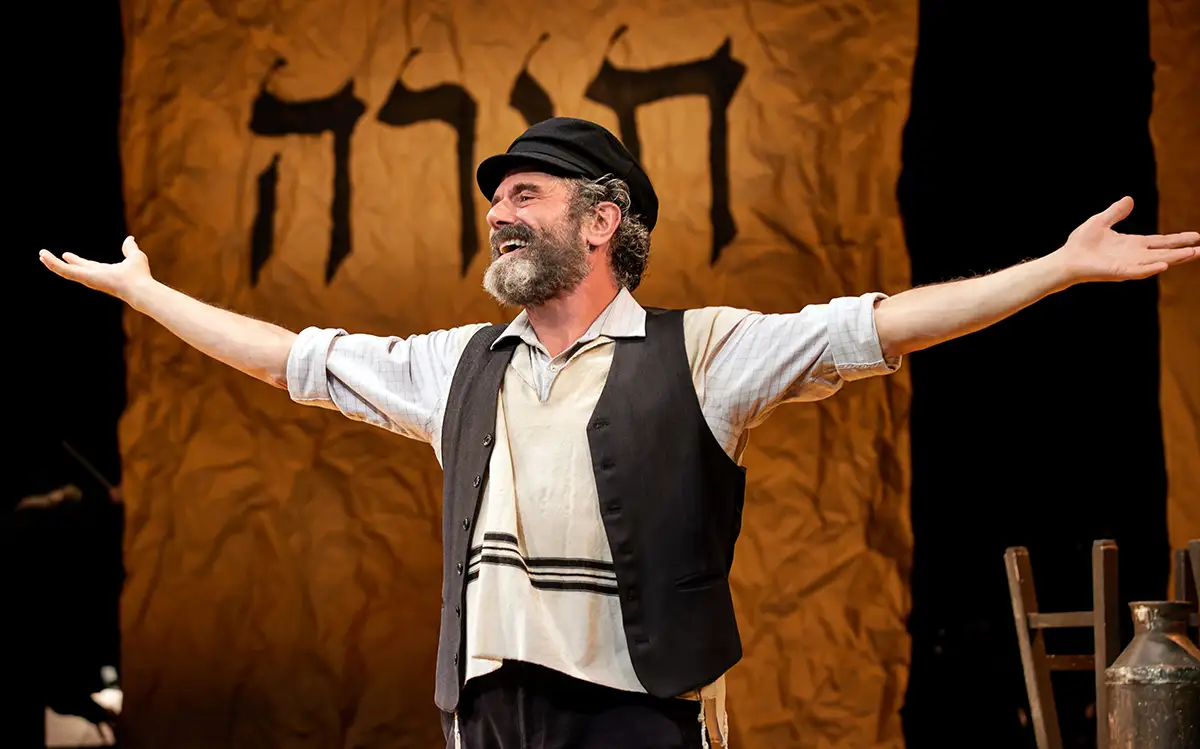
During the song If I Were a Rich Man, Tevye dreams of his ideal of wealth: devoting his life to prayer, studying Torah, and sitting in the synagogue all day. In 2026, with synagogues across the world (including right here in Toronto) facing threats, vandalism, and violence, that line carries new weight. There’s no guaranteed safety, even in your place of worship. A sad reality of our times and Tevye’s.
This is what antisemitism has always been, and what society keeps failing to absorb. It’s the canary in the coal mine — a dire warning sign that the atmosphere is toxic and the air is getting harder to breathe. Hatred aimed at Jews rarely stays contained, and when antisemitism becomes socially permissible, broader democratic and social fractures are likely already underway. We’ve become very good at turning Jewish suffering into symbolism — stories, lessons, even prestigious art to be admired for its emotional power. We are far less good at responding to the conditions that make those stories feel current again.
So, no. Of course this production will not “fix” antisemitism. No single work of art can, no matter how respectful, how thoughtful, how Jewish. Nor will it close the door that universalizing Jewish pain has left open for people who want to feel righteous without interrogating their own conscious and subconscious biases. Their spectatorship will not give them a hall pass to keep doing nothing. But here’s what it will do:
For three hours, in the glorious Elgin Theatre, it insists that this culture is still alive. It does so in the language of a people history has tried so hard to erase, accompanied by rich, joyous Klezmer-inspired music brought to new heights by the musicians. These stories belong to real people, speaking in a real language, and carry a weight that no amount of abstraction can fully lift. Grey’s directorial interpretation, simple, direct and minimal, has been crafted by someone whose father, Mickey Katz, was a renowned Yiddish musician and comedian. Grey knows this world inside and out. And Steven Skybell’s Tevye, deepened by many years of performing this role through increasingly dark times, does not let audiences off the hook. What audiences do when they walk out of the theatre, well, that’s on them.
We don’t have the luxury of waiting for a better answer. What we have in this city, and in this moment, is this production — authentic, nuanced, and stubbornly, defiantly present. Go see it. Bear witness. It’s the oldest form of resistance there is. Tonight, that’ll have to be enough.
Fiddler on the Roof in Yiddish | Harold Green Jewish Theatre Company
Photo: Jeremy Daniel