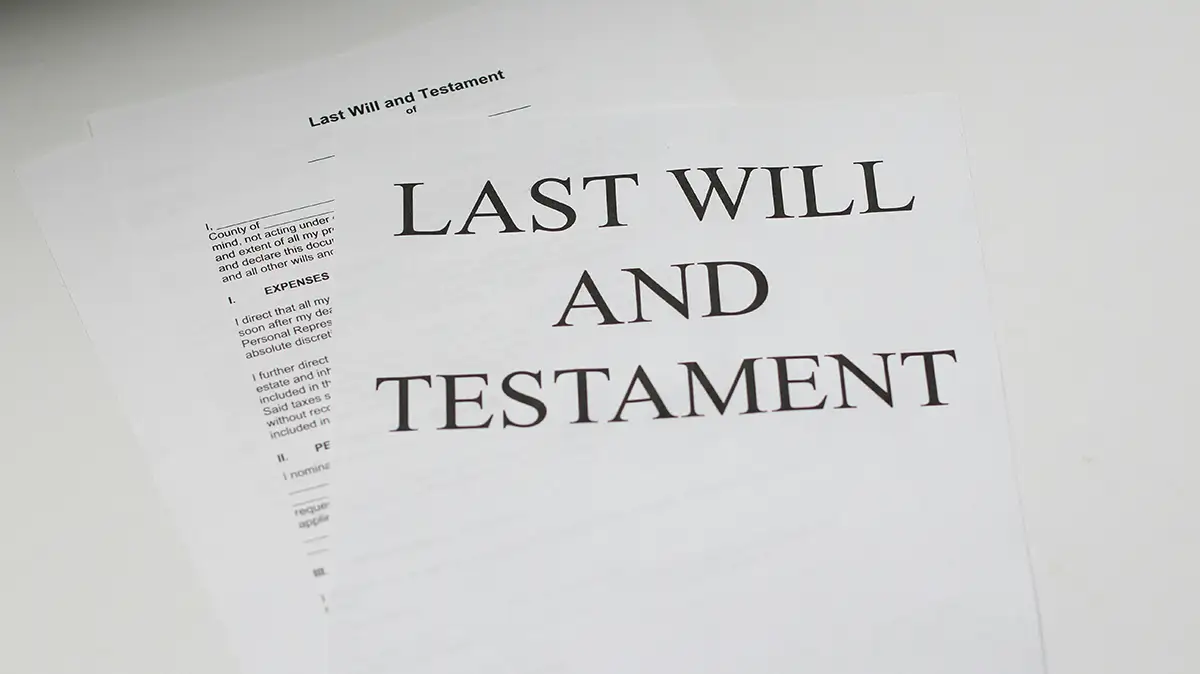



Last will and testament document on a desk, representing estate planning in Canada

What Happens If You Die Without a Will in Canada?

What Happens If You Die Without a Will in Canada?

More than half of Canadian adults do not have a current will. A 2024 Narrative Research survey found that only 43 percent of Canadians have one in place, while 53 percent have none and 4 percent are unsure. Most people assume their spouse will automatically receive everything if the worst happens. That assumption is often wrong. Your home province applies a fixed legal formula to your estate, and the result rarely matches what your family expects. Unmarried partners can be left with nothing. Blended families face complicated splits. Courts step in to settle questions that should have been yours to answer. Here is what to expect and how to keep control.

Key Takeaways

• Passing without a will means dying “intestate,” and provincial succession statutes govern who inherits.
• Unmarried partners are excluded from inheritance in most provinces, with British Columbia being the main exception.
• A surviving spouse may receive a “preferential share” before children inherit, ranging from $150,000 to $350,000 depending on the province.
• The court appoints an administrator, which adds months of delay and thousands of dollars in costs.
• Writing a will protects your family, avoids disputes, and keeps control where it belongs: with you.

What Does It Mean to Die Intestate?

Dying intestate is the legal term for passing away without a valid will. When this happens, your province applies a strict statutory formula to divide your estate. There is no flexibility, no consideration of personal relationships, and no room for verbal wishes you expressed in life. A court-appointed administrator or estate trustee gathers your assets, pays debts and taxes, then distributes what remains under that statute.

This applies whether you own $20,000 or $2 million. Experienced probate counsel speeds the process, particularly for families with cross-provincial assets. Firms like One80 Law handle probate applications and estate administration across Alberta, British Columbia, and Ontario, with virtual document signing that removes the need for in-person meetings during an already difficult time. Professional guidance reduces both delays and the personal liability risks executors commonly face.

Who Actually Inherits When There Is No Will?

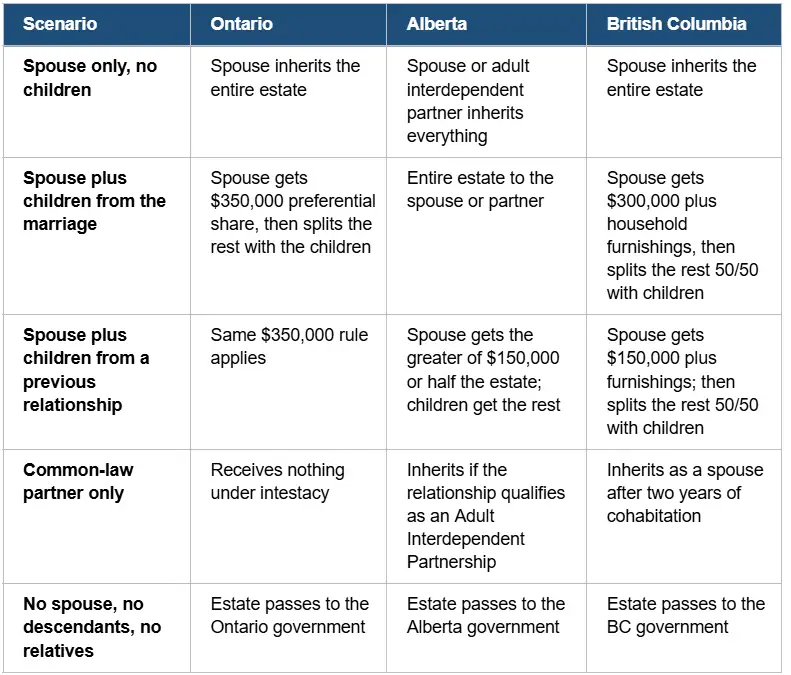
Every province has its own intestacy statute. The general pattern is similar, but the dollar figures and the treatment of unmarried partners differ significantly. Here is how three of Canada’s largest provinces handle the same situation: a married person who dies leaving a spouse and children from the marriage.

Figure 1: Spouse’s preferential share by province when children are from the marriage.

Unmarried Partners Face the Steepest Risk

The biggest shock for grieving families is how unmarried partners are treated under intestacy. Ontario, Alberta (outside of registered Adult Interdependent Partnerships), and most other provinces give a common-law partner no automatic inheritance, regardless of how long the relationship lasted. The legal spouse, if there is one, takes priority. A shared home, joint bank accounts, and personal investments all flow to legal next of kin first.

British Columbia stands apart. Under the Wills, Estates and Succession Act, a partner who lived with the deceased for at least two years in a marriage-like relationship inherits exactly like a married spouse. That single difference can flip the outcome of an estate depending on which side of a provincial border the deceased lived.

Probate felt overwhelming at first, but One80 Law provided steady guidance and clear next steps. Their support made a difficult process much easier to manage.
  Linda T., Google review, January 2026

The Administrator Problem: Months of Delay, Real Costs

Without a named executor, your loved ones face a court process to have someone formally appointed to manage your affairs. In Ontario that person is the estate trustee without a will. In Alberta and BC the title is personal representative or administrator. Either way, the application takes weeks to prepare, runs hundreds to several thousand dollars in legal and court fees, and may require posting a surety bond as financial security.

Until the grant is issued, assets are essentially frozen. Bank accounts cannot be accessed. Property cannot be sold. Bills continue to come due. For families already navigating grief, the financial pressure during this waiting period adds an avoidable layer of stress.

What an administrator must do

• Apply to the provincial superior court for a grant of administration.
• Identify, locate, and value every asset the deceased owned alone.
• Notify creditors and pay all valid debts, including the final tax return to the Canada Revenue Agency.
• Distribute the remainder strictly according to provincial intestacy formulas.
• Account to every beneficiary in writing, with full receipts and a summary statement.

Administrators carry personal liability throughout this process. Distributing money to the wrong person, missing a creditor, or filing late tax returns can leave the administrator paying out of their own pocket. Estate planning advisors often recommend that families with assets above the small-estate threshold consult counsel early, in much the same way financial advisors guide clients toward financial independence through every life stage.

Why Are So Many Canadians Caught Without One?

Canadian estate-planning statistics have been stable, and sobering, for over a decade. Younger adults assume they are too young or own too little to bother. Older adults often had documents drafted decades ago and never updated them after a divorce, remarriage, or move.

Figure 2: Percentage of Canadians without a current will by age group. Sources: Narrative Research (2024), Angus Reid Institute.

An Angus Reid Institute poll found that only 35 percent of Canadian adults have an up-to-date will, with one in six holding documents they have not reviewed in years. The cost of inaction is rarely visible until something goes wrong, and by then the deceased cannot fix it.

How to Keep This From Happening to Your Family

The fix is simpler than most people expect. A properly drafted, witnessed, and stored will takes the entire intestacy regime off the table. You name the executor. You name the beneficiaries. You decide what happens to your children’s guardianship, your charitable gifts, and your specific items of value. Provincial formulas step aside.

A short estate planning checklist

Draft a valid will. Most provinces require it in writing, signed by you, and witnessed by two adults who are not beneficiaries.
Name an executor you trust. Pick someone organized, financially literate, and likely to outlive you. Name a backup.
Update beneficiary designations. Life insurance, RRSPs, TFSAs, and pensions pass directly to named beneficiaries outside the will.
Appoint a power of attorney. Separate documents cover financial decisions and personal care if you lose capacity while still alive.
Review every five years, or after major life events. Marriage, divorce, a new child, a death in the family, or a move between provinces all warrant a refresh.

Ottawa has one of the deepest pools of legal expertise in Canada, with over 100 law firms across the city handling everything from real estate closings to contested estates. Cross-provincial estates have become more common as Canadians retire across borders or buy property in different markets. If your assets sit in more than one province, your will needs to acknowledge that reality.

Frequently Asked Questions

Does my spouse automatically inherit everything if I die without a will?

Not necessarily. Only if you have no children. If you have children, your spouse receives a preferential share first, then splits the remainder with them under provincial formulas. The exact split varies by province and by whether the children are from the current relationship.

What happens to my children if I have no will?

The court appoints a guardian, and any inheritance for minors is typically held in trust by the public trustee until they reach the age of majority. Without a will, you have no say in who raises your children if both parents pass away.

How long does it take to settle an estate without a will?

Most intestate estates take nine to eighteen months to fully settle, and longer if any family member contests the administrator appointment. Estates with a clear executor and valid documentation often close in six to twelve.

Do common-law partners ever inherit under intestacy?

Yes, in British Columbia once cohabitation reaches two years, and in Alberta if the partner is registered as an Adult Interdependent Partner. In Ontario, Quebec, and most other Canadian jurisdictions, unmarried partners receive nothing automatically and must apply for support through the courts.

What if I move provinces, does my will still work?

A valid will travels with you, but provincial differences in spousal entitlements, executor compensation, and probate fees can produce unexpected results. Review your document whenever you change provinces or acquire real estate in a new jurisdiction.

Where can I find official guidance on Ontario intestacy rules?

The Ontario government publishes plain-language guidance at ontario.ca/page/administering-estates, including details on the Succession Law Reform Act and the role of the Office of the Public Guardian and Trustee.

Closing Thoughts

Provincial intestacy formulas treat every family like a statistical average. Yours is not. The most common excuse for putting off a will, that there is nothing complicated to sort out, is exactly the assumption that creates problems. Couples discover long-term partners receive nothing. Blended families learn stepchildren are not legally children. A short document, drafted today, avoids all of it. For executors navigating an intestacy, Ottawa Life’s coverage of Canada’s estate law landscape is a useful starting point. The right counsel, engaged early, costs far less than the alternative.

References

Narrative Research and Logit Group, “Half of Canadians Don’t Have a Last Will and Testament,” 2024. URL: https://logitgroup.com/canadians-last-will-and-testament/

Angus Reid Institute, “Lacking the Will: Half of Canadians say they don’t have a last will and testament,” 2023. URL: https://angusreid.org/will-and-testament/

Government of Ontario, “Administering estates,” 2024. URL: https://www.ontario.ca/page/administering-estates

Government of Alberta, Wills and Succession Act (SA 2010, c W-12.2), CanLII. URL: https://www.canlii.org/t/8ntp

Government of British Columbia, Wills, Estates and Succession Act (SBC 2009, c 13). URL: https://www.bclaws.gov.bc.ca/civix/document/id/complete/statreg/09013_01

Fact Check: All statistics, dollar figures, and legal claims in this article were verified against original sources, including provincial statutes and published survey data, as of May 2026. Sources are listed in the References section.

Photo: Melinda Gimpel, Unsplash