Why Canadian AI Pioneer Christopher Olah, co-founder of Anthropic Went to the Vatican for Guidance

The creators of the machine are asking an ancient spiritual authority to guide what comes next.


By Dr. Sean Tobin

Pope Leo XIV’s first encyclical, Magnifica Humanitas, is a continuation of his namesake. Leo XIII wrote Rerum Novarum in 1891 in the middle of the industrial revolution — a document that refused to leave workers at the mercy of forces they could not name or resist. This Leo is doing the same thing for a different revolution. The technology has changed; the question has not: what happens to ordinary people when power concentrates and the human person gets lost in the machinery?

Magnifica Humanitas landed on every major news channel this week, and it is being read and argued about in places that do not normally pay attention to what popes write. Some of that attention is owing to the subject itself, since artificial intelligence has a way of concentrating minds, but some of it is owing to the quality of the argument. Leo XIV engages the nuances of AI with real pastoral precision, returning again and again to the human person — to solidarity, to the poor and underprivileged who will bear the weight of technological disruption without any of its benefits if the powerful choose otherwise. He speaks of the Church not as a watchdog or a regulator but as a sacramental presence of communion in the world, present within the crisis, speaking from inside it, drawing people toward the dignity they are in danger of forgetting.

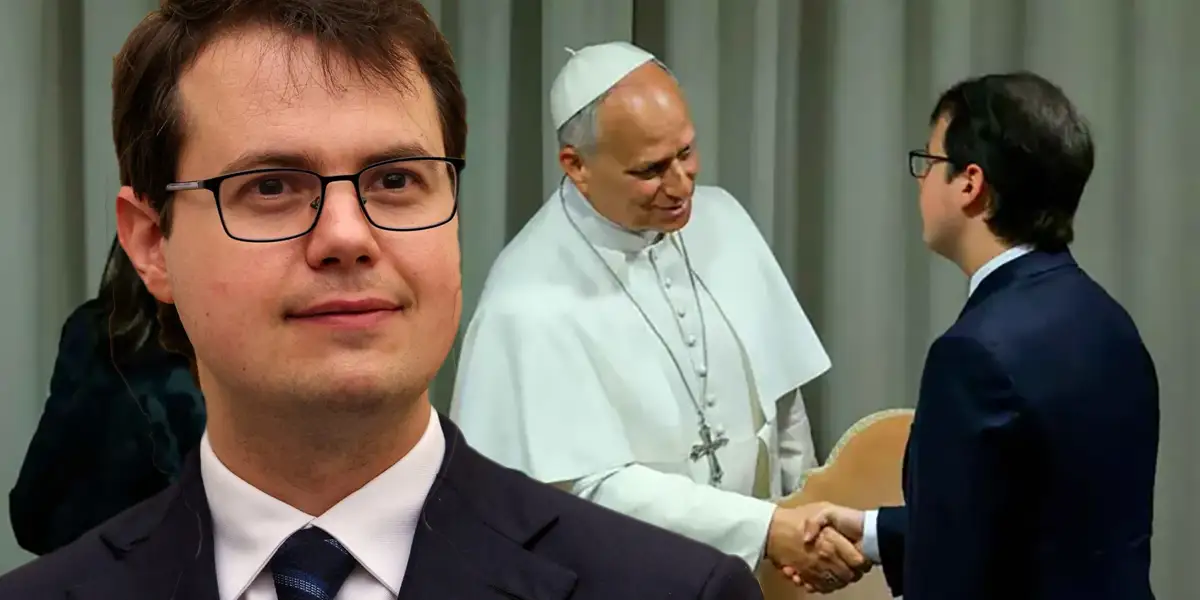
That is a strong claim, and it drew a strong response. Seated beside Leo at the presentation of the encyclical was Christopher Olah, co-founder of Anthropic, thirty-three years old and, by his own account, not a believer. The image is worth pausing on: an atheist AI researcher seated in the house of Peter while a pope spoke with authority about the soul of the technology Olah has spent his career building. Whatever one makes of that moment, it is not nothing.

What Olah said

Standing at that podium, Olah opened with a confession his peers in the industry rarely make in public. Every frontier AI lab — including his own — operates under pressures that do not always point toward the good: commercial survival, the race to the research frontier, geopolitical competition, and the older, plainer pressures of pride and ambition. No amount of sincere intention, he said, fully neutralizes those pressures, which is why it matters enormously that there be people outside them — people the incentives cannot reach, who are willing to say hard things and insist on safety.

But the more striking part of his speech was not the confession. It was the picture he drew of what these systems actually are. AI models are not engineered the way a bridge or an airplane is engineered, where every part is designed and the physics are understood. They are grown on a structure roughly modeled after the brain, on an enormous inheritance of human thought and speech, and what has grown is far more subtle, odd, and beautiful than science fiction prepared anyone for. They are not the cold calculating robots of the old imagination. They are, as Olah put it, made from us — from our words — and they remain in important ways mysterious even to the people who train them.

“We dwell so often on what divides us, but humanity, full of dignity and conscience, has so much common ground. If this technology is coming, it must go well — for our common home, and for the children to come.”

He named three things he believes the Church is specifically needed for. The first is the global poor: AI development is concentrated in a handful of wealthy nations, and there is no existing mechanism to ensure the gains are shared — a problem, he said, that the Church has historically refused to let the world ignore. The second is moral imagination about what human flourishing actually looks like, questions that no lab can answer but that traditions like the Church have carried for millennia and must carry into this new moment. The third was the strangest: he leads a research team that studies the internal structure of AI models, and they keep finding things they cannot explain — structures that mirror results from human neuroscience, evidence of something resembling introspection, internal states that functionally mirror joy, fear, grief, and unease. He does not know what that means, and rather than filling the uncertainty with confident projections, he brought it to Rome and asked for discernment.

The cynical reading 

There is a version of this story that is cynical — Anthropic is navigating regulatory risk, the Church is culturally influential, and a photograph with a pope is worth something — and that version is not obviously wrong. These are companies with investors and timelines and every incentive to be seen as the responsible actor in a field concentrated, as Olah himself noted, in the hands of a few wealthy nations and a handful of labs.

But cynicism is not the full story, and the reasons to believe that are worth sitting with. Anthropic has delayed model releases before, holding back work they called Mythos because they were not satisfied with the safety evaluation — and companies that treat ethics as marketing do not voluntarily slow down. They do not stand at a Vatican podium and confess that they do not understand what they are building, and they do not ask a religious institution to serve as their conscience. The request Olah made in Rome was specific: send critics we cannot silence, give us moral voices the incentives cannot bend, and push us in a better direction. That is a rare thing to ask in public, and rarer still to mean.

What the Church brings

What Olah was reaching for in Rome is precisely what the Catholic tradition offers and almost nowhere else can provide: a thick account of what the human person is. Not a consumer, not a user, not a node in a network, but a being made for communion, whose dignity is not derived from function and whose identity cannot be reduced to preference or output. The builders know they are building something consequential, and the best of them are genuinely afraid of getting it wrong. What they lack is not intelligence or good intention but formation — a tradition deep enough to hold the weight of what they are doing and tell them not just what to avoid but who to become.

The document Antiqua et Nova, released earlier this year, reads not like a pastoral letter about screen time but like a serious philosophical engagement with what intelligence is, what persons are, and what is at stake when we build systems that can simulate but cannot instantiate genuine relationship, genuine moral judgment, genuine love. The Vatican is not treating this as a novelty to be managed. It is treating it as a civilizational question that requires the full weight of a two-thousand-year tradition to answer.

“The questions raised by AI are bigger than the AI research community. Not just in their implications, but also in their nature.”

Olah said that himself, and it is worth taking seriously coming from someone who has spent years studying what is actually happening inside these models. He came to Rome and said plainly that the questions this technology raises belong to the humanities, to religion, to philosophy, to society at large — that the machinery is the work of math and programming and science, but what character we choose, how these systems ought to interact with the world, these are questions for traditions that have been thinking about the nature of persons far longer than any lab has existed. That is either the most honest thing a tech founder has said publicly about AI, or it is a very sophisticated performance. The fact that he was willing to say it in front of the press, in the Vatican, suggests the former.

A vision, not a regulation

When the Church goes quiet on what it means to be human, something else fills the space, and we have watched it happen. The transhumanist vision — that consciousness is substrate-independent, that death is a design flaw, that the next version of humanity will be built rather than born — is no longer a fringe position. It is embedded in the assumptions of the people building these systems, and it has the money, the talent, and in the absence of a serious anthropology to answer it, the argument by default. What the Christian tradition holds, and what Leo XIV was insisting on in that hall, is that humanity is not a problem to be solved, the body is not a limitation to be overcome, and the person is not a pattern of information to be uploaded. These are not sentimental preferences. They are conclusions drawn from two thousand years of serious thinking about creation, incarnation, and the particular dignity of the creature made in the image of God.

Christopher Olah does not believe what Leo XIV believes. He does not share the sacramental vision, and he does not pray. And yet he flew to Rome, sat in that hall, and stood at that podium and asked, in front of the world, for the Church to be his industry’s conscience. That is the moral authority of the papacy operating in real time — not coercive, not political, just the accumulated weight of centuries of serious thinking about the human person, concentrated in one office, drawing even those who do not believe toward the questions they cannot answer alone.

The desert fathers had a word for the person who encounters that kind of mystery and does not run from it. They called it the beginning of wisdom. Whether the collaboration that began in Rome can hold the weight of what is coming remains to be seen, but the fact that it is beginning — and that it drew the attention of the world in doing so — is itself a kind of answer to the question of whether the Church still has something to say.

It does. And people are listening.


Originally published on May 27, 2026, this article is republished with the author’s permission.

Photo: Courtesy dariopuntual.com