Heat Pump Sizing: The One Decision That Shapes Your Comfort and Energy Bills
A surprising number of Ontario homeowners invest in a quality heat pump and still end up shivering in February or sweating through a sticky July. The brand wasn’t wrong. The price wasn’t the issue. The system was simply the wrong size for the house it was installed in.
Sizing is the single biggest factor in whether a heat pump performs the way it was sold to you, and it’s the one variable most contractors quietly skip. This article walks through what happens when sizing is off, the six factors that drive the calculation, and why a Manual J load assessment should be standard before anyone recommends a system.
What Goes Wrong When a Heat Pump Is the Wrong Size

Incorrect sizing creates two distinct problems, and they look nothing alike:
The Problem With an Oversized Heat Pump
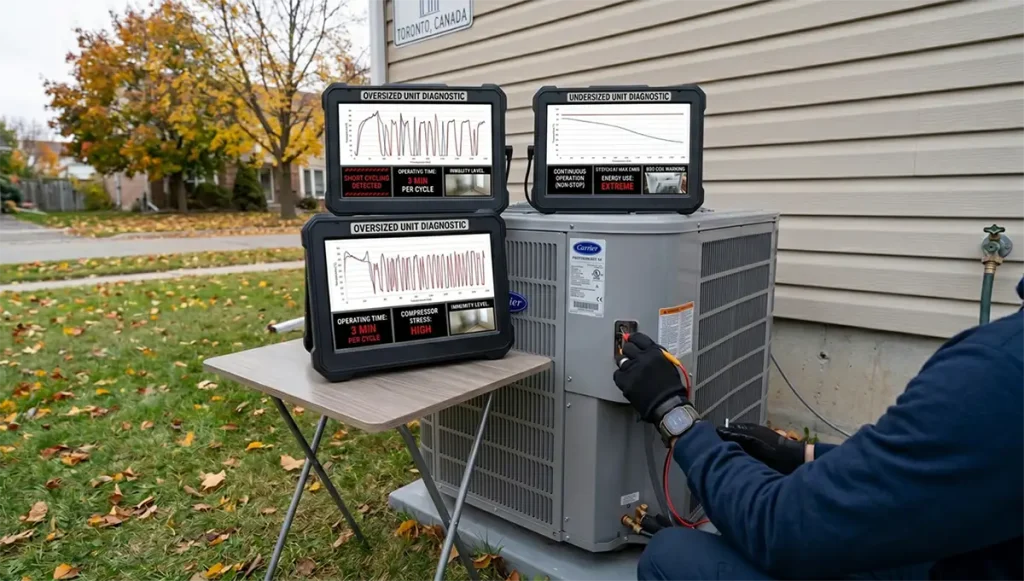
An oversized unit blows past the target temperature, shuts off, and fires back up a few minutes later. That constant start-stop pattern (called short-cycling) puts heavy mechanical stress on the compressor. The comfort side is just as rough: the system never runs long enough to pull humidity out of the air, so the thermostat reads the right number but the house still feels damp and sticky all summer.
There is a financial side to it too. An oversized system never delivers the efficiency rating it was sold on. Those ratings assume the unit runs in a steady state, not in short bursts, so the gap between marketing numbers and real hydro bills can be significant.
The Problem With an Undersized Heat Pump
An undersized unit runs non-stop, trying to hit a temperature it physically can’t reach. The prolonged overload ices up the coil, drives hydro bills up, and shortens the system’s lifespan by years. You feel it the hardest on the coldest days of winter, which is exactly when you need the system to be at its most reliable.
Both scenarios end in the same place: avoidable repair bills and a system that fails long before it should.
The Six Variables That Determine Your Heat Pump Size
Sizing is a layered calculation, not a guess. The numbers a contractor runs are not arbitrary — they come from the six factors below, and every one of them shifts the final load figure for your home.
1. Floor Area and BTU Baseline
Square footage is the starting point, not the answer. Two homes with identical floor plans can land on very different load figures once every other variable on this list is factored in.
2. Local Climate and Design Temperature
Ontario’s climate is not one climate. The design temperatures used for Niagara or Windsor are noticeably milder than those for Sudbury, Barrie, Parry Sound, or North Bay. A system sized for the south end of the province will run undersized in the north.
3. Insulation Quality and Air Sealing
A well-insulated, air-tight home holds heat far more effectively and needs less heating capacity to do it. An older home with poor insulation loses heat fast, and a contractor has to size for the real building envelope rather than the ideal one.
4. Window-to-Wall Ratio and Orientation
Large windows let more heat out in winter and let more solar heat in during summer. South-facing homes pick up considerably more sun than north-facing ones. Both effects push the sizing calculation in opposite directions depending on the season.
5. Ceiling Height and Floor Plan Layout
Higher ceilings mean more air volume to heat or cool. A home with vaulted ceilings carries a noticeably higher load than an open-plan home of the same square footage built with standard eight-foot ceilings.
6. Occupancy Load and Internal Heat Sources
People and appliances generate heat. A house with a basement gym and a busy kitchen creates far more internal heat gain than a comparable one without them. The system size has to account for that, not ignore it.
Why Square Footage Alone Is a Dangerous Rule of Thumb
Relying on square footage alone ignores the features that make every home unique, and that shortcut routinely turns into an expensive mistake.
How Two Identical Homes Can Need Completely Different Systems
Take two 1,800 sq. ft. bungalows side by side: one built in the 1960s, the other built in 2024. The new build has high-performance windows, modern insulation standards, and tight air sealing. The older one has none of that. The footprint matches. The square footage matches. The systems they need do not.
A contractor who quotes both homes the same way is doing neither homeowner any favours.
What to Watch For Before You Sign Any Quote
If a contractor’s quote is based on square footage alone, the real sizing work hasn’t been done. A proper sizing conversation covers insulation, window area, layout, ceiling height, and local design temperature before anyone recommends equipment. If those questions never came up, the number on the quote shouldn’t be trusted.
Manual J Load Calculation: What It Is and Why It’s Non-Negotiable

The industry-standard way to calculate a home’s actual heating and cooling load is the Manual J Load Calculation. It is what every reputable HVAC professional is trained to run, and it is the only result a homeowner should be sizing equipment
What a Manual J Calculation Measures
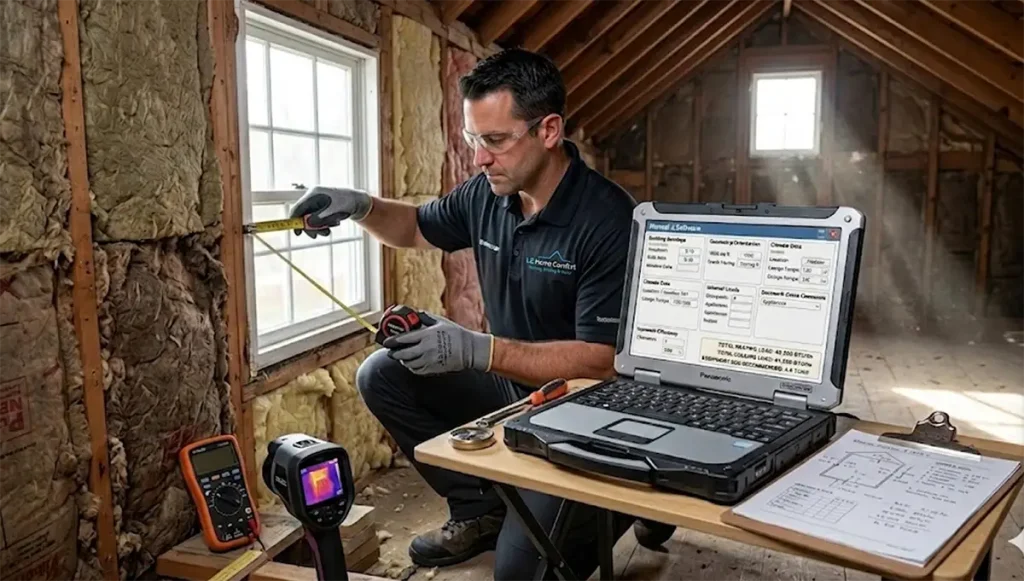
Manual J is the industry-standard method for calculating a home’s exact heating and cooling load. It combines all six variables above (plus local design temperatures, duct losses, air infiltration rates, and solar heat gain coefficients) to produce a specific BTU figure for your house. Not a ballpark. Not a range. A real number your system is engineered to match.
The Right Question to Ask Every HVAC Contractor
Before you sign anything, ask the contractor a single question: “Will you perform a Manual J load calculation on my home before recommending equipment?”
If the answer is no, that contractor isn’t following proper sizing protocol, and you are quietly absorbing all of the risk that comes with that decision. A proper load assessment is a requirement for a compliant installation, and it is what protects your manufacturer’s warranty and rebate eligibility down the line.
How Sizing Affects Your Access to Rebates and Incentives
Incorrect sizing costs more than comfort. Worst of all, the wrong-sized unit can disqualify your installation from the rebate programs you were counting on to make the project affordable in the first place.
Federal and Provincial Rebate Eligibility Requirements
Rebate programs like the Canada Greener Homes Grant and Ontario’s Enbridge HER+ require installed equipment to meet specific capacity and efficiency thresholds. An incorrectly sized unit, even a high-efficiency one, can fail to qualify if it does not meet those program standards. Local utility incentives across many Ontario communities carry similar conditions, so the sizing decision flows directly into the rebate decision.
Why Non-Compliant Sizing Can Cost You More Than Comfort
Install a non-compliant system and you lose two things at once: the upfront rebate money, and the long-term energy savings that were supposed to pay the system off. Accurate sizing is what makes the economics of a heat pump work in the first place.
What Everyday Life Looks Like with a Correctly Sized Heat Pump
When sizing is right, the system more or less disappears into the background. Every room holds a steady temperature with no cold corners or hot spots. The compressor runs longer, quieter cycles instead of starting and stopping all day. Indoor humidity stays balanced through the summer without a separate dehumidifier. And the efficiency the system was sold on finally shows up where it matters: your hydro bills, not just the spec sheet.
Getting Heat Pump Sizing Right Starts with the Right Contractor
A successful installation comes down to choosing a contractor who treats load assessment as a requirement, not an optional extra.
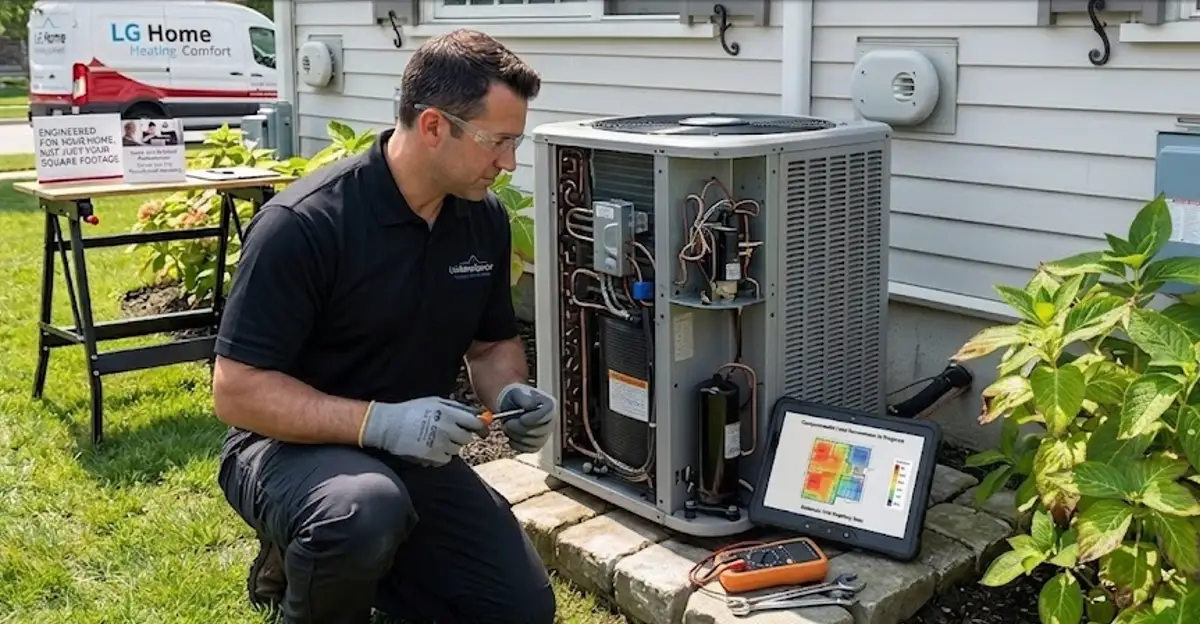
Why LG Home Comfort Assesses Before Recommending
Whether you are in a newer subdivision in Brampton or Oakville, an older home in Hamilton or Kingston, or a community like Guelph, Barrie, or Sudbury, LG Home Comfort runs a full load assessment before recommending any system. The assessment is built around your home’s actual structure, not just its floor plan.
Serving Homeowners Across Ontario
From dense urban neighborhoods to smaller northern communities, the sizing process stays the same, and so does the commitment to getting it right. A correctly sized heat pump is a long-term asset. An incorrectly sized one is a recurring cost. Book a no-pressure in-home load assessment with LG Home Comfort’s TSSA-licensed technicians and find out exactly what your home needs before any equipment is recommended.