
What Are Western Incubators Incubating? China is Building Companies, Canada is Hosting Wellness Workshops
By Chris Pereira
Walk into a “startup incubator” at a major Canadian university and take a look around. What do you see? In the daytime, people mull around well-supplied kitchenettes in the co-working space. Teams meetings abound, as many professors work from home Wednesday-Thursday-Friday (WTF).vAnd in the evenings, white-haired professors give self-aggrandizing speeches and hold “fireside chats”, sharing mind-numbingly boring anecdotes from when they met so-and-so for the first time and cracking stale jokes to stiff laughter. Students glance at the clock, waiting for the food and drinks to come out. Meanwhile, consulting contracts are quietly signed between those same professors and governments eager to demonstrate how much they are doing to support young people through the “startup ecosystem.”A steady stream of workshops and “ideation sessions” fills the academic calendar. They rarely produce an actual product, but they do generate plenty of discussion panels and excellent photos for LinkedIn.
So yes: Western incubators are definitely incubating, just not founders.
At least, that has been my experience over the past decade visiting universities and “incubators” across the West. When I started my current company, I visited many of them as a young entrepreneur. I quickly realized I would not find the business acumen I desperately needed within those decaying ivory halls. In fact, had I followed the advice of many of those organizations, I would almost certainly have failed in business.
What real incubation looks like
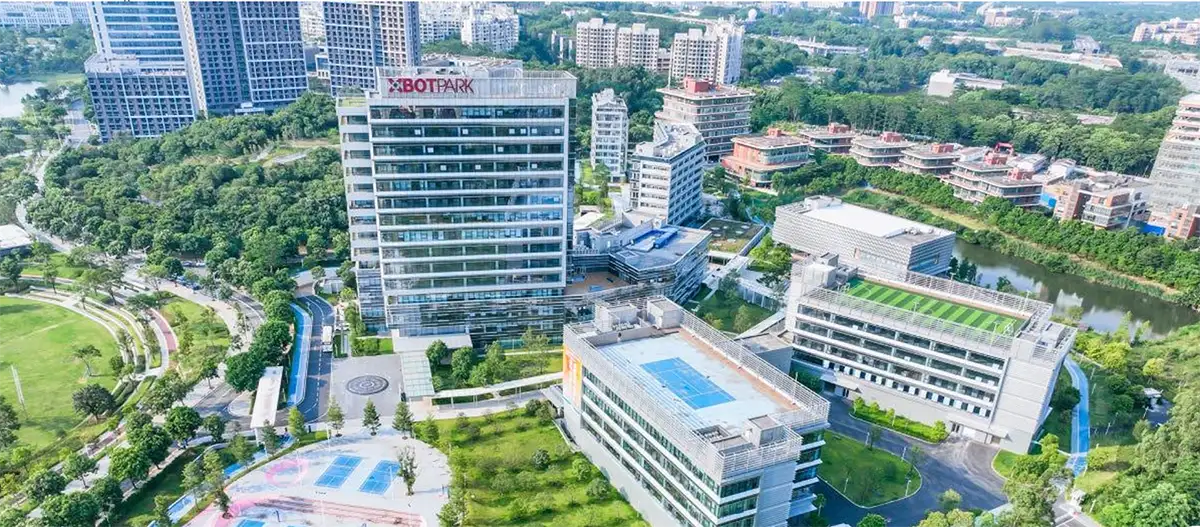
9,000 kilometers away in Shenzhen’s Nanshan District, Li Zexiang (李泽湘) is running a very different kind of operation. The HKUST professor and co-founder of DJI founded 深圳科创学院 (Shenzhen XBotPark) in 2021, but the ecosystem he built stretches back more than three decades. Over that time, it has produced more than 200 hard-technology companies, including 12 unicorns and 4 publicly listed firms. One professor has accomplished this over the course of a single career.
Li’s model immerses undergraduates in hands-on, project-based learning from day one. Students build prototypes on-site and source parts through Shenzhen’s vast supply chain. Iterations of early-stage products line the walls of startup offices throughout the building, documenting the gradual evolution of an idea into a market-ready product. Meetings happen face-to-face. Work happens in person.At XBotPark, one in four startups has the potential to become a national champion. And XBotPark is not alone.
Tsinghua University’s 启迪之星 (TusStar) has operated since 1999 and has established more than 150 incubation bases across China. The organization spans nearly 400,000 square meters of incubation space, has served more than 10,000 enterprises, graduated over 2,000 companies, and helped more than 41 reach public listing.
I experienced this ecosystem firsthand. HKUST’s 蓝海湾孵化港 (Blue Bay Incubator) helped me open my first office in Shenzhen in 2023, proactively connecting me with the resources, contacts, and support I needed to get my company off the ground. I feel embarrassed even attempting to compare this to the output of most Canadian “incubators,” whose failure rates are nearly universal, instead offering wellness workshops and discussions about “the entrepreneurial mindset.”
XBotPark, Shenzhen
The subsidy myth
Western commentators continually explain China’s growth as a function of government subsidies. This framing allows Western institutions to avoid a more uncomfortable question: why do their own programs produce so little? The subsidy narrative is convenient because it shifts attention away from institutional failure. It allows Western policymakers, universities, and economic development organizations to explain away China’s success without confronting why so many of their own initiatives produce so few meaningful outcomes.
Interestingly, and somewhat ironically, the West features far more subsidies than China does, and many of them flow toward established interests rather than people creating new value. The result is a system that often protects incumbents while offering comparatively little support to young people trying to build companies and compete in global markets. In other words: it allows boomers to ride their slow gravy train to retirement.If the West is to regain any semblance of competitiveness, it needs to stop prioritizing subsidies for the old and start helping the next generation gain traction in international markets. Yes, Canada, I’m looking at you.
Canada’s competitiveness crisis
I already gave you a flavour of the Canadian university incubators I visited. Frankly, it’s embarrassing to even try to compare these environments to Chinese equivalents. Even more embarrassing are the excuses that inevitably follow. (“But Chinese people don’t take holidays!” / “But China has no work-life balance” / “But Chinese companies steal intellectual property, which is why they’re getting ahead!” / But… but… but…).
The real driver in China is competition. There is market competition on a scale that Canada’s semi-socialist economy has not seen in decades: competition between individuals, between companies, between districts, between cities, and between provinces, all racing to attract and retain the best projects emerging from these incubators.
The bureaucratic malaise created by ineffective incubators and university department retirees is inflicting real damage on Canada’s global competitiveness. Canada’s venture capital investment as a share of GDP fell from nearly 0.5 percent in 2021 to 0.2 percent in 2024, a decline of more than half in just three years. Leaders Fund analyzed nearly 3,000 venture-backed startups founded by Canadians between 2015 and 2024 and found that by 2024, nearly half of founders who had raised more than $1 million USD were building their companies in the United States. Canada’s share of new high-potential startups collapsed from 4.8 percent in 2018 to 1.5 percent in 2024.
The talent is still there. The ambition is still there. The founders are leaving.
Canada’s competitiveness crisis is growing. Y Combinator quietly removed Canada from its list of accepted countries of incorporation in late 2025, a move that would have required Canadian founders to reincorporate in the United States, the Cayman Islands, or Singapore in order to participate. YC’s own CEO explained why: in the accelerator’s twenty-year history, Canadian startups that reincorporated in the United States achieved roughly twice the average valuation of those that did not, and nearly every company approaching unicorn status had reincorporated in Delaware. The decision was eventually reversed after public backlash, but the underlying conditions remain unchanged.
Boomers… it’s time to stop “helping” the youth
Canadian incubators are preserving boomer retirement plans while sacrificing young Canadians’ entrepreneurial prospects. A 22-year-old founder does not have years to wait. At best, they have a few months of savings, one shot before they have to take the corporate job, and a runway that burns faster than anyone in a tenured position can imagine.
Walk into a Canadian university incubator and that young founder gets office hours with a professor who last built something in 1997, a government grant application with a six-month processing window, and a networking evening with free wine.
Walk into a Chinese incubator and that same 22-year-old entrepreneur gets immediate support from mentors who have actually built companies, have access to capital, have supply-chain connections, business training rooted in their actual sector, and a community of peers running the same race. They work extraordinary hours because they believe the opportunity is worth it.
The difference in outcomes should not surprise anyone.
Canada’s startup failure rate is embarrassingly high. How many boomer retirement plans are failing? Not many. The old are eating the young.
I’m reminded of a line from the writer Lu Xun (鲁迅), who uses the metaphor of cannibals to represent the old feudal order in China: “他们都是吃人的人!” – “They consume people!”
What has to change?
Real incubators get judged by the projects they successfully bring to market.
Everything else: workshops, panels, networking events, fireside chats, LinkedIn posts – is secondary. If founders are not building successful companies, the incubator is failing, regardless of how many people it employs or how many events it hosts. So I’ll ask the same question at the end that I asked at the beginning: walk into your local university incubator and look around.
Who is it actually for?
It is time for the West to start supporting its young people again. They are the future of our societies, our economies, and our competitiveness. Boomers, please stop “helping” the younger generation. They’ll be fine without you. You’ve done enough.
This article has been reprinted with permission from substack.com
Chris Pereira is a Singapore-based entrepreneur, author, and commentator with more than two decades of experience at the intersection of Chinese business and global markets.