Recommended Articles

Is Cyrpto Gambling Legal in Ottawa

5 Reasons to Invest in a Custom LED Neon Sign

Hosting in Ottawa? Skip the Stress. Serve the Standard


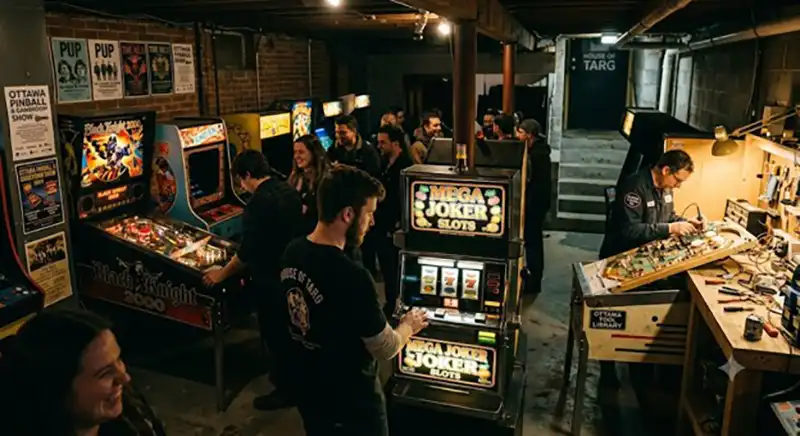
Ottawa’s civic identity usually defaults to federal buildings and technology parks. Scratch the surface and you find something completely alien to the bureaucracy above. Step into the House of TARG on Bank Street. Your nose gets hit immediately with a wall of hot cooking oil from the vegan pierogies, mixed with the sharp scent of ozone and dust baking on fifty-year-old amplifier tubes. This isn’t a retro-themed bar capitalizing on cheap nostalgia. TARG operates as a living museum where a dedicated community actively fights the physical decay of arcade history.
Let’s be real. The financial reality of keeping these machines alive is a black hole. Venue operators practically give away plays at twenty-five cents, relying heavily on live punk rock shows to keep the lights on and the rent paid. Local players are fanatical about this survival. The 2018 tornadoes killed the Ottawa power grid. Nobody at the Ottawa Pinball & Gameroom Show cared. Vendors and collectors just grabbed flashlights. They spent hours dragging 150 dead-weight wooden cabinets across the floor under emergency backup lamps instead of abandoning the exhibition. That level of obsession requires more than just a passing love for 8-bit graphics; it demands serious mechanical and electrical literacy.
The IFPA World Pinball Player Rankings paint a clear picture of this local talent. Competitors like Carter Casselman and Phil Birnbaum do not just mash buttons blindly. Tournament pinball at this level requires an intimate, localized understanding of applied physics. Every single cabinet plays differently because solenoid wear, playfield pitch, and leaf-switch gapping introduce massive physical variance. You have to read the physical decay of the machine just as much as the printed rule card.
Maintenance of 1970s logic circuits requires a specific strain of madness. Electro-mechanical (EM) machines run on terrifying networks of physical relays, score motors, and 120-volt lines. Solid-state (SS) cabinets bring their own unique miseries, mostly involving alkaline battery acid eating through irreplaceable circuit boards. The Ottawa Tool Library (OTL) provides the exact infrastructure needed to combat this relentless decay. Rather than hoarding expensive oscilloscopes and soldering stations in private garages, locals pool their resources here.
Maker House Co. actively funds this space, realizing that hardware hackers need raw materials just as much as traditional woodworkers. Over at the Nepean Centrepointe library branch, the Imagine Space acts as a localized factory for obsolete arcade parts. Hobbyists fire up Epilog laser cutters to fabricate custom acrylics or use 3D printers to replace shattered drop targets that haven’t been manufactured since 1986. A cheap microswitch might be easy to buy off the internet, but an authentic, gold-plated leaf switch delivers the perfect analog actuation needed for complex maneuvers like drop catches. Nobody in this scene accepts cheap knockoffs when it comes to the physical snap under their fingers.
The catch? You need somewhere to actually put these monsters. Ottawa’s aggressive urban densification has brutally collided with the reality of owning a 300-pound Williams pinball cabinet. Neighborhoods like Hintonburg are highly desirable right now, pushing condominium prices toward half a million dollars for spaces hovering well under 900 square feet. A standard commercial machine eats up twenty-five square feet of that premium real estate once you factor in the glass clearance and maintenance access.
Space is only half the battle, though; the acoustics are an absolute nightmare for multi-residential living. Solenoids fire heavy metal plungers at ridiculous speeds, generating a sharp, 78-decibel mechanical snap with every button press. You can throw down interlocking gym tiles and thick rubber pads all you want. The low-frequency structural vibration of a heavy steel ball tearing across a resonant wooden playfield will travel straight down through the load-bearing concrete into your neighbor’s bedroom. A simple reduction in coil voltage ruins the game entirely, leaving players with sluggish flippers completely incapable of making the steep ramp shots the game was designed for.
This acoustic hostility forces a heavy pivot toward digital emulation. The goal here isn’t just a pretty screen; it is the absolute, one-to-one replication of physical kinetics. Open-source engines like Visual Pinball X (VPX) have abandoned basic 2D models for rigorous rigid-body physics. Code contributors actually measure real-world ball trajectories to write scripts that perfectly mimic vulcanized rubber falloff and the exact millisecond delay of copper coil magnetic ramp-ups.
Latency is the immediate enemy here. Push a button. If the digital flipper takes more than 100 milliseconds to fire, your brain rejects the illusion entirely. All your muscle memory becomes useless garbage. Builders brutally force this lag down to nothing by chaining custom Pinscape USB boards directly to high-refresh 144Hz gaming panels. This aggressive hardware brute-forcing drives total lag down to a microscopic four milliseconds.
Builders bypass standard subwoofers entirely and mount haptic exciters directly to the bare interior walls of the wooden cabinet to solve the noise complaints without losing the grit. This Surround Sound Feedback (SSF) system violently tricks your nervous system. The software calculates the exact 3D coordinates of a digital bumper hit and fires a micro-vibration straight into the plywood panel next to your palm. The cabinet physically kicks back, splintering the air with high-frequency energy right under your fingertips, yet that violence miraculously refuses to bleed through the apartment floorboards.
The reality is that some machines were always just mathematical engines wearing a physical disguise. While pinball emulation chases kinetic perfection, the preservation of fruit machines centers entirely on probability models and algorithmic tension. Vintage fruit boxes relied on heavy iron gears and actual metal stoppers to dictate payouts. Modern tech gutted that physical machinery entirely. The modern era replaced steel teeth with invisible Pseudo-Random Number Generators (PRNG). Those spinning graphics you see today? They are just a pretty cartoon layered over a relentless, invisible math equation.
Space constraints make housing these vintage math boxes impossible for most urbanites. Perfect digital replication is the only viable lifeline for arcade purists stuck in tiny Centretown rentals. Developers have managed to extract the exact algorithmic tension of vintage European cabinets, boiling them down to raw code. You can experience the exact volatility and pacing of classic Mega Joker slots without surrendering half your living room to a massive metal box. Games like this preserve the brutal 99% Return to Player (RTP) rate and the dual-grid ‘Supermeter’ logic that defined the original hardware. The psychological loop remains entirely intact, completely divorced from the physical decay of an aging motherboard.
This subculture refuses to let the era die, but they aren’t stupid about how they keep it alive. The technicians spending three days cleaning oxidized relays in a Bank Street basement share the exact same goal as the coders shaving five milliseconds of lag off a virtual controller board. Their singular objective is to rip the soul out of heavy, obsolete metal and find a way to make it fit into the modern urban grid. The hardware will eventually rot, but the math and the physics are going nowhere.
Image: Gemini