Recommended Articles
Belt and Road Initiative: 10 need-to-know facts

Are Tasers Giving Police More Power?

Canada’s 20/20 Vision



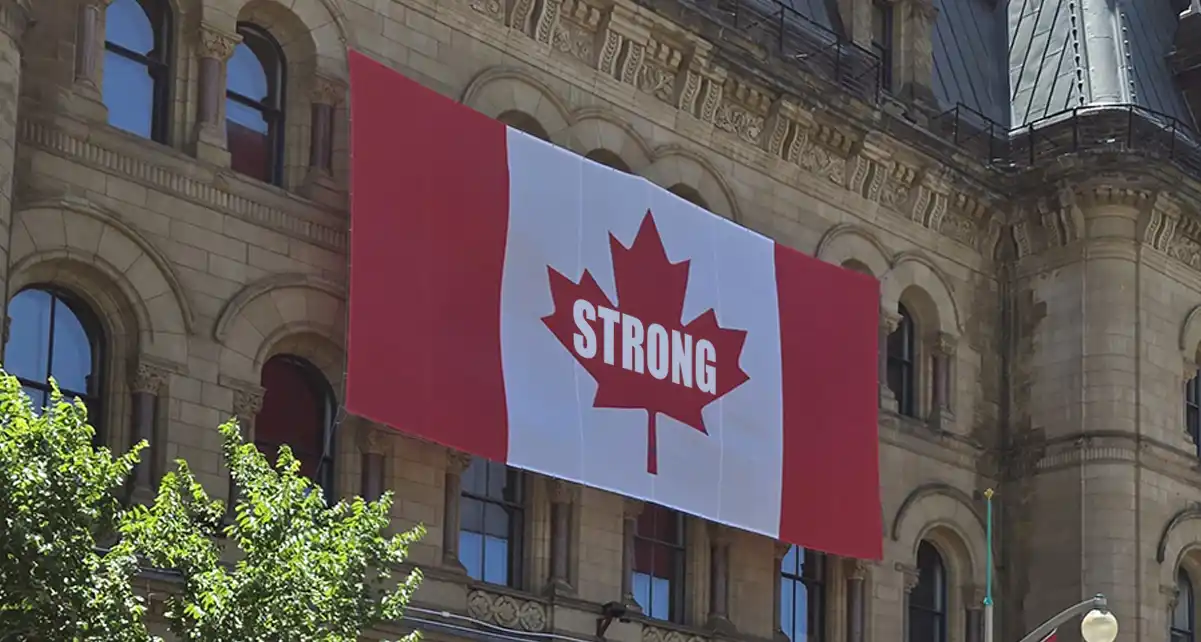
There is something increasingly strange about the way Canada is discussing its deteriorating relationship with the United States. A serious economic and diplomatic dispute has gradually been transformed into something resembling a national morality play, with Donald Trump cast as the villain, Canada cast as the plucky underdog and anyone who asks whether Ottawa might also have made mistakes treated as though they have somehow failed the patriotism test. The reality is considerably more complicated, and if Canadians are serious about protecting this country, we need to start talking about it that way.
Donald Trump is an unusually combative president, and there is plenty to criticize in his approach to Canada. His tariff strategy carries significant economic risks for American businesses and consumers as well as Canadians. His rhetoric has repeatedly been provocative, and his suggestion that Lake Ontario might be renamed “Lake America” is difficult to interpret as anything other than political theatre. Canadians have every right to object. Canada is also perfectly entitled to retaliate against American tariffs and refuse an agreement it believes is contrary to our interests.
But there is an important distinction between defending Canada and convincing ourselves that everything Canada has done is automatically wise simply because Washington is being unreasonable.
The United States is a sovereign country with an elected government, and Americans have the right to determine their own trade policy, just as Canadians have the right to determine ours. That does not make every American tariff sensible, fair or economically beneficial. It does mean, however, that sovereignty cannot be a principle we invoke only when it is convenient. If Canada believes it has the right to make decisions in its own national interest, we should at least acknowledge that the United States possesses the same right.
There is also a much larger Canadian responsibility that cannot be blamed on Donald Trump.
For decades, governments of different political stripes deepened Canada’s economic integration with the United States while allowing our export markets to become extraordinarily concentrated. At the same time, Canada spent years below NATO’s two per cent defence spending benchmark and relied heavily upon the United States within the North American defence relationship, including through NORAD. Canada has now accelerated defence spending and says it has reached the two per cent NATO benchmark, but that does not erase the fact that Canada spent years below it.
The point is not that America is entitled to dictate Canadian policy. The point is that genuine sovereignty requires genuine Canadian capacity. A country cannot spend decades benefiting from continental economic and security integration while leaving a disproportionate share of the military burden to its much larger neighbour and then act surprised when Washington eventually questions the arrangement.
That brings to mind John Turner’s famous warning during the 1988 free trade debate. Turner argued that giving up Canada’s economic levers could ultimately diminish the country’s political independence. During the 1988 debate, he warned that “when the economic levers go, political independence is sure to follow.” Turner was not proven correct about every consequence he predicted. Canada entered into free trade with the United States, NAFTA followed, and the economic relationship expanded enormously. But the underlying question remains worth asking. What happens to a country’s strategic freedom when such a large proportion of its economic prosperity depends upon access to another country’s market?
The answer is found in the numbers, and those numbers should temper some of the triumphalism surrounding Canada’s current negotiating position. According to Statistics Canada, Canadian merchandise exports to the United States represented 71.7 per cent of Canada’s total merchandise exports in 2025, down from 75.9 per cent in 2024. Canada still recorded an $81.6 billion merchandise trade surplus with the United States in 2025. At the same time, Canada’s merchandise trade with countries other than the United States grew significantly, with total non U.S. merchandise trade rising to approximately $553 billion.
The data recently highlighted by journalist Chris George in The Niagara Independent are therefore worth another look. His numbers provide a useful bucket of cold water in a debate that has become increasingly overheated. They remind Canadians of something political rhetoric can obscure: diversification is strategically necessary, but economic geography cannot simply be wished away.
Europe matters enormously to Canada and should matter more. The European Union is Canada’s second-largest trading partner as a bloc, and the Canada-European Union Comprehensive Economic and Trade Agreement provides an important foundation for expanding that relationship. But the combined scale and geographic integration of Canada-United States trade remains in another league.
Europe can become a more important Canadian economic partner. It cannot simply replace the United States overnight. That structural imbalance matters because Canada is not negotiating with an equal sized economy. The United States is vastly larger than Canada, while Canada’s exports to the United States account for an extraordinarily large share of Canadian merchandise exports. Canada has genuine leverage because American companies and consumers depend upon Canadian energy, minerals, agricultural products and industrial inputs. American manufacturers also depend upon deeply integrated Canadian supply chains. But having leverage is not the same thing as possessing equal bargaining power.
Professor Ian Lee of Carleton University has emphasized the importance of understanding that distinction. Canada has bargaining power in sectors where the United States depends upon Canadian supplies, but Canada also has a profound economic interest in maintaining access to the American market. The smart strategy is therefore not surrender. It is to use Canadian leverage intelligently while simultaneously reducing Canada’s vulnerability. This is where the latest collapse in trade talks deserves a much more sober examination.
Prime Minister Mark Carney has said that Washington introduced demands Ottawa considered unacceptable, including demands involving Canadian cultural and linguistic policies. Those are serious allegations. They should therefore be treated seriously. But serious allegations also deserve serious evidence. Canadians have largely been asked to accept Ottawa’s description of what happened without seeing the complete negotiating record behind the competing claims. The United States has disputed Canada’s characterization of the French language issue. U.S. Trade Representative Jamieson Greer said that language issues were discussed but were not a “red line” for Washington. Canadian officials, meanwhile, have said that American demands threatened Canada’s ability to protect French language and culture.
Perhaps the two governments interpreted the same negotiating language differently. Perhaps Washington underestimated the political significance of language policy in Canada. Perhaps Ottawa interpreted an American trade concern more broadly than Washington intended. Or perhaps both governments are presenting the version of events most useful to their domestic audiences. Without greater disclosure, Canadians cannot know with confidence. That is precisely why transparency should not be treated as a partisan principle. It should be a Canadian one.
There is another reason Canadians should be demanding clarity from their government. The Gordie Howe International Bridge episode demonstrated how quickly questions about government communications can become questions about credibility.
The bridge is an enormous Canadian public investment and a critical piece of infrastructure connecting Windsor and Detroit. The Canadian government announced that the bridge would open on July 27, 2026, describing it as a vital economic link between the two countries. The Windsor-Detroit corridor carries approximately 30 per cent of Canada-United States trade by truck, with more than $274 million in trade moving through the gateway each day.
The controversy arose after Carney publicly said that Canada would not share bridge toll revenues with the United States until Canada’s investment had been recovered. Subsequently released documentation regarding the bridge’s financial arrangements contained revenue sharing provisions that did not clearly reflect that condition. That does not establish that Carney deliberately misled Canadians. It does establish that there was enough ambiguity between the Prime Minister’s public description and the wording of the agreement to create a legitimate credibility issue. And that is the point. When a government asks Canadians to trust it in an enormously consequential negotiation, its words need to match the documents. On a multibillion-dollar public asset, clarity should not be optional.
The emotional politics surrounding the trade dispute make this even more important.
Canadians have been told to keep their “elbows up.” Ontario Premier Doug Ford has used extraordinarily blunt language toward Trump, at one point telling him to “kiss my ass.” Manitoba Premier Wab Kinew has also used highly personal rhetoric in criticizing Trump, including references to the Epstein controversy. British Columbia Premier David Eby has encouraged British Columbians to reconsider discretionary travel to the United States and promoted buying Canadian. Politicians are entitled to speak forcefully when Canadian jobs and economic interests are at stake. But Canadians should also recognize the obvious symmetry.
When Trump promotes economic nationalism, we call it protectionism. When Canada promotes economic nationalism, we call it patriotism. When Trump insults Canadian leaders, we call it reckless diplomacy. When a Canadian premier tells the American president to kiss his ass, we call it standing up for Canada. When Washington uses tariffs as leverage, we call it bullying. When Ottawa retaliates with tariffs and encourages Canadians to buy domestic products, we call it economic leverage. Everyone appears to have discovered the same negotiating manual.
Perhaps the better approach would be to put some of the emotion aside and ask which policies actually advance Canadian interests. That is particularly true because Washington appears increasingly frustrated with Canada over issues that extend beyond tariffs. Some of that frustration may be justified, and some may not be. But Canadians should at least understand how our actions can look from Washington.
Consider the extraordinary controversy surrounding CBC’s handling of the September 11 attacks. Last week, CBC came under fire after an internal editorial memo reminded journalists of its longstanding policy of not independently describing specific attacks as “terrorism” without attribution, a policy that was particularly striking because the guidance was reiterated ahead of the 25th anniversary of September 11. The episode is difficult to view in isolation. It comes amid persistent and widely reported criticism of CBC’s coverage of Israel and Jewish people, including allegations of selective framing, misleading reporting and an editorial culture that applies different standards to Israel and its adversaries. Against that backdrop, CBC’s handling of September 11 raises a troubling question: is an ostensibly objective editorial standard being used to create a veneer of neutrality around descriptions that, in ordinary factual language, require no qualification?
CBC subsequently created an exception allowing journalists to describe September 11 as a terrorist attack without attribution. CBC said it had never denied that the attacks were terrorist acts and explained that its broader policy was intended to distinguish factual reporting from labels considered politically or emotionally charged. But that explanation makes the policy more, not less, troubling.
September 11 was a coordinated terrorist attack carried out by al Qaeda in which almost 3,000 people were murdered, including 24 Canadians. The Canadian government recognizes the attacks as terrorism. Calling September 11 a terrorist attack is therefore not a partisan characterization or political judgment. It is an accurate description of an established fact. Why, then, would CBC’s editorial framework require attribution before journalists could state it plainly?
The reasonable concern is not that CBC as an institution supports terrorism, but whether individuals within it are manipulating the presentation of facts to serve an ideological narrative, as has been alleged in other institutions, including UNRWA. If that is happening, Canadians are entitled to ask who is responsible, how these editorial decisions are made and why they are tolerated.
Objectivity does not mean treating every description as equally contestable. Journalism is not made more neutral by refusing to call demonstrable acts what they are. An organized attack deliberately targeting civilians for political purposes can accurately be described as terrorism. When elaborate rules of neutrality instead obscure established facts, particularly in reporting on Israel, Jews, terrorism and the Middle East, it is reasonable to question whether those rules are genuinely neutral or merely editorial discretion presented as objectivity.
The September 11 episode therefore matters beyond the wording of one policy. It illustrates the danger of allowing an institution’s pursuit of neutrality to become a mechanism for avoiding plain facts. That is especially consequential for Canada and its relationship with the United States. The two countries cooperate extensively on intelligence, border security, law enforcement and counterterrorism, and share a fundamental interest in accurately identifying terrorism and condemning the deliberate murder of civilians. It is profoundly unhelpful for Canada’s national public broadcaster to create an avoidable controversy over whether one of the clearest terrorist attacks in modern history can simply be called terrorism.
CBC eventually changed its guidance, and the Canadian government has made clear that September 11 was a terrorist attack. But the episode should not disappear simply because the policy was corrected. The larger issue is credibility.
A public broadcaster’s authority depends on the public believing that its editorial standards are genuinely neutral, consistently applied and grounded in facts. If those standards appear to minimize or obscure the actions of one side while applying harsher descriptions to another, Canadians are entitled to question whether the standard is actually objective.
That question is particularly important because CBC is publicly funded and enjoys the explicit political support of Mark Carney, whose government has committed to increasing its funding. Supporting public broadcasting is a legitimate policy choice. But public funding should increase the expectation of accountability, sound editorial judgment and credibility, not diminish it.
The issue is not whether CBC has the right to establish editorial standards. It does. The issue is whether those standards consistently serve the truth. When an institution’s definition of objectivity requires journalists to qualify the description of an obvious terrorist atrocity, Canadians are entitled to ask whether objectivity is still serving the truth or has become a mechanism for avoiding it.
The same intellectual honesty should apply to the Lake Ontario controversy.
Trump’s suggestion that Lake Ontario could be renamed “Lake America” is both provocative and childish. It does not change the name used by Canada or international authorities. But the Canadian outrage becomes somewhat stained when we remember that Canada itself has repeatedly changed names for streets, institutions and public spaces as historical and cultural attitudes have evolved.
Trutch Street in Vancouver became šxʷməθkʷəy̓əmasəm Street. The Sir John A. Macdonald Parkway in Ottawa became Kichi Zībī Mīkan. Yonge Dundas Square became Sankofa Square. Ryerson University became Toronto Metropolitan University. Winnipeg’s Bishop Grandin Boulevard became Abinojii Mikanah. Amherst Street in Montreal became Atateken Street. There are legitimate historical and cultural reasons behind many of those Canadian changes, and that is not an argument against them. It is simply a reminder that Canada does not possess a monopoly on the idea that governments can change names.
If we believe our own renamings can be legitimate expressions of sovereignty and cultural identity, we should understand why Americans can do something similar within their own jurisdiction, even when we find their choice ridiculous. What is good for the goose is good for the gander. The most serious question, however, is what Canada does next.
Ottawa has imposed retaliatory tariffs against American goods and announced billions of dollars in measures intended to support workers and businesses affected by the dispute. The United States has imposed tariffs on Canadian goods, while Canada has announced retaliatory measures against American imports. Canada has also announced a $7.5 billion support package for affected workers and businesses.
The United States will feel pain as well. American manufacturers rely upon Canadian inputs, and American consumers can ultimately bear some of the cost of tariffs. Trump’s strategy therefore carries substantial economic risks for the United States.
The difference is that Canada’s exposure is greater. That is why the government’s response needs to be measured by outcomes rather than rhetoric. If Canada can use its leverage to obtain better terms, protect critical industries and encourage genuine diversification, Ottawa deserves credit. If the result is simply higher costs, reduced investment and a permanent deterioration in the relationship with our largest trading partner, Canadians will eventually have to ask whether the strategy worked. That is also why the decision not to recall Parliament deserves scrutiny.
Prime Minister Carney has described the current rupture with the United States as a profound challenge to Canada’s economic future. His government is talking about dramatically reducing Canada’s dependence upon the American market and building new relationships abroad. If that is genuinely the scale of the challenge, Canadians have a reasonable argument for wanting Parliament sitting so the government can explain its strategy and opposition parties can challenge it.
There is nothing wrong with Carney travelling to Europe. Strengthening Canada’s relationship with Europe is precisely the kind of diversification Canada should pursue. But there is something symbolically awkward about the prime minister preparing to address the European Parliament while Canada’s own Parliament is not sitting during what the government itself portrays as a major economic and geopolitical challenge. A parliamentary recall would not necessarily change government policy. It would simply provide a forum where the government could defend its decisions, opposition parties could challenge them, and Canadians could hear the evidence. That is what Parliament is supposed to do.
Canada has genuine strengths. We possess enormous energy resources, critical minerals, agricultural capacity, advanced manufacturing expertise, access to three oceans and an exceptionally valuable geographic position beside the world’s largest economy. The problem is that we have not always converted those advantages into the productivity, infrastructure, investment and military capacity required to turn them into strategic power. That is the work now.
Canada needs faster approvals for major projects. It needs to eliminate internal trade barriers. It needs to make investment easier rather than harder. It needs to expand ports, electricity infrastructure and transportation capacity. It needs to deepen relationships with Europe and Asia. It needs to strengthen defence and continental security. Most importantly, it needs to make Canada a country where capital wants to stay and where businesses want to grow. None of that requires Canadians to become pro Trump. It requires Canadians to become pro Canada. There is a profound difference.
The easiest political story is that Donald Trump is the problem and Canada is the victim. The harder story is that Trump is a serious challenge, but he is also exposing vulnerabilities that Canada has allowed to accumulate for decades. That story is less satisfying because it does not give us someone else to blame. But it may be the story Canada actually needs.
We can oppose Trump’s tariffs without pretending Canada has unlimited bargaining power. We can defend Canadian sovereignty without confusing outrage with strategy. We can criticize American policy without demonizing Americans. We can support Carney’s decision to negotiate hard while demanding that his government show Canadians the evidence behind its claims. We can support CBC while expecting considerably better judgment from a public broadcaster. We can diversify trade without pretending Europe can replace America overnight. We can put our elbows up without taking our hands off the steering wheel.
Because when the cameras disappear, the slogans fade and the politicians move on to the next crisis, the Canadian worker cannot pay the mortgage with patriotism, the Canadian manufacturer cannot invest with applause, and the Canadian economy cannot build its future on emotion. Canada does not need to win an argument with America. Canada needs to become strong enough that it does not have to depend upon winning one.