
Vietnam-Canada: From Partnership to a New Era of Investment and Growth
As Vietnam reshapes its economy around higher-quality investment, technology, innovation and global capital, new opportunities are emerging for Canadian businesses looking to deepen their presence in one of Southeast Asia’s most dynamic markets.
The global economy is being reshaped by profound shifts in trade, supply chains, technology, energy and capital flows. Increasingly, the strength of economic relationships is measured not only by how much countries trade, but by their ability to create new sources of growth together.
For Vietnam and Canada, this is a timely opportunity.
The two countries have the potential to move beyond a relationship driven primarily by trade and the exchange of goods toward a deeper partnership encompassing investment, technology, finance, energy, innovation and global value chains.
Vietnam and Canada established diplomatic relations in 1973 and elevated their ties to a Comprehensive Partnership in 2017. More than half a century later, economic, trade and investment cooperation has become an increasingly important pillar of the bilateral relationship.
Canada identifies Vietnam as its largest trading partner in Southeast Asia and an important economic partner under its Indo-Pacific Strategy. The Government of Canada also views Vietnam as a dynamic economy committed to rules-based trade and sustainable development — making it a natural partner in Canada’s efforts to diversify its trade relationships.
The Comprehensive and Progressive Agreement for Trans-Pacific Partnership, or CPTPP, provides another important platform. Canada sees the agreement as a gateway for its businesses to some of the Indo-Pacific’s most dynamic economies, while Vietnam is serving as Chair of the CPTPP Commission in 2026.
What makes the current moment particularly significant, however, is not simply what has already been achieved.
Vietnam itself is changing.
From Attracting Capital to Building a Modern Investment Ecosystem
Foreign investment has been a major driver of Vietnam’s industrialization and international economic integration for decades.
But the country’s development priorities are evolving.
Vietnam no longer needs capital alone. It increasingly needs technology, knowledge, management expertise, research and development capacity, a highly skilled workforce and stronger connections with international value chains.
This shift is reflected in Resolution No. 10-NQ/TW, issued by the Politburo on June 8, 2026, on the development of the foreign-invested economy.
The Resolution marks a move away from an approach centred primarily on attracting capital toward the development of a broader foreign-investment ecosystem — connecting foreign direct investment, indirect investment, capital markets, international financial centres and new economic development spaces.
Quality and effectiveness of investment, technology transfer, innovation, value added and stronger linkages with Vietnamese companies are all being given greater priority.
By 2030, Vietnam aims to attract approximately US$200–300 billion in registered FDI, with realized investment reaching US$150–200 billion. At the same time, it is seeking a larger share of investment from economies with strong capabilities in technology, capital and modern management.
For Canadian investors, the message is important.
Vietnam is looking for investors that can create long-term value, not simply provide capital.
Companies with advanced technologies, research capacity, high governance standards, the ability to train skilled workers, use green energy and build links with Vietnamese businesses are particularly well aligned with Vietnam’s new investment priorities.
That alignment is significant given Canada’s strengths in technology, energy, mining, agriculture, finance, education and innovation.
A More Favourable and Predictable Business Environment
Vietnam is also accelerating institutional reforms, simplifying administrative procedures and seeking to improve the transparency and stability of its business environment.
Major policy directions introduced during 2025–2026 in law-making and enforcement, private-sector development, science and technology, digital transformation and international integration are forming an increasingly connected reform agenda.
The objective is not simply to offer businesses more incentives.
It is to make doing business easier, more predictable and less costly in terms of regulatory compliance.
That matters particularly to long-term Canadian investors.
Large-scale projects require an environment in which investors can reasonably understand legal procedures, their rights and obligations, expected timelines and the mechanisms available for resolving problems that arise.
Vietnam is moving toward greater decentralization and digitalization, fewer unnecessary procedures, a shift from ex-ante controls to ex-post supervision, and stronger accountability among implementing authorities.
The domestic private sector is also being positioned as an important engine of growth.
For foreign investors, a stronger Vietnamese private sector means more potential partners for joint ventures, technology cooperation, supply chain development, and regional expansion.
Vietnam’s Capital Market Opens Another Door
Foreign investment in Vietnam has traditionally been associated with factories, production facilities and conventional FDI projects.
That landscape is now expanding.
One of the most important developments is the continued modernization and upgrading of Vietnam’s stock market.
Following years of reforms to the legal framework, trading and settlement infrastructure, information disclosure, corporate governance and market access for foreign investors, FTSE Russell has confirmed that Vietnam will be upgraded from Frontier Market to Secondary Emerging Market status.
The significance goes beyond the classification itself.
Emerging-market status can draw greater attention from international investment funds, asset managers and index-tracking institutional investors.
More importantly, the upgrade reflects reforms aimed at improving market accessibility, transparency and the operating infrastructure of Vietnam’s capital markets.
For Canadian investors, that creates an additional channel for participating in Vietnam’s growth.
Canadian investment funds, asset managers and financial institutions can potentially gain exposure through equities, bonds, investment funds and other capital-market products, in addition to conventional direct investment.
A deeper capital market can also give Canadian companies already operating in Vietnam more options to raise capital, expand and develop long-term financial structures.
Resolution No. 10-NQ/TW reinforces this approach by placing direct investment, indirect investment and capital markets within the same foreign-investment ecosystem.
Vietnam is gradually moving from simply “attracting capital into projects” toward building a broader system in which international capital can enter, circulate and be allocated more efficiently across the economy.
For global financial investors, that is a significant structural change.
International Financial Centres: A New Area of Opportunity
Another major step is the establishment of an International Financial Centre in Vietnam.
The National Assembly adopted Resolution No. 222/2025/QH15 on the International Financial Centre, effective September 1, 2025.
The Centre is being developed in Ho Chi Minh City and Da Nang, with the two locations designed to complement one another while building on their respective strengths.
The International Financial Centre in Ho Chi Minh City officially launched in February 2026, while Da Nang has also inaugurated its local International Financial Centre.
The objective is much broader than creating another financial district.
Vietnam aims to build a financial ecosystem that connects domestic and international capital with the development needs of the economy, while creating room for new financial products, green finance, Fintech, digital assets and modern financial models.
A development plan through 2035, approved in July 2026, aims to make the International Financial Centre an important platform for mobilizing, allocating and efficiently using domestic and international financial resources while strengthening Vietnam’s place in regional and global financial networks.
Vietnam is also developing a dedicated legal framework for activities within the Centre. The National Assembly has adopted the Law on the Specialized Court at the International Financial Centre, effective January 1, 2026, aimed at creating a dispute-resolution mechanism better suited to international financial activities and international practices.
For Canadian financial institutions, investment funds and businesses, these developments create a notable new area for cooperation.
Canada has strong capabilities in banking, asset management, insurance, capital markets, green finance and professional services.
Vietnam needs precisely these types of financial resources and expertise to support infrastructure, energy, technology and green-growth projects.
The International Financial Centre in Ho Chi Minh City is also being positioned as a hub connecting international green capital with sustainable-development projects, consistent with Vietnam’s goal of achieving net-zero emissions by 2050.
This is one area where Canadian strengths and Vietnamese development needs could prove particularly complementary.
Where Canada and Vietnam Can Build Together
The opportunities extend across several sectors.
In energy and the green transition, Vietnam needs capital, technology and experience to develop a modern energy system, while Canada has capabilities in energy, liquefied natural gas, clean technology and green finance.
In critical minerals, Vietnam has resource potential and growing demand in processing industries, while Canada brings experience in mining, technology, environmental governance, and supply chain development.
In technology and innovation, Vietnam is advancing artificial intelligence, digital transformation and high technology. Canada has a strong foundation in research, education, technology and highly skilled talent.
In agriculture and food, Canadian technology, equipment and expertise can complement Vietnam’s production capacity, processing industries and market.
In finance, the upgrading of Vietnam’s stock market and the development of the International Financial Centre create new opportunities for Canadian banks, asset managers, investment funds, Fintech companies and other financial institutions.
And in infrastructure and logistics, Vietnam’s continuing urbanization, industrialization and trade expansion are creating demand for transportation, ports, warehousing, digital infrastructure and modern management solutions.
What these sectors have in common is that they need more than capital.
They need capital combined with technology, knowledge, standards, management expertise and international connectivity.
That is where Canada’s strengths can meet Vietnam’s development needs.
From “Investing in Vietnam” to “Growing with Vietnam”
A new chapter in Vietnam–Canada economic relations can be built on a deeper model of partnership.
Vietnam is no longer simply looking for investors that bring capital to individual projects.
Under its new approach to the foreign-invested economy, it is seeking partners that can help strengthen the capacity of the economy itself.
That is why Resolution No. 10-NQ/TW places particular emphasis on technology, innovation, technology transfer, workforce development and linkages with domestic enterprises.
This approach aligns closely with what many Canadian businesses can offer.
Canada can bring capital, technology, research capacity, management expertise, international standards and experience in sustainable development.
Vietnam brings a growing market, a capable workforce, manufacturing capacity, a strategic position within ASEAN and the CPTPP, and a rapidly expanding economy.
When these strengths come together, the value created can be far greater than that of any single investment project.
Canadian and Vietnamese companies can jointly develop new products and technologies, build supply chains, train skilled workers and expand into regional markets.
A Timely Moment for a Deeper Partnership
Several important trends are now converging.
Vietnam is reforming its institutions and improving its business environment. Its private sector is being given greater room to grow. FDI policy is shifting toward higher-quality capital.
Vietnam’s stock market is set to move to Secondary Emerging Market status from September 2026. International Financial Centres are being developed in Ho Chi Minh City and Da Nang. The country is also continuing to advance technology, innovation, the green transition and international integration.
Canada, meanwhile, is pursuing greater trade and investment diversification under its Indo-Pacific Strategy, with Vietnam identified as an important economic partner.
Canada is also negotiating a free trade agreement with ASEAN, creating additional prospects for economic connectivity with a region in which Vietnam is an active member.
Vietnam is opening its doors not only to direct investment, but also to international financial capital, technology and knowledge.
Canada is looking for reliable partners in a region whose economic weight and growth continue to rise.
Those two trends are increasingly converging in Vietnam.
This is an opportunity for Vietnam–Canada relations to evolve from a dynamic trading relationship into a deeper investment and development partnership — one in which the capital, technology, markets and knowledge of both countries can combine to create new value.
Through the reforms now underway, Vietnam is seeking a broader role in the regional economy: not only as a manufacturing base, but also as a place where capital can be mobilized and allocated, technology developed, innovation advanced and international value chains connected.
For Canada, Vietnam can become an increasingly important partner in Southeast Asia.
From “Investing in Vietnam” to “Growing with Vietnam” — that may be the defining message for the next chapter of Vietnam–Canada economic relations.
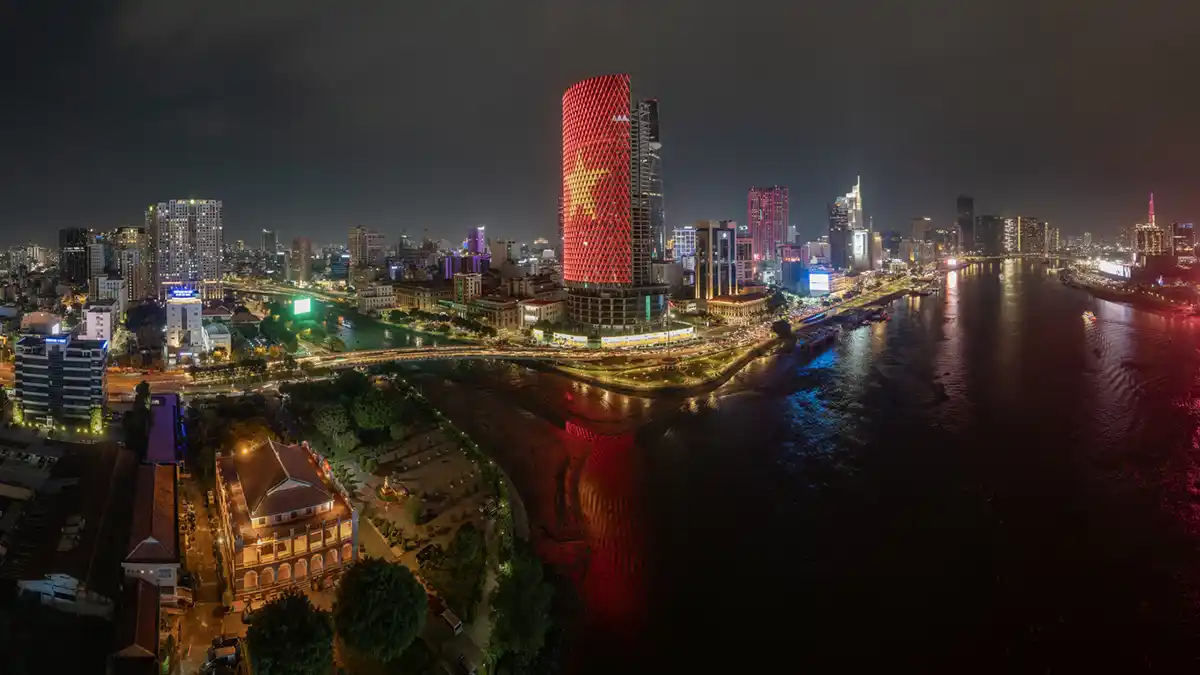
Header image: Night view of Ho Chi Minh City skyline and the Saigon River, Vietnam (Son Truong, iStock)