Carney’s Canada: Parliament Returns as the Economic Promise Meets Reality
Eighteen months into Mark Carney’s government, the Prime Minister has put an extraordinarily ambitious economic plan on the table. As Parliament returns, the harder question is whether his government can turn its promises, targets and projections into measurable results.
Parliament returns to Ottawa today, and with it comes the moment when Mark Carney’s economic agenda begins to face a different kind of scrutiny. For much of the past year and a half, the prime minister has had the luxury of setting the agenda from podiums, investment conferences, international summits and meetings with foreign leaders. He has travelled, negotiated, announced new partnerships and promised to make Canada a country that builds again. Now the House of Commons is back, a fall economic agenda is taking shape, and the government is preparing legislation intended to accelerate major projects. The political arguments will be loud, as they always are, but underneath them lies a more consequential question: can the machinery of the Canadian government actually execute the ambitious program Carney has designed?
That is the question worth asking because Carney did not enter office promising incremental change. He arrived with an unusually strong economic résumé and a political proposition built around numbers, investment and execution. His government would increase productivity, attract capital, restrain government spending, accelerate housing construction, diversify trade, expand defence production and build infrastructure on a scale Canada has not seen in generations. In November 2025, he put the philosophy bluntly: “We will spend less to invest more.” He promised to limit the growth of direct program spending to 0.5 per cent annually over five years, reduce the federal public service by 10 per cent, balance the operating deficit within three years and catalyse more than $1 trillion in total investment over five years. He also promised to double the pace of affordable housing construction over the coming decade.
Those are enormous ambitions. They are also precisely the kind of promises that require a government to be judged not by the elegance of the announcement but by what eventually appears on the ground.
Carney became prime minister on March 14, 2025. Eighteen months is not long enough to determine the ultimate success or failure of a program designed to reshape the Canadian economy over five or ten years. Some of his major initiatives are still in their early stages. But eighteen months is long enough to examine the direction of the numbers, identify where the government’s claims are supported by evidence, identify where they are not, and, perhaps most importantly, ask whether the federal government has the capacity to deliver what the prime minister says he wants to build.
That last issue has become increasingly difficult to ignore.
Carney’s central economic diagnosis is that Canada suffers from a productivity problem, and on that point the evidence is difficult to dispute. The OECD has noted that Canada’s GDP per capita growth has slowed dramatically, falling from more than 2.5 per cent annually in the late 1990s to close to zero between 2019 and 2023. Productivity is therefore not an abstract economic statistic. It is one of the principal reasons Canadians can work harder without necessarily becoming materially more prosperous.
The recent numbers, however, are more encouraging than some of Carney’s critics suggest. Business sector labour productivity increased 0.6 per cent in 2024 and another 1.1 per cent in 2025. Productivity then fell 0.4 per cent in the first quarter of 2026 before increasing 1.0 per cent in the second quarter, its largest quarterly increase since the extraordinary pandemic-related increase in the second quarter of 2020. Second quarter productivity was 1.2 per cent higher than a year earlier, although unit labour costs were also up 3.2 per cent year over year. The numbers suggest improvement, but one or two strong quarters do not establish that Canada has solved a structural problem that has developed over decades.
The investment story is similarly more complicated than the political rhetoric would suggest. Business investment increased 0.3 per cent in 2025, although machinery and equipment investment declined 3.5 per cent. Business capital investment then fell 0.7 per cent in the first quarter of 2026 before strengthening in the second quarter. Engineering structures increased 2.3 per cent and machinery and equipment spending reached its highest level since the second quarter of 2024. Investment in computers and computer peripherals jumped 16.7 per cent, driven in part by data centre investment.
This is not an investment collapse. Nor is it yet the investment transformation Carney is promising. That distinction matters because the government’s $1 trillion figure is a target, not $1 trillion that has already been invested. At the Canada Investment Summit last week, Carney expanded the government’s tax incentives and introduced what it calls the Productivity Mega Deduction. The government says approximately $280 billion in federal capital investments and incentives over five years are expected to enable more than $1 trillion in total public, private and institutional investment. The new measures will broaden immediate spending to cover more than 65 per cent of eligible assets and are expected to reduce Canada’s marginal effective tax rate on new business investment to 6.4 per cent. Those are substantial policy changes. They are also mechanisms intended to produce future investment, not evidence that the projected investment has already occurred.
The distinction between a target and an outcome has become one of the central issues in assessing Carney’s government. A projected investment is not an investment already made. A tax incentive is not a factory. A government agency is not a completed project. A forecast of higher GDP is not higher GDP. For a prime minister whose public reputation rests heavily on the credibility of economic numbers, that distinction should be particularly important.
The foreign investment numbers provide another useful corrective to the political debate. Claims that foreign investors are simply abandoning Canada are not supported by the latest Statistics Canada data. Foreign direct investment in Canada reached $96.8 billion in 2025, the highest level since 2007. More than half originated in the United States. Global Affairs Canada, using a different methodology, put the 2025 figure at approximately $93 billion. Either way, the evidence does not support the proposition that foreign capital is fleeing Canada.
But there is a larger question about investment that Ottawa should not avoid simply because the headline numbers are impressive. Foreign capital is useful. Canada needs it. But the size of an investment does not, by itself, tell us whether the investment strengthens Canada’s productive capacity, who controls the resulting assets, where the profits ultimately flow, or whether the project creates long-term strategic value for the country.
The Canada Investment Summit demonstrated that global investors are interested in Canada and that enormous pools of international capital are looking for opportunities here. That is important. But attracting capital and building national economic capacity are not necessarily the same thing. A foreign company acquiring a controlling interest in a Canadian asset can increase the foreign investment number while simultaneously changing who owns the asset, who makes the strategic decisions and who receives the long term return. Canada should welcome foreign capital, but the quality, ownership and productive consequences of that capital matter at least as much as the size of the cheque.
The government’s relationship with the United States also needs to be understood in that context. Carney’s effort to diversify Canadian trade should not be confused with abandoning the American market. The United States remains Canada’s overwhelmingly important economic partner, even after the changes brought about by tariffs and the deterioration in the bilateral trading environment. Carney himself has acknowledged that the relationship remains deeply integrated. His argument is essentially that Canada cannot afford to depend on a single market when access to that market has become less predictable.
That is why the government’s pursuit of European and other international markets is better understood as diversification than as a strategic divorce from the United States. Canada can pursue new markets while maintaining the deepest possible relationship with its largest trading partner. The real test will be whether diversification produces actual Canadian exports, investment and productive capacity rather than simply a series of diplomatic announcements.
Which brings us back to execution.
Carney has created or strengthened a series of institutions intended to make the government move faster. The Major Projects Office is supposed to accelerate major infrastructure and resource projects. Build Canada Homes is intended to increase housing supply. The Defence Investment Agency was created to improve the speed and effectiveness of defence procurement. Invest in Canada is supposed to attract international investment. The government has also proposed a new framework built around the principle of “one project, one review, one year.”
The philosophy sounds good. Canada has spent too long discussing what it should build and too little time actually building it. But creating new institutions does not automatically solve the institutional problems that prevented the old ones from moving quickly in the first place.
The most revealing example may be Doug Guzman, the banker Carney brought in to lead the new Defence Investment Agency. Guzman left his senior position at RBC to take on the job and was tasked with helping dismantle the complicated structure through which defence procurement moves between federal departments, each with its own rules, approvals and institutional interests. Reporting in September said Guzman was preparing to leave after becoming frustrated with the slow pace of federal bureaucracy. The government itself had described the agency as a way to streamline procurement, cut red tape and speed delivery.
Guzman’s departure should not be reduced to a personnel story or treated as proof that the government’s defence strategy is inherently wrong. The more important question is what it reveals about the way Carney’s government is attempting to reform the federal state.
Bringing in outsiders to fix structural inertia in Canada’s bureaucracy is, in principle, a smart idea. Ottawa desperately needs people with fresh perspective, real operational experience and the temperament to push through MAD — the federal art form known as Maximum Administrative Delay. Those people exist. They are strategic, relentless, allergic to failure and focused on results rather than rituals. Michael Sabia is one of them. He has run major institutions, reshaped cultures and delivered outcomes in environments where accountability is real and excuses are not accepted. That is the profile you need if you expect someone to bend Ottawa’s machinery into motion.
The mistake is assuming that anyone with a private‑sector résumé automatically fits that description. Guzmán came out of consulting and Canada’s banking oligopoly — a sector that looks like a business but behaves more like a protected utility. The big banks don’t compete in any meaningful way, they don’t fight for market share, and they don’t innovate because they don’t have to. When your margins are guaranteed and your customers have nowhere else to go, efficiency becomes optional and urgency is a foreign concept. It’s a world built on strategy decks, not operational leadership. Guzmán had never run a major organization, never been responsible for delivering results inside a complex institution and never had to fight inertia at scale.
Dropping someone with that background into a process‑laden civil service produced exactly what Ottawa produces when the wrong outsider is chosen. The bureaucracy absorbed the newcomer, buried them in process and spit them out as if nothing had happened. PM Carney’s agenda won’t fail because it’s ambitious. It will fail if he cannot find the rare outsiders who can actually force the system to move. In Ottawa, ideas are cheap. Execution is everything.
Carney needs people who can execute — people who can move projects from announcement to contract, from contract to construction, and from construction to productive operation. But he also needs to give those people enough authority to change the systems that prevent execution. A new title, a new office and a new mandate mean little if the person responsible for delivery still has to navigate the same layers of approval that caused the original problem.
This matters because Carney’s economic strategy depends on the government becoming an accelerator rather than another source of delay. The prime minister can announce a major project office, a defence agency, a housing corporation and a new investment regime, but if each institution must operate through the same bureaucratic culture, the government risks creating new layers around old problems. The machinery won’t move unless the people running it have both the skill and the power to break through MAD — and unless Carney is willing to let them.
The housing market offers perhaps the clearest example of the difference between headline numbers and actual outcomes.
There is evidence that some things are moving in the right direction. National rent prices fell to an average of $2,035 in August 2026, down 4.8 per cent from a year earlier and 7 per cent from two years earlier. In Ottawa, the average rent was $2,168, down 1.6 per cent from a year earlier, although it increased 1.1 per cent from July. The rental market has therefore softened significantly from its peak.
Housing construction also increased in 2025, with total starts rising 6 per cent. But the composition of those starts matters. Much of the increase was driven by rental apartments and missing middle housing, while ownership construction remained weak, condominium presales collapsed and unsold inventories increased.
That is where the political argument has become sharper.
Conservative Leader Pierre Poilievre and his party have repeatedly argued that the government’s housing numbers obscure a deeper weakness in construction intended for ownership. In Parliament and in public statements, Conservatives have pointed to falling starts and to the declining share of new construction intended for ownership. Those are political arguments and should be distinguished from the underlying construction data. But the underlying data themselves are serious enough without political embellishment. CMHC reported that actual housing starts in centres with populations above 10,000 fell 19 per cent year over year in July 2026, while year-to-date starts were down 4 per cent from the same period in 2025.
The August numbers cited by the Conservatives point in the same general direction, with the party’s housing critic reporting that starts during the first eight months of 2026 were down almost 4 per cent compared with the same period in 2025. That statement is partisan and should be treated as such, but it is based on CMHC data. The larger point is that both sides can find numbers to support their preferred political narrative because the housing market is genuinely mixed. Rents are falling. Rental construction has been strong. Yet the ownership market is under considerable pressure, and CMHC continues to say Canada is building below the pace required to restore affordability to 2019 levels.
That means Carney can legitimately point to improvements in rental affordability while still facing a serious problem in homeownership. For millions of Canadians, that distinction is not academic. A country can add thousands of rental units and still leave an entire generation wondering whether it will ever be able to buy a home.
The government’s housing challenge is therefore not simply to build more units. It is to build enough of the right kinds of units, in the right places and at prices that correspond to the incomes of the people who need them. That requires land, infrastructure, financing, construction capacity and municipal cooperation. It also requires the federal government to understand where its own rules are adding costs and delays.
Again, execution.
The same issue appears in the fiscal numbers. Carney promised to reduce the growth of direct program spending to 0.5 per cent annually, reduce the public service by 10 per cent and balance the operating deficit within three years. There has been movement on the size of the federal bureaucracy. The public service fell from 367,772 employees in 2024 to 357,965 in 2025, a reduction of approximately 9,800 people, with the government targeting approximately 330,000 employees by 2028-29.
That is measurable progress toward a stated target. But the fiscal picture remains more complicated. Program expenses in 2024-25 were $489.9 billion, an increase of 5 per cent, while public debt charges rose 13 per cent to $53.4 billion. The government’s own projections have debt charges rising to approximately $55.6 billion in 2025-26 and $60 billion in 2026-27.
The significance of those numbers is not ideological. Interest costs are simply a claim on future government revenues. They do not build a bridge, increase productivity or create a new business. They service the debt accumulated by previous governments.
Carney has promised to change that trajectory. The question is whether the fiscal numbers over the next several years demonstrate that he has done so.
Economic growth provides another reason for caution about both triumphalism and pessimism. Canada’s real GDP grew 1.7 per cent in 2025, the slowest annual growth since 2020. GDP contracted 0.2 per cent in the fourth quarter. Growth in the first quarter of 2026 was subsequently revised to 0.1 per cent, followed by growth of 0.8 per cent in the second quarter.
The employment picture is similarly mixed. Canada had approximately 21.17 million people employed in August 2026, while the unemployment rate stood at 6.4 per cent and employment fell 0.2 per cent from July. This is not an economic boom. But neither does the data support a description of economic collapse. The more important issue is what happens to Canadians on a per-person basis. GDP can grow while the population grows faster. Employment can increase while productivity stagnates. Investment can rise while ownership of productive assets shifts elsewhere. A country can attract billions of dollars in capital without generating the kind of productivity gains required to raise real living standards. That is why GDP per capita and output per worker are ultimately more revealing measures than the size of the economy alone.
There are areas where the Carney government has made meaningful changes that should be acknowledged.
Immigration is the one area where there is a glaring policy disconnect inside the government. Since Carney became prime minister, Canada has added roughly one million additional people through permanent and temporary admissions without expanding the systems those people rely on.
The new 2026 to 2028 plan reduces temporary resident targets to 385,000 in 2026 and 370,000 in both 2027 and 2028, while permanent resident admissions remain at 380,000 annually. Ottawa notes that the share of non‑permanent residents has fallen from 7.6 per cent to 6.5 per cent, but the absolute intake remains historically high. The contradiction is glaring. Youth unemployment is 14 per cent. Housing supply is at crisis levels. Healthcare wait times are rising. Infrastructure is strained. Expert analyses show that Canada’s intake remains far above what its systems can absorb. Lowering temporary resident numbers slows the pressure but does not resolve the mismatch between immigration volumes and national capacity.
This disconnect is amplified by weak leadership on the file. Immigration Minister Lena Metlege Diab has repeatedly struggled to explain the policy framework in Question Period and at committee. Her appearances have underscored a clear lack of command over the numbers, the capacity constraints and the operational realities of the department. When a minister cannot defend or even coherently describe a policy of this scale, it signals a deeper problem: the government has entrusted a complex, high‑pressure portfolio to someone who is not equipped to manage it.
The environmental numbers also require a more measured assessment than the political debate usually provides. Canada’s greenhouse gas emissions were approximately 685 megatonnes in 2024, down 0.3 per cent from revised 2023 levels and 10.3 per cent from 2005. Electricity sector emissions have fallen dramatically since 2005, while emissions from the oil and gas sector have increased over the same period.
Again, the evidence does not fit neatly into either political narrative. Emissions are falling, but Canada remains short of its longer-term targets. The economic challenge is to reduce emissions while simultaneously increasing productivity, investment and living standards. That is an enormously difficult task, but it is also the standard the government has set for itself.
Which brings us back to Parliament.
The Carney government is now moving into the phase in which announcements have to become projects, tax measures have to become investment, investment has to become productive capacity and productive capacity has to become higher living standards. The government is expected to introduce a wide-ranging economic bill as Parliament resumes, including measures intended to make the economy more resilient and legislation aimed at accelerating major project approvals. Carney has described the principle behind the latter as “one project, one review, one year.” That is exactly the right place to focus the debate.
Can Ottawa approve projects faster without weakening legitimate environmental and Indigenous consultation? Can the government reduce bureaucracy without simply creating another bureaucracy? Can it recruit people capable of executing major reforms and then give them enough authority to do their jobs? Can it attract $1 trillion in new investment without confusing capital inflows with Canadian economic development? Can it build enough housing for both renters and prospective homeowners? Can it reduce program spending while absorbing the rising cost of servicing the national debt? Can it increase productivity sufficiently to reverse Canada’s long-running decline in GDP per capita? And can it diversify Canada’s trade while preserving and strengthening the extraordinary economic relationship with the United States?
Those are the questions that are expected to dominate the economic debate as Parliament returns.
The Carney government deserves credit where the numbers warrant it. Productivity has improved. Business investment has shown signs of strengthening. Foreign direct investment has not collapsed. The public service is smaller than it was but it is still way above where it needs to be. Rents have fallen in many markets. Housing construction reached a high level in 2025.
But those facts do not settle the larger argument.
The government has also promised an investment transformation that has not yet fully appeared in the numbers, housing affordability remains far from resolved, ownership construction is under pressure, GDP growth remains modest, unemployment is elevated compared with the period before the pandemic, debt servicing costs are rising, and Canada’s structural productivity problem remains.
Most importantly, some of the government’s most impressive numbers are still projections. One trillion dollars of investment is a target. A doubling of affordable housing construction is a target. A 10 per cent reduction in the public service is a target that is still being implemented. A balanced operating budget is a future objective. A projected increase in GDP from investment is a forecast. The distinction between those things and actual results is not semantic. It is the difference between government policy and government performance.
And that is why the Doug Guzman episode deserves more attention than a simple headline about another senior official leaving government. It illustrates the central problem Carney’s government now faces. The prime minister has correctly identified that Canada needs to move faster. He has identified the need for investment, construction, productivity and defence procurement. He has created institutions intended to accelerate those things.
But Canada does not suffer from a shortage of strategies. It suffers from a shortage of execution. If Carney wants to transform the Canadian economy, he will need people who can get things done and the authority to let them do it. He will need to make government simpler rather than merely creating new structures around the existing system. He will need to measure success by completed projects rather than announcements, productive investment rather than investment pledges, homes occupied rather than homes promised, and higher output and incomes rather than optimistic forecasts. That is the standard Parliament should now impose.
Eighteen months into the Carney government, it is too early to declare the transformation a success or a failure. The evidence does not support either conclusion. What it does show is a government attempting a substantial change in direction while still struggling with some of the institutional and economic constraints that made that change necessary in the first place.
Carney has spent much of his first eighteen months telling Canadians, investors and the world that Canada is going to build again. Now Parliament is back. The speeches are largely over. The plans have been announced. The agencies have been created. The targets have been set. The next chapter is much less forgiving. Can the government actually execute? That is where the promise of Carney’s Canada will finally meet the reality of Canada.
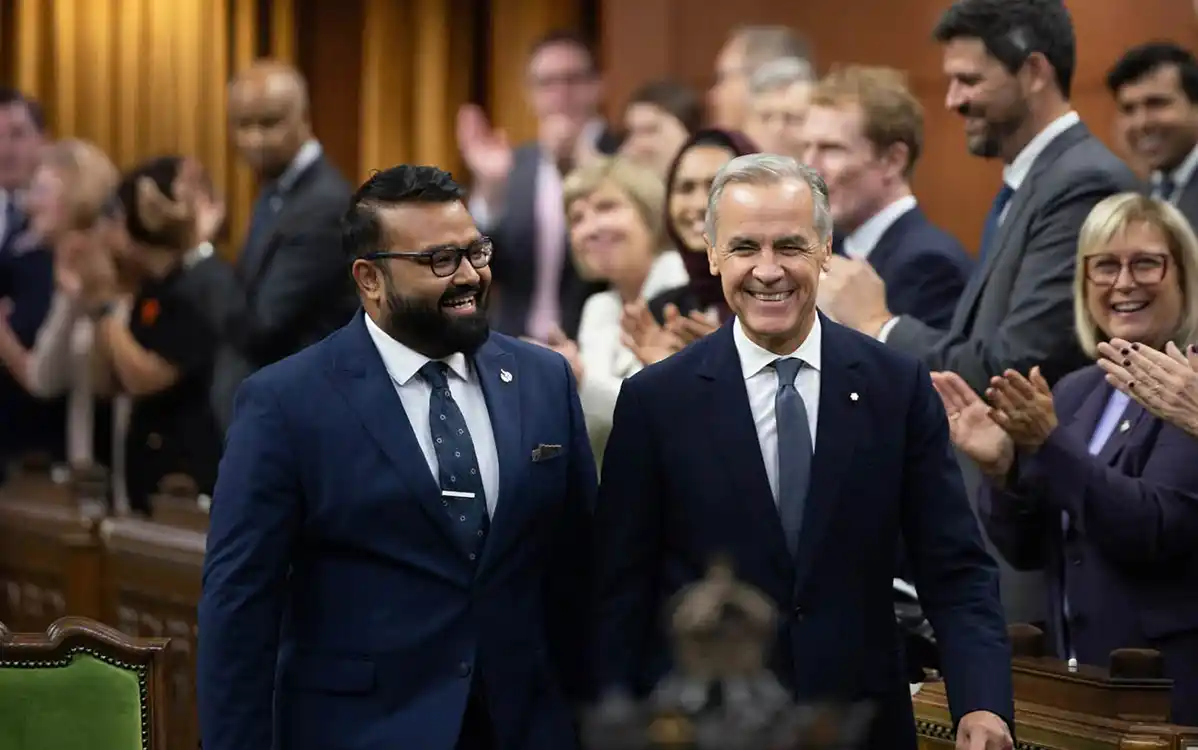
Photo: Daniel Pereira, Office of the Prime Minister of Canada