Witness to October 7: What I Saw in Israel and What Canada Must Confront
Viewer discretion is strongly advised. The footage contains graphic images and scenes of violence that many readers may find profoundly disturbing.
I arrived in Israel expecting to learn. I did not expect to be changed. Instead, I walked through the charred remains of family homes in the kibbutzim near Gaza. Children’s toys still lay scattered where families had once gathered for breakfast. Bullet holes marked walls that once displayed family photographs. Burned-out safe rooms stood as silent witnesses to the final moments of parents who believed they were protecting their children.
I stood at the Nova Music Festival site, a place built for music, friendship, and celebration, and found myself staring across ground that had become a killing field. Then I watched the footage of Hamas in all their sickness as they barbarically murdered and butchered children, seniors and family pets and raped and gang raped their way across undefended communities with a glee that can only be found in serial killers. They were and are animals from a medieval time. Nothing prepares you for it. Not the headlines. Not the statistics. Not the political arguments.
The videos I viewed were not scenes from a conventional battlefield. They were scenes of ordinary people being hunted. Young people running for their lives. Families torn apart. Terror. Panic. Desperation. The final moments of people who woke up expecting an ordinary Saturday and instead found themselves face to face with a level of hatred most modern societies struggle to comprehend.
The scale and brutality of the attacks are documented in video evidence that can be viewed here.
As the hours passed, I felt nauseous. I felt grief. I felt disbelief. But most of all, I felt anger. Not political anger. Moral anger. Because what Hamas carried out on October 7 was not an act of resistance, a freedom struggle, or a military operation against an opposing army. It was a barbaric and deliberate campaign of terror directed solely at civilians. The evidence is overwhelming. Hamas terrorists murdered entire families in their homes. They slaughtered young people at a music festival. They kidnapped children, parents, grandparents, and foreign workers. Survivors, eyewitnesses, forensic investigators, and international inquiries have documented their murderous rampage, torture, sexual violence, mutilation, arson, and kidnapping on a scale that shocked even seasoned investigators.
Anyone who seeks to justify, excuse, or celebrate what Hamas did that day has abandoned any serious claim to moral authority. October 7 was not simply a terrorist attack. It was the largest massacre of Jews since the Holocaust. Standing in the places where it happened, speaking with survivors, and confronting the evidence left behind, I was struck by an uncomfortable realization: there are moments in history when language becomes inadequate.
October 7 is one of those moments.
How does one describe parents murdered in front of their children? Children murdered in front of their parents? Entire communities transformed into crime scenes in a matter of hours? How does one explain that while Israelis were still collecting their dead and searching desperately for hostages, crowds in cities thousands of kilometres away were already celebrating? The truth is that words eventually reach their limit.
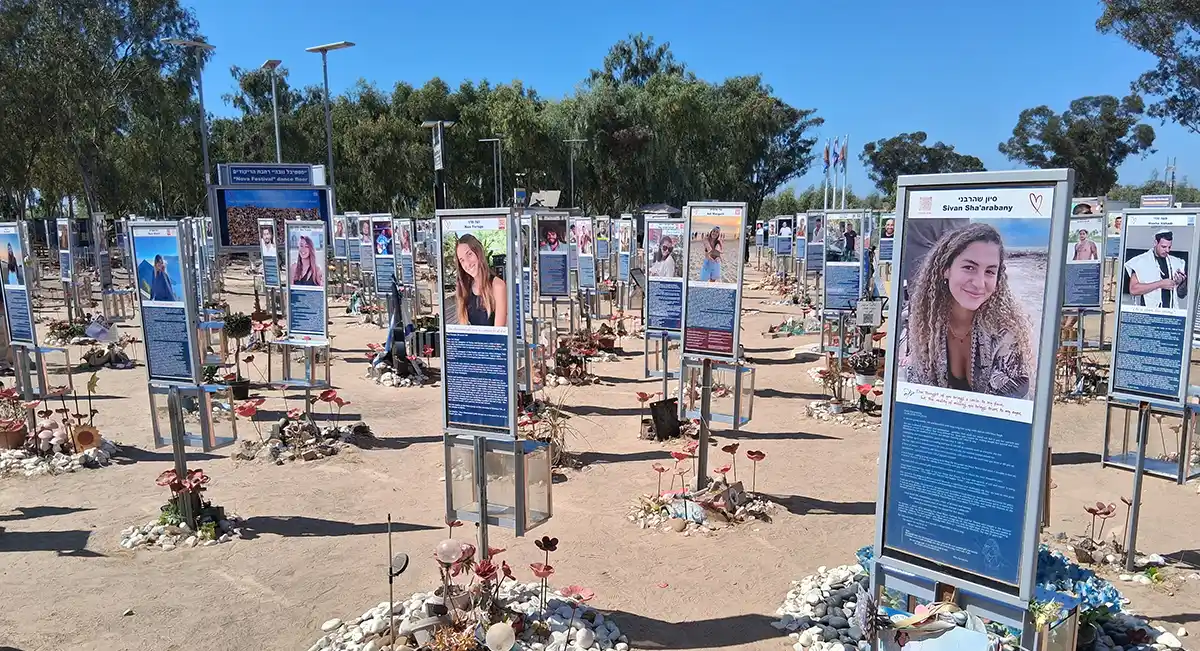
As I walked through the memorial at the Nova Music Festival site, one moment stayed with me more than any other. A young woman, perhaps in her twenties, stood silently before a photograph of a murdered friend. Tears streamed down her face as those around her tried to comfort her. She reached out gently and touched the photo. In that moment, all the statistics, slogans, political arguments, and social media debates disappeared. What remained was a young woman grieving someone she loved, and the irreplaceable human loss left behind by a day of unimaginable cruelty.
It was impossible not to see my own family in those images. So many of the young women smiling back from the memorial walls had the same joy, optimism, and warmth I see in my daughters. The young men reminded me of my own son, kind-hearted and decent, the sort of person who would go out of his way to help a stranger rather than harm a living thing. These were not soldiers. They were not combatants. They were young people dancing at a music festival, celebrating life, friendship, and freedom.
Then death came for them.
Not as a tragic consequence of war, but as the deliberate objective of a sick cult. They were hunted, tortured, raped and gang raped, kidnapped, and murdered by people raised in an ideology that glorifies hatred and sanctifies violence. This was not random brutality. It was the predictable outcome of generations of indoctrination that teach not coexistence but domination, not tolerance but fanaticism, and not peace but the elimination of those deemed enemies.
The slogan “From the River to the Sea” is too often presented in the West as a benign political aspiration. For many of those who carried out and celebrated the atrocities of October 7, it meant exactly what its most extreme advocates have always intended it to mean: a Middle East cleansed of Jewish sovereignty and, ultimately, of Jews themselves.

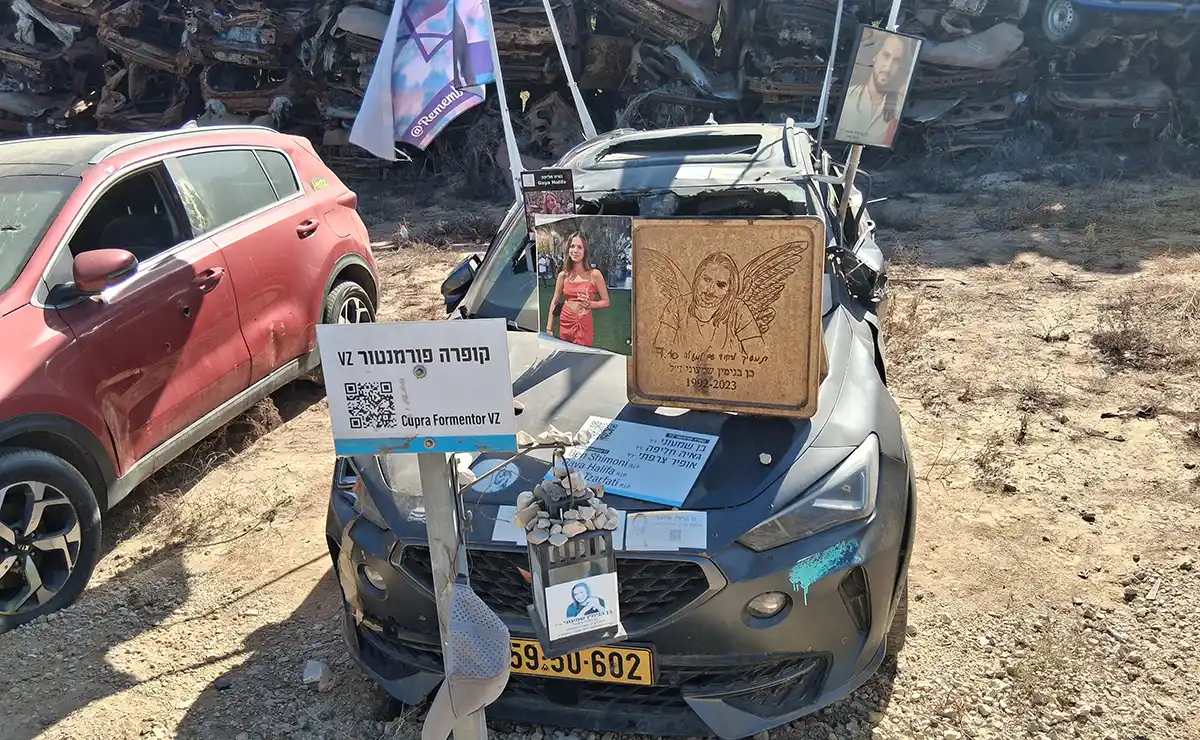
ABOVE: The Car Wall holds hundreds of vehicles burned by Hamas on October 7, 2023. Once owned by Nova Festival victims, they now stand as an official memorial, each car symbolizing lives lost.
Standing there among the photographs, surrounded by reminders of lives interrupted and futures stolen, it became impossible to dismiss these events as just another distant conflict. The victims ceased to be statistics. They became sons and daughters, brothers and sisters, friends and loved ones. They became people who could easily have been our own. My own.
Why I Went
Before going further, readers deserve full transparency.
My visit to Israel took place at the invitation of the Exigent Foundation. The delegation brought together professionals from a range of backgrounds, including business, law, medicine, public policy and the think-tank community. Our objective was not simply to see Israel, but to better understand the historical, religious, political and security realities that continue to shape one of the world’s most complex regions.
Over the course of the week, we visited some of the most significant religious sites on earth, including the Church of the Holy Sepulchre, the Jordan River baptismal site traditionally associated with Jesus, the Western Wall, and the Al-Aqsa Mosque. Just as importantly, we met directly with Jewish, Christian, Muslim, Druze and Arab residents whose daily lives are shaped by the realities of the region.
The experience extended far beyond the holy sites. We travelled from the communities in southern Israel devastated by the October 7 attacks to the ancient port city of Caesarea, the Rambam Health Care Campus in Haifa, and communities along Israel’s northern border. We spent time in Druze villages bordering Syria, met with security and intelligence experts, journalists, medical professionals, business leaders and community representatives, and heard perspectives that are rarely presented together in a single conversation.
It was an intensive and often emotionally challenging journey, encompassing more than a dozen locations and countless discussions. By the end of the week, I had gained something increasingly rare in today’s polarized environment: the opportunity to listen directly to people living the reality rather than relying on those interpreting it from a distance.
For a journalist, there is no substitute for seeing things firsthand. My purpose in going was not to arrive with a predetermined conclusion. It was to see, listen and learn. What I encountered changed my understanding of the conflict and, ultimately, changed the questions I began asking about Canada.
Journalists interview presidents, generals, police chiefs, dictators, dissidents, prosecutors, activists and people accused of serious crimes every day without being accused of endorsing everything they hear. Yet when the subject is Israel or Jews, a curious exception often emerges. The act of listening itself becomes suspect. The unstated rule appears simple: if your reporting confirms the preferred narrative, you are an independent observer. If your reporting challenges it, you are a propagandist. That is not journalism. It is ideology.
The New Orthodoxy
The deeper problem is not disagreement. Democracy requires disagreement. The problem emerges when disagreement itself is treated as a moral offence.
Across parts of the Western activist landscape, political identity increasingly dictates which facts are considered important and which victims receive sympathy. Nuance becomes betrayal. Context becomes heresy. Evidence becomes expendable whenever it complicates a preferred narrative.
This is particularly dangerous in universities, whose fundamental purpose should be the pursuit of knowledge through open inquiry and debate.
There is nothing wrong with examining the Israeli-Palestinian conflict through theories of power, colonialism, nationalism or oppression. Those are legitimate subjects for scholarship. The problem arises when a theoretical framework becomes so dominant that evidence is forced to conform to it rather than being allowed to challenge it.
The result is an intellectual culture in which some students are encouraged to see political questions primarily through the categories of oppressor and oppressed, with little room for the possibility that reality can be more complicated.
One can acknowledge the suffering of Palestinians. One can also acknowledge the suffering of Israelis. One can criticize Israeli governments. One can also condemn Hamas. One can support Palestinian dignity while simultaneously defending Israel’s right to exist. These positions are not contradictory. They are the foundation of intellectual honesty.
Yet too often after October 7, the discussion shifted away from the moral character of the attack itself and toward elaborate efforts to explain why it somehow mattered less. That brings us to one of the most disturbing aspects of the aftermath.
Civil Commission on October 7 Crimes by Hamas Against Women and Children
On May 12, 2026, the Civil Commission on October 7 Crimes by Hamas Against Women and Children, an independent body established to document and investigate atrocities committed during the October 7 attacks and the hostage crisis that followed, released the findings of a two-year investigation. Drawing on more than 10,000 photographs and video segments, over 1,800 hours of visual evidence, and more than 430 testimonies and interviews with survivors, witnesses, released hostages, experts, and victims’ families, the Commission concluded that sexual and gender-based violence was not incidental to the attacks but was systematic, widespread, and integral to them. According to the report, these crimes occurred across multiple locations and phases of the assault, including during the attacks, abductions, transfers, and captivity in Gaza. The significance of this finding extends beyond the report itself.
In Western societies, we have spent decades insisting that victims of sexual violence must be heard and believed. That principle should be universal. It cannot depend upon whether the victims are Israeli or Palestinian, Jewish or Muslim, politically sympathetic or politically inconvenient.
The United Nations independently investigated allegations of sexual violence associated with the attacks and found reasonable grounds to believe that conflict-related sexual violence occurred at several locations. That finding should have removed any serious doubt that sexual violence was part of the horror of that day.
The question that remains is why acknowledgement of those crimes became so politically difficult for some organizations and activists. That question deserves an honest answer.
The Moral Relativism Problem
One of the strangest features of Western coverage since October 7 is how rarely Israel is described as what it actually is: A nation at war.
Israel was attacked by Hamas and other Palestinian armed groups. More than 1,200 people were killed, the overwhelming majority civilians. More than 250 hostages were taken. Israel then declared war on Hamas. That chronology matters.
Had a comparable attack occurred against Canada, Britain, France or the United States, few serious observers would question the attacked nation’s right to respond militarily. The debate would concern how that response should be conducted, not whether the victims had a right to defend themselves.
Yet Israel’s military response has frequently been discussed as though it emerged in a vacuum.
The massacre becomes a footnote. The response becomes the story. This is where legitimate criticism can become moral distortion.
Israel’s right to defend itself does not mean that every Israeli military action is justified. International humanitarian law applies to Israel just as it applies to every other state. Civilian life must be protected. Military operations must comply with the laws of armed conflict. Allegations of unlawful conduct should be investigated.But acknowledging those obligations does not erase the fundamental fact that Israel was responding to an armed attack.
Nor does the suffering of Palestinian civilians transform Hamas from an aggressor into a defender.
Two things can be true at the same time. The deaths of innocent Palestinians are tragic. Israel had a right to defend its population. Those propositions are not morally incompatible.
The Allied campaign against Nazi Germany provides an imperfect but instructive historical comparison. The Allied war effort caused enormous civilian suffering. Cities were destroyed, and hundreds of thousands of civilians died. Yet history does not classify the Allied campaign as genocide because its purpose was not the destruction of the German people. It was the defeat of Nazi Germany.
The moral distinction between aggressor and defender does not disappear simply because war produces horrific civilian casualties. That distinction is essential to understanding Israel’s position.
How Did Canada Become an Apologist for the Indefensible?
The real question is not what happened on October 7. The question is how so many educated Canadians came to view the massacre of civilians as something to justify, instead of outright condemn.
Sadly for the Canadian government and many of our learning institutions, including the cognitively dissonant CBC, the atrocity became something to contextualize, excuse, or explain away. This did not happen on the fringes of Canadian society. It also occurred in most of our universities, among public-sector union leadership, and throughout activist networks that have spent years presenting themselves as moral authorities.
What was most striking was not their outrage, but its absence. Faced with the largest massacre of Jews since the Holocaust, too many seemed more interested in explaining the motivations of the perpetrators than condemning the crime itself. The victims often appeared as secondary characters in their own story.
In many university classrooms, students have spent years being taught to view the world primarily through the lens of power, oppression, and competing grievances. The predictable result is that some graduates now struggle to recognize evil when it appears in front of them. Every act must be explained. Every atrocity must be contextualized. Every moral judgment must be suspended pending further theoretical analysis.
The irony is difficult to miss. Some of the loudest lectures about privilege, accountability, and social responsibility come from professors whose tenure largely insulates them from accountability, commentators funded by the public purse, and organizations sustained by compulsory dues from workers who may not share their politics. They speak endlessly about power while rarely examining the power they themselves possess.
Their particular skill is turning clarity into confusion. Give them enough academic language, and they can transform terrorism into resistance, barbarity into grievance, and moral judgment into an alleged failure of sophistication. In their world, certainty is naïve, common sense is unsophisticated, and the obvious must always be explained away.
The problem is that reality eventually intrudes. No amount of theory can change what happened. No amount of ideological interpretation can make the deliberate murder and kidnapping of civilians morally ambiguous. Some things are exactly what they appear to be.
Israel’s Reality
To understand why Israel’s response cannot be judged in isolation, it is necessary to understand the country itself.
Israel is not a failed state, a military dictatorship or an impoverished society struggling to survive. It is a modern, highly developed country with a parliamentary political system, competitive elections, an independent judiciary and a vigorous civil society. Freedom House currently rates Israel as Free, making it the only country in the Middle East to receive that designation in its 2026 assessment.
That does not mean Israel is perfect.
It is not. Israel has serious political divisions, ongoing disputes over judicial independence, and legitimate controversies over its treatment of minorities, Palestinians and the territories. Those issues deserve scrutiny. But they should not obscure what Israel has accomplished.
Israel is a high-income economy whose prosperity was not built on the vast oil wealth that transformed the economies of the Gulf. The country developed a remarkably sophisticated economy through human capital, entrepreneurship, science, technology, research and innovation. The OECD (Organisation for Economic Co-operation and Development) describes its high-tech sector as a major engine of economic growth, accounting for roughly 20 percent of GDP and 53 percent of exports in 2023. Its technology sector has made Israel a global player in cybersecurity, artificial intelligence, medicine, agriculture and other advanced industries.
Israel’s economic success is particularly striking given its geography, its small population, limited natural resources compared with many of its neighbours, and the enormous resources it has had to devote to national defence. This is a country that has built much of its prosperity through ingenuity. That achievement is part of the Israeli story that is often missing from Western political discussion. So too is the country’s democratic character. Within Israel’s internationally recognized borders, citizens vote in competitive elections, political parties compete openly, governments can change through elections, courts exercise significant authority, opposition politicians criticize the government openly, and a robust civil society regularly protests government policy.
That does not settle every argument about Israel. But it does matter. Because Israel is not simply another armed actor in the Middle East. It is a democratic society confronting enemies that include organizations and regimes that do not share its political values or its commitment to liberal democracy.
Since October 7, more than 1,318 members of Israel’s security forces have been killed, including soldiers, police officers, intelligence personnel, firefighters, prison service officers, security coordinators, and local emergency responders. More than 7,150 family members have joined Israel’s community of bereaved families, including 2,143 parents, 355 widows, 880 orphans, and 3,772 siblings. In addition, more than 1,000 Israeli civilians have been killed in terrorist attacks and acts of war since October 7, while tens of thousands of Israelis have been recognized as victims of physical and psychological trauma resulting from the conflict.
PHOTO?
Statistics tell only part of the story. Behind each number is a family whose life has been permanently altered.
Israel is also geographically tiny. It occupies roughly 22,000 square kilometres, making it smaller than Vancouver Island. Yet it faces security threats from Gaza, Lebanon, Syria, Yemen, Iraq and Iran, as well as terrorism and instability originating elsewhere in the region.
Seven fronts. A single nation. Few modern democracies face such a strategic environment. That does not make every Israeli policy correct. It does make the security problem impossible to ignore.
The Double Standard
The question, then, is not whether Israel should be criticized. Of course it should. The question is whether Israel is being judged according to standards that are applied consistently to other countries fighting wars against armed groups embedded in civilian populations.
Gaza presents one of the most difficult urban warfare environments in the modern world. Hamas constructed an extensive tunnel network and embedded military infrastructure in densely populated areas. Israel has said it has used evacuation warnings, leaflets, phone calls, text messages, humanitarian corridors and operational pauses in an effort to reduce civilian casualties.
John Spencer, Chair of Urban Warfare Studies at West Point’s Modern War Institute, has written extensively about the extraordinary difficulties presented by the battlefield in Gaza and the measures used by Israel to mitigate civilian harm. Reasonable people can and should debate whether those measures have been sufficient. They should debate civilian casualties. They should investigate alleged violations. They should scrutinize Israeli military decisions. But they should also recognize the reality of the battlefield. The laws of war do not say that a country loses its right to defend itself because its enemy deliberately operates from within civilian areas. Nor do they say that a terrorist organization can make itself immune from attack by placing military infrastructure beside civilians. That is not a defence of every Israeli military action. It is an argument against pretending that Israel is fighting a conventional army on an open battlefield.
The Genocide Question
This is also why the language used to describe the war matters. “Genocide” is not simply another word for a terrible war. Under international law, genocide requires proof of a specific intent to destroy, in whole or in part, a protected national, ethnic, racial or religious group as such. The International Court of Justice has not issued a final judgment on the merits determining that Israel is committing genocide. The proceedings remain unresolved.
That distinction is important. The enormous civilian suffering in Gaza is undeniable and heartbreaking. But casualty numbers, photographs of destruction and the terrible conditions produced by war do not, by themselves, establish the legal crime of genocide.
At the same time, the unresolved legal status of the case does not mean Israel should be immune from scrutiny.It means the allegation should be treated with the seriousness required by the gravity of the word.A society committed to truth should be capable of holding two ideas simultaneously: Palestinian civilian suffering is real and deserving of compassion, and the legal definition of genocide cannot simply be rewritten to accommodate political rhetoric.
The moral danger comes when legal terminology becomes a political slogan.If every devastating war becomes genocide, the word eventually loses its meaning.And if the word loses its meaning, one of the most serious crimes in international law becomes a political weapon rather than a legal judgment.
The Problem Was Never the Jews. It Was Antisemitism.
There is another uncomfortable reality that deserves reflection. There are approximately 2.4 billion Christians in the world. Approximately 2 billion Muslims. Approximately 1.4 billion Indians. Approximately 1.4 billion Chinese. The global Jewish population is approximately 15 million people. Less than two-tenths of one percent of humanity. Israel is the world’s only Jewish-majority state. These facts alone do not prove anything. But they should provoke reflection.
Why has one of the smallest peoples on earth so often occupied such a disproportionately large place in humanity’s hatreds? Historians, philosophers, political scientists, and scholars of antisemitism have wrestled with that question for centuries. Their answers vary. Some blame religious prejudice. Others point to conspiracy theories, political extremism, economic myths, nationalism, xenophobia, or the tendency of societies under stress to seek convenient scapegoats. What makes antisemitism unique is its extraordinary adaptability.
Jews have been accused of being too powerful and too powerless. Too wealthy and too poor. Too separate and too assimilated. Too religious and too secular.Too nationalistic and too cosmopolitan. The accusations change. The target rarely does.
That persistence is why antisemitism should be understood as one of history’s most enduring and adaptable forms of hatred. One need not agree with every decision of the Israeli government to recognize this reality. Nor does recognizing antisemitism require abandoning legitimate criticism of Israel. The two are perfectly compatible. Indeed, distinguishing between them is essential.
Canada’s Test
Ultimately, October 7 is not only an Israeli story. It is also a Canadian story. It is a test of whether our institutions can distinguish between terrorism and resistance, whether journalism values evidence over ideology, whether universities remain places of inquiry rather than conformity, and whether political leaders have the courage to confront antisemitism when doing so is difficult.
I travelled to Israel expecting to learn about a tragedy. I returned having learned something about Canada as well. What I witnessed in Israel revealed the depths of human cruelty. What I witnessed afterwards revealed how easily ideology can distort moral judgment when people become more committed to defending a political narrative than confronting uncomfortable facts.
The answer is not to abandon sympathy for Palestinians. It is to recover consistency. We should demand protection for Palestinian and Israeli civilians, the release of the hostages, accountability for Israeli wrongdoing where evidence warrants it, and the unequivocal condemnation of Hamas terrorism, antisemitism and anti Arab and anti-Muslim hatred.
But there is another consequence of Canada’s failure to maintain that moral clarity. It is now being felt at home.
B’nai Brith Canada documented 6,800 antisemitic incidents in 2025, the highest number recorded in its annual audit since 1982 and a 145.6 per cent increase from 2022. By July 15, 2026, it had already recorded 27 violent antisemitic incidents, more than twice the total for all of 2025. Statistics Canada separately reported 788 police reported hate crimes targeting Jews in 2025, representing about 71 per cent of hate-motivated offences based on religious identity.
These are not simply statistics. They mean that Jewish Canadians are increasingly being forced to think about whether it is safe to attend synagogue, send their children to Jewish schools, display a mezuzah or Star of David, or openly identify as Jewish. A society that allows a community to be intimidated into hiding its identity has already begun to surrender one of the fundamental promises of a free society.
Criticism of Israel is legitimate. Political protest is legitimate. What is not legitimate is threatening Jewish Canadians, glorifying the murder of Jews, intimidating Jewish students, targeting synagogues or businesses, or treating Canadian Jews as responsible for the actions of a foreign government.
Nor can Canada ignore the danger posed by people who bring political hatreds into this country and seek to normalize intimidation, extremism or violence. Immigration and pluralism depend upon a basic obligation to respect the rights, safety and dignity of others, and the democratic laws and norms of Canada.
This is where the failure of our institutions matters. When terrorism is rationalized, antisemitism is minimized, intimidation is dismissed as activism, and political violence is excused because it is attached to a cause, the boundaries of acceptable conduct begin to move.
That should concern every Canadian. Israel is not above criticism. Neither is Canada. Neither are our universities, media organizations, unions, governments or activist movements. The same principles must apply to everyone.
Murdering civilians is wrong. Kidnapping children is wrong. Raping women is wrong. Taking hostages is wrong. Targeting civilians because they are Jews is wrong. Targeting civilians because they are Palestinians is wrong. Terrorism is wrong. Antisemitism is wrong. No political theory or historical grievance should make those truths negotiable.
I went to Israel expecting to witness history. Instead, I came home wondering what history will eventually say about those who witnessed it and chose not to see it, and those who saw it and refused to remain silent.
The warning comes from Martin Niemöller, the German pastor who reflected after the Holocaust on the consequences of silence: “First they came for the Socialists, and I did not speak out… Then they came for the Trade Unionists, and I did not speak out… Then they came for the Jews, and I did not speak out… Then they came for me—and there was no one left to speak for me.”
When hatred is directed at Jews, Canadians cannot wait to see where it goes next. We must speak out now.
Header image: The Nova Festival Victims Memorial commemorates the victims of the music festival massacre during the October 7, 2023 attacks.