Resonance of Dunhuang: Ancient Silk Road Music Comes Alive in Ottawa
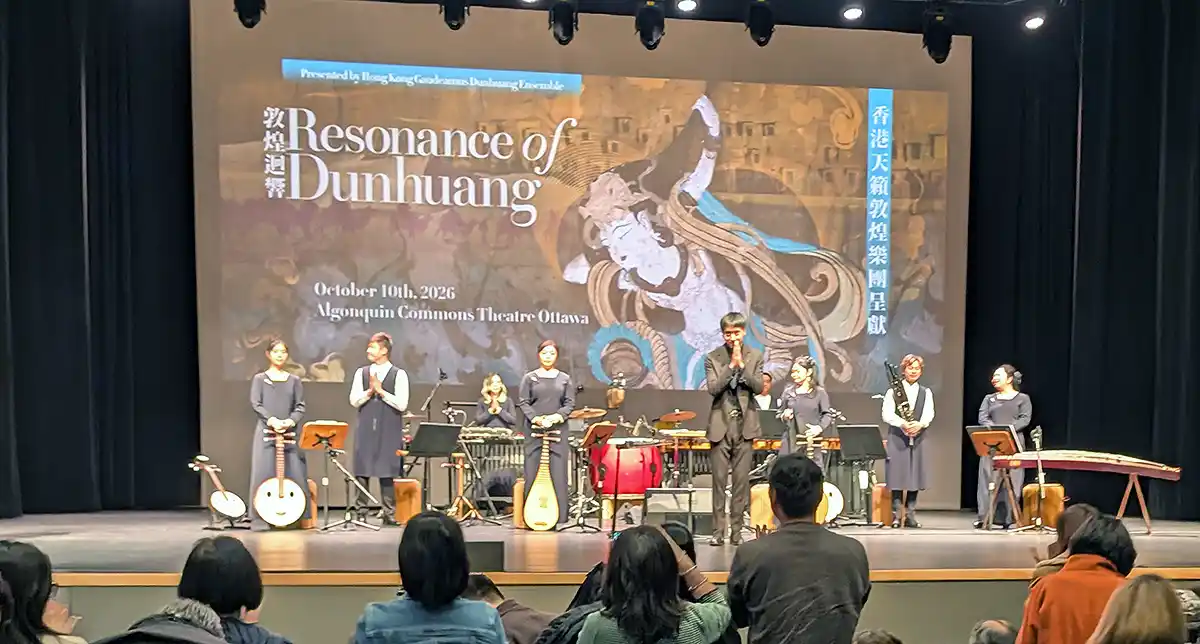
The past seemed to breathe again on October 10 at Algonquin Commons Theatre, where Hong Kong’s Gaudeamus Dunhuang Ensemble delivered a captivating performance that brought the ancient musical and artistic traditions of China’s Silk Road into the present.
Titled Resonance of Dunhuang, the concert combined the distinctive sounds of traditional Chinese instruments with contemporary compositions and animated imagery inspired by the extraordinary murals of Dunhuang. Projected on a large screen behind the performers, the moving images transformed the concert into an immersive encounter with an artistic world created more than a millennium ago.
What made the performance so compelling was the remarkable musicianship and precision with which the music and visual presentation were brought together. The ensemble’s eight musicians played together in full-group passages before shifting into smaller combinations of two or three performers, depending on the musical theme being explored. These transitions were seamlessly integrated with the animated imagery projected behind them, creating a fluid performance in which the sounds, movements and visuals complemented one another. The technical skill of the musicians, the distinctive character of their instruments and the careful coordination of every element made for a memorable evening.
The Ottawa concert followed the ensemble’s October 9 performance at Toronto’s Jane Mallett Theatre. The Canadian appearances marked the 56th anniversary of the establishment of diplomatic relations between Canada and China on October 13, 1970. The tour received support from the Chinese Embassy in Canada and other cultural partners.
A Musical Journey to Dunhuang
To understand the ensemble’s work, it helps to understand Dunhuang itself.
Located in northwestern China’s Gansu Province, Dunhuang was once a major crossroads along the ancient Silk Road, the network of trade routes that connected China with Central Asia, the Middle East and Europe. For centuries, merchants, monks, travellers and artists passed through the region, bringing with them goods, beliefs, instruments and artistic traditions.
The legacy of that cultural exchange survives most spectacularly in the Mogao Caves, a UNESCO World Heritage site containing hundreds of Buddhist cave sanctuaries decorated with sculptures and murals. Among the paintings are musicians, dancers and celestial figures playing instruments that provide a remarkable visual record of ancient musical life.
Yet the murals preserve images rather than sound. Although historical manuscripts contain musical notations, reconstructing the music as it was originally performed remains a challenge. Modern musicians must interpret the surviving evidence while acknowledging that the precise sound of performances from centuries ago cannot be known with certainty.
That challenge lies at the heart of Resonance of Dunhuang. Rather than claiming to reproduce an unknowable past, the ensemble draws inspiration from ancient musical scores, historical research and the instruments portrayed in the murals to create original compositions that place historical material in conversation with contemporary musical expression.
From Hong Kong to the World
Established in 2018, the Hong Kong Gaudeamus Dunhuang Ensemble brings together young musicians and resident composers Kam Shing Hei and Chu Kai Yeung. Its artistic approach combines the study and reinterpretation of Dunhuang’s musical heritage with original composition, performance and visual storytelling.
The musicians play traditional Chinese instruments, including the pipa, guzheng, ruan, sheng, dizi and xiao, alongside percussion and the konghou, an ancient harp-like instrument depicted in Dunhuang art. The concert featured replicas of ancient instruments, bringing their distinctive sounds into a contemporary performance setting.
The ensemble also draws on 25 ancient musical scores preserved in manuscripts associated with Mogao Cave 17. Interpreting historical musical notation for modern performance is not straightforward, so the composers combine surviving sources with their own musical ideas.
The result is neither a strict historical reconstruction nor a conventional concert of traditional Chinese music. It is a contemporary artistic interpretation of an ancient culture, shaped by research, imagination and a willingness to experiment.
When Murals Begin to Move
In Ottawa, the animated imagery projected behind the musicians was integral to the experience. The screen offered far more than a decorative backdrop. Images inspired by Dunhuang’s murals and architecture brought the audience into the visual world that had inspired the music, creating a dialogue between what could be seen and what could be heard.
The effect was particularly striking because of the range of sounds produced by the instruments. The bright, expressive plucked strings of the pipa and ruan contrasted with the flowing tones of the flute and the breath-driven sound of the sheng. Percussion added rhythmic definition and dramatic energy, while the compositions shifted between moments of delicacy, reflection and intensity.
The changing musical arrangements were matched by visual sequences that evoked the movement, colour and spiritual imagination of the ancient murals. As the performers moved between playing together and smaller combinations, the imagery helped establish the mood and character of each passage. The timing and coordination made the visual component feel like an integral part of the performance rather than an accompaniment added after the fact.
The musicians’ accomplishment lay not only in their individual playing but also in their ability to work as a cohesive ensemble while responding to the production’s visual and technical elements. The result was a carefully integrated presentation that made the historical material feel immediate without diminishing its sense of age and mystery.This approach also speaks to the ensemble’s larger purpose: cultural preservation need not mean leaving the past unchanged. By interpreting traditional sources through contemporary composition and multimedia, the musicians invite audiences unfamiliar with Dunhuang to discover its artistic significance for themselves.
Preserving the Past, Creating the Future
The ensemble’s Canadian performances marked the 56th anniversary of Canada–China diplomatic relations, highlighting the role cultural exchange can play in bringing people closer beyond politics and trade. Through music, traditional instruments and animated imagery inspired by Dunhuang’s murals, Resonance of Dunhuang introduced Canadian audiences to a remarkable part of China’s artistic heritage.
The ensemble has performed internationally in cities including London, Paris, Bangkok and Tokyo. Its North American debut in Toronto and Ottawa extends that work to Canadian audiences.
The Ottawa performance demonstrated how an ancient artistic tradition can inspire contemporary expression. The musicians’ skill, the interplay of instruments and the precise coordination of the animations brought Dunhuang’s imagery to life, creating a compelling connection between the past and the present.
About the Canada–China Cooperation Series:
Ottawa Life Magazine’s Canada–China Cooperation series explores the evolving relationship between Canada and China through news, analysis, interviews and commentary. The series includes independently reported editorial coverage as well as sponsored content supported by the Embassy of China. This article is sponsored by the Embassy of China. The sponsorship does not influence Ottawa Life Magazine’s editorial decisions, reporting, analysis or opinions. OLM retains full editorial independence and responsibility for its published content.