
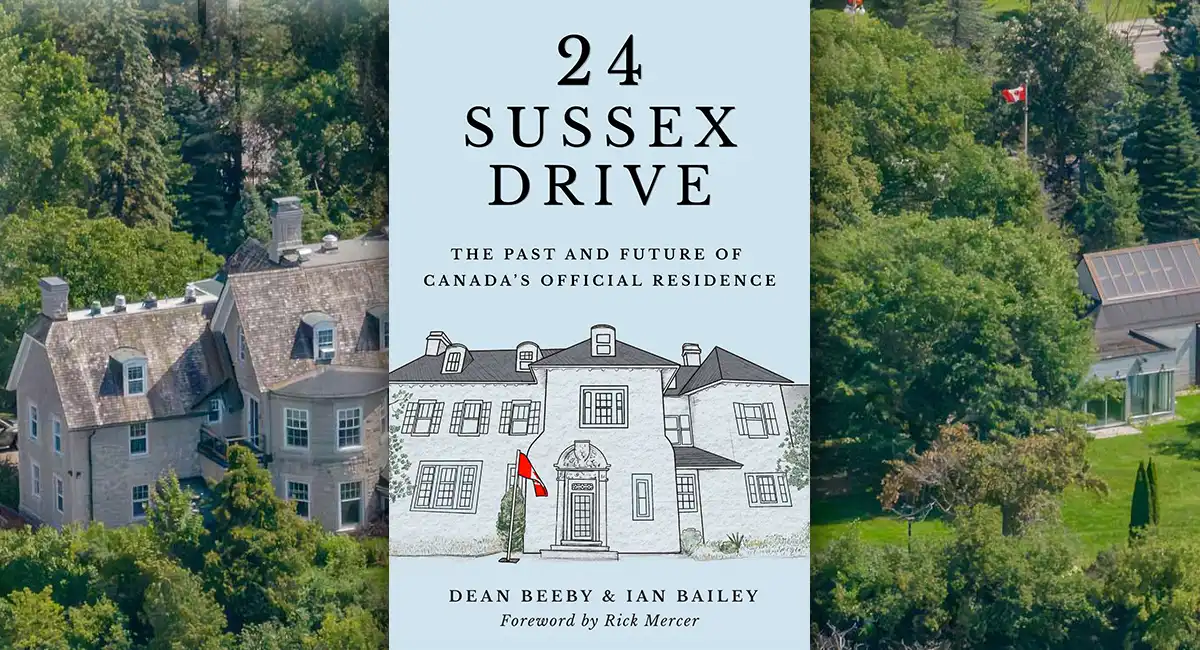
Book Review: ’24 Sussex Drive’ and the Battle Over Canada’s Official Residence
When Justin Trudeau was elected the 23rd Prime Minister of Canada, he ironically inherited the dilemma of what to do with the house where he had been raised for most of his early years. The address is one that everyone in the National Capital Region and all of Canada knows, although no prime minister has resided there since 2015.
Sitting on the sidelines as a political hot potato that no party wants to touch, journalists Dean Beeby and Ian Bailey provide an in-depth look at the Prime Minister’s Residence, from the time of its construction through its notable occupants, and examine the future of one of Canada’s most famous houses in 24 Sussex Drive: The Past and Future of Canada’s Official Residence.
When Bytown was founded in the early 1800s, the Rideau River played a vital role in the logging industry. Joseph Currier, an American by birth, migrated to the area and rose through the ranks of the local industry, becoming the manager of the New Edinburgh mill. Built for an astonishing $15,000 at a time when average wages were six dollars a week, Currier’s mansion was completed in 1868. It was originally called Gorfyfwysa, or “place of rest” in Welsh.
The book covers the construction of the lumber baron’s home and its future residents, from Prime Minister Louis St-Laurent to the Harper family, who were the last to inhabit 24 Sussex. In all, nine prime ministers have resided at the property.
By 1943, Prime Minister Mackenzie King wanted a property in proximity to Rideau Hall to serve as an official residence. He requested that the near-dilapidated residence be expropriated for use by the Canadian government. Ironically, King would never reside in the house, preferring his own property, known as Laurier House. His successor, Louis St-Laurent, however, took up residence there following the passing of the Prime Minister’s Residence Act. During St-Laurent’s tenure, he used the property extensively for events, eager to show it off as Canada’s 10 Downing Street.
Beeby and Bailey, though, demonstrate that not everyone was eager to reside in the house. Prime Minister Lester Pearson’s wife stated that she felt as though she was living in a hotel, while Prime Minister John Diefenbaker felt little inclination to invest public funds in the house during his six years at the residence.
Born during his father’s tenure as prime minister, Justin Trudeau was the first child to reside in the official residence. Unlike Deifenbaker, Pierre Trudeau undertook extensive renovations, even requesting the installation of an indoor swimming pool. Apparently, it was “vital to his health.” Conversely, Margaret Trudeau did not enjoy her tenure in the mansion, calling it, among other things, “shabby” and a “great stone toad.” Despite the oppressive atmosphere she described, she gave birth to two more children while at the residence and continued to live in the attic after her separation from Pierre Trudeau. Justin Trudeau remarked in his 2014 book that the property retained bad memories for him of his parents’ separation.
While delving into the personal and historical aspects of the property, the book also explores the political aspects, illustrating the acts and legislation that led to its official designation as the Prime Minister’s Residence and examining the budgetary constraints placed on a prime minister’s family regarding staffing and renovations.
24 Sussex Drive paints a picture of a house born into its official role amid controversy, an existence that never ceased. A National Capital Commission report states that the house is in the worst condition of the six official residences owned by the organization. The authors also cover the political divisions surrounding the house, examining arguments in favour of its destruction.
Included among those who do not want to invest further public money in the property are National Post columnist Chris Selley and former NCC Chair Russell Mills, who argued that the house should be torn down and the land incorporated into the grounds of Rideau Hall. Still others, particularly proponents of heritage preservation, have called for the property to be saved from “demolition by neglect.”
Prime Minister Jean Chrétien has expressed regret at the lack of investment in the property but did not want to be seen to be investing in himself while in office, something he admits was a mistake. This view was carried forward as a de facto policy until former PM Stephen Harper left office in 2015.
Presenting the personal home as inherently political and illustrating the federal government’s gridlock over issues surrounding the renovation of official residences, the authors reveal a particular attitude of frugality that Canadian politicians are more eager to embrace than their American neighbours.
24 Sussex Drive: The Past and Future of Canada’s Official Residence is an engaging read for Canadian history buffs, political savants, and anyone interested in discovering how the multilayered federal bureaucracy allowed Canada’s national residence to fall into a state of squalor in its short 75-year lifespan, leaving it suspended in a sort of purgatory from which it may never emerge.
As Rick Mercer candidly points out in the introduction, “24 Sussex is every Canadian’s house”, and the book is a call to action. But now we, as taxpayers and citizens, must figure out what that call to action looks like and whether we want a solution at all.
24 Sussex Drive: The Past and Future of Canada’s Official Residence is published by Southerland House and available for purchase from the publisher.