Recommended Articles

Bring Ottawa’s Beauty Inside with Best Canvas

Your Guide to Waffles

Balancing Screen Time for Students’ Mental Well-Being




Ottawa thrives as Canada’s bilingual capital, a city where over 225,000 students under 19 navigate two official languages daily. Eight post-secondary institutions draw thousands of international learners each year, all facing the same reality: conversational fluency alone won’t carry you through a university essay, a research presentation, or an IELTS exam. The gap between chatting with friends and writing a thesis statement can feel enormous.
This guide covers everything non-native students in Ottawa need in 2026, from university-level bridging programs and free community resources to exam preparation strategies and actionable daily habits. Whether you’re preparing for admission or already struggling with citation conventions, working with a qualified academic English tutor can transform how you read, write, and think in an academic setting. That bridge between “getting by” and truly excelling? It’s shorter than you think.
Academic English operates on different rules than everyday conversation. You might order coffee perfectly, joke with classmates, even follow a Netflix series without subtitles. But structuring a persuasive argument with discipline-specific vocabulary, formal register, and proper APA citations demands a completely different skill set.
Ottawa’s bilingual context adds another layer. International students encounter French on street signs, in government offices, and sometimes in mixed-language campus environments. This dual-language exposure, while enriching, can slow down the process of mastering academic English conventions for students already juggling a third or fourth language.
The stakes are real. Students who complete academic bridging courses like uOttawa’s ESL 0140 show a 12% higher completion rate for undergraduate programs. Early support with essay writing, critical analysis, and formal presentations doesn’t just improve grades. It keeps students enrolled and on track to graduate.
The EIP spans five levels, from beginner to intermediate-advanced, and builds both academic abilities and intercultural awareness. Students work directly with uOttawa professors across four core components:
1. English for Academic Purposes
2. Academic English Enrichment
3. University Integration Workshops
4. Communication course (CMN 1148)
Each level develops reading, writing, listening, and speaking in academic contexts specifically. Students who complete the program can access a conditional offer of admission pathway, plus a potential 10% tuition discount, a significant financial incentive.
Algonquin’s two-level program targets beginner ESL students preparing for the full EAP stream. Applicants must be 18 or older and complete a $50 placement test, though existing standardized scores (IELTS, TOEFL, CAEL) can waive this requirement. Current intakes run September 2025 through August 2026, with the next cycle starting September 2026.
This intensive program packs 25 hours per week into a focused schedule: 17 hours of live online classes plus 8 hours of independent study. Students tackle discipline-specific projects tied to their intended field, so a future engineering student works on different material than someone entering political science.
Conversation Pods give learners real interaction practice and early exposure to Canadian university culture. The program runs online in the Ottawa timezone, which means no study permit or relocation costs upfront.
A qualified academic english tutor can make the difference between spinning your wheels and making measurable progress each week. But not every tutor fits every student. Here’s what matters when choosing.
Look for TESL or OCELT certification first. Experience with non-native speakers counts heavily, as does familiarity with Canadian academic standards (citation formats, grading rubrics, presentation expectations). A tutor who’s coached students through IELTS prep brings different strengths than one specializing in graduate-level essay writing.
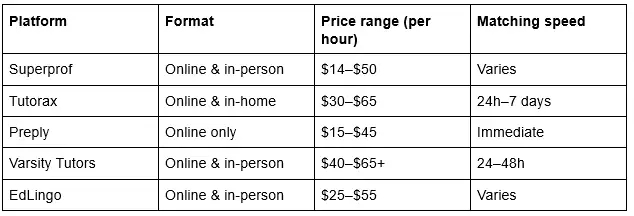
When reviewing tutor profiles, prioritize years of experience, specializations (essay writing, exam prep, critical analysis), and student reviews. Personalized lesson plans matter more than flashy credentials. Tutorax guarantees matching within 7 days for in-home sessions and 24 to 48 hours for virtual tutoring.
The Government of Canada funds LINC (Language Instruction for Newcomers to Canada), offering free language training to permanent residents and refugees. This program removes financial barriers entirely for eligible learners.
The Ottawa Catholic School Board runs ESL classes in person, online, and hybrid formats across multiple locations. Their higher CLB-level classes include academic preparation and IELTS prep components. The Ottawa-Carleton District School Board also operates ESL/LINC programs with homework clubs and summer language classes for year-round support.
ELTOC (English Language Tutoring for the Ottawa Community) pairs adult newcomers with TESL/OCELT-certified staff and trained volunteers for small group tutoring. The focus leans toward practical skills, but the structured environment serves as a solid stepping stone before tackling formal academic English programs.
The Ottawa Public Library maintains curated resource lists for English language learners, including books, online tools, and conversation workshop schedules. All free, all accessible with a library card.
Strong academic English programs zero in on the triad of reading, writing, and critical analysis. Your tutor should push you beyond grammar drills into real academic work.
• Academic writing: essay structure, thesis development, argumentation, proper citations (APA, MLA, Chicago)
• Critical thinking: analyzing texts, building arguments around quotations, evaluating source credibility
• Oral communication: seminar discussions, formal presentations, using academic vocabulary naturally in spoken contexts
• Advanced grammar: discourse structures, formal register, discipline-specific terminology
• Study skills: effective note-taking, time management, understanding Canadian academic expectations around plagiarism and originality
A tutor who only corrects your grammar misses the point. The goal is transforming how you engage with ideas at a university level, not just fixing comma splices.

Each exam serves different purposes. Choosing wisely saves time and money.
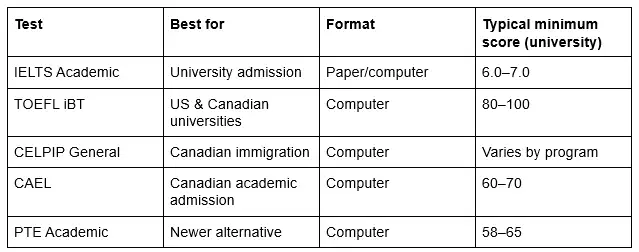
CELPIP keeps growing in popularity for Canadian immigration applications and some academic programs. CAEL targets the Canadian academic context specifically, which makes it a smart choice for students planning to stay in Ottawa long-term. An academic English tutor can build a targeted study plan with mock tests, timed writing practice, and detailed feedback on weak areas.
The YMCA’s Language Assessment and Referral Centre (Y-LARC) handles language assessments for government-funded programs. Algonquin College operates as a test centre for several standardized exams.
Book well in advance, especially during peak intake seasons (September, January). IELTS results typically arrive within 13 days, and scores remain valid for two years. Planning your test date around application deadlines avoids unnecessary stress.
Ottawa’s English-speaking environment gives you a built-in advantage. Use it. Attend campus events, join conversation groups at community centres, and switch your phone, social media, and streaming services to English. Immersion isn’t just about classes.
Write something academic every week. A short response to a news article, a book review, a practice essay on a topic you care about. Then ask your tutor or a peer to give honest feedback. Improvement comes from revision, not just production.
Ottawa’s cultural scene doubles as a learning tool. Visit the Canadian Museum of History, attend free talks at the National Gallery, or join university integration activities. You absorb discipline-specific vocabulary and Canadian cultural references without even trying.
Study groups work best when they mix native and non-native speakers. Debating ideas out loud forces you to organize thoughts quickly, defend positions, and respond to counterarguments, all core academic skills.
Set measurable goals. “Improve my English” means nothing. “Raise my IELTS writing score from 5.5 to 6.5 by April” gives you something concrete. Track progress monthly. Apps like Grammarly catch surface-level errors, while academic vocabulary builders and conversation exchange platforms fill different gaps.
Rates range from approximately $14 to $65+ per hour, depending on the platform and tutor experience. Online tutoring generally costs less than in-person sessions. Community programs like LINC and ELTOC offer free English language support for eligible newcomers.

Absolutely. LINC programs, funded by the Government of Canada, provide free training for permanent residents and refugees. ELTOC runs free volunteer-based tutoring in small groups. The Ottawa Public Library also offers resources and conversation workshops at no cost.
Academic English uses formal, structured language suited for essays, research papers, and university lectures. General English covers everyday communication, from casual conversation to basic reading. An academic English tutor focuses specifically on critical thinking, citation skills, discipline-specific vocabulary, and formal argumentation.