
Advancing the Global Security Initiative – Deepening International Law Enforcement Cooperation
By H. E. Wang Di, Chinese Ambassador to Canada
Today, new types of transnational crimes—especially telefraud and online scams—have become a global scourge and a governance challenge confronting the international community. For example, the Canadian Anti-Fraud Centre received 52,000 fraud reports involving CAD 645 million in reported losses in 2024, continuing an upward trend.
In November 2025, the 93rd session of the INTERPOL General Assembly adopted a resolution which highlighted the increasingly rampant crimes such as human trafficking, online phishing, romance scams, and investment fraud by transnational scam centres across the world. The resolution calls on member countries to work together to curb the spread of crime by strengthening intelligence-sharing, conducting joint operations, and supporting the victims.
In April 2022, Chinese President Xi Jinping proposed the Global Security Initiative (GSI), advocating a vision of common, comprehensive, cooperative and sustainable security, with the long-term goal of building a community with shared security. The GSI calls for a new path to security featuring dialogue over confrontation, partnership over alignment and win-win over zero-sum. Guided by the Initiative, China has made full efforts to combat telefraud and online scams, and actively advanced international law enforcement cooperation.

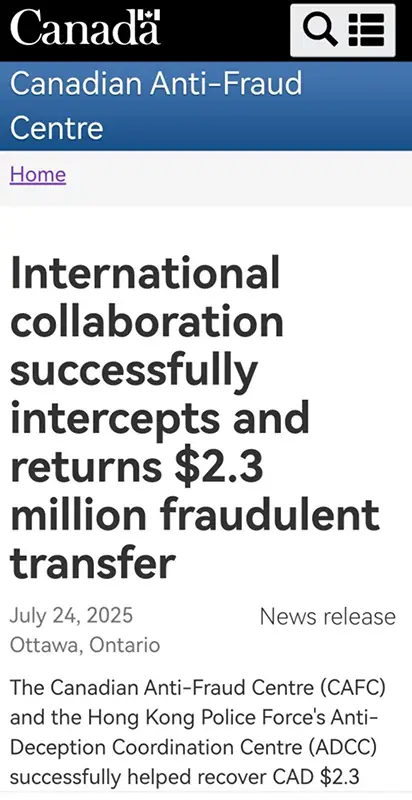
In June 2025, a Canadian law firm in Vancouver fell victim to a Business Email Compromise scam. Fraudsters posed as a regular contact sent fraudulent emails to trick the firm into wiring CAD 2.3 million to a bank account in Hong Kong. After identifying the fraudulent transfer, the bank alerted the Hong Kong Police Force. Thanks to the close cooperation between Chinese and Canadian police forces, the transfer was successfully intercepted and the money recovered finally. As Chris Lynam, Director General of the Canadian Anti-Fraud Centre, said, “This recovery demonstrates the power of global partnerships in the fight against fraud. Through trusted coordination and timely intelligence exchange with our colleagues of the Hong Kong Police Force, we not only helped a Canadian business avoid a significant loss, but also disrupted criminal activity at the international level.”
China has also actively carried out law enforcement cooperation with countries including Spain, the United Arab Emirates, Myanmar, Indonesia, the Philippines, Laos, Thailand and Cambodia, advancing joint law enforcement operations, dismantling thousands of overseas scam groups and bringing tens of thousands of overseas suspects to justice. In particular, China dealt a devastating blow to the notorious four criminal clans in Kokang region of northern Myanmar, extradited Chen Zhi, the ringleader of a major cross-border gambling and fraud criminal syndicate, from Cambodia to China, and extradited She Zhijiang, the principal of Yatai Xincheng gambling and fraud criminal syndicate, from Thailand to China. This has effectively imposed a strong deterrent against overseas scam syndicates and curbed the rampant telefraud and online scams.
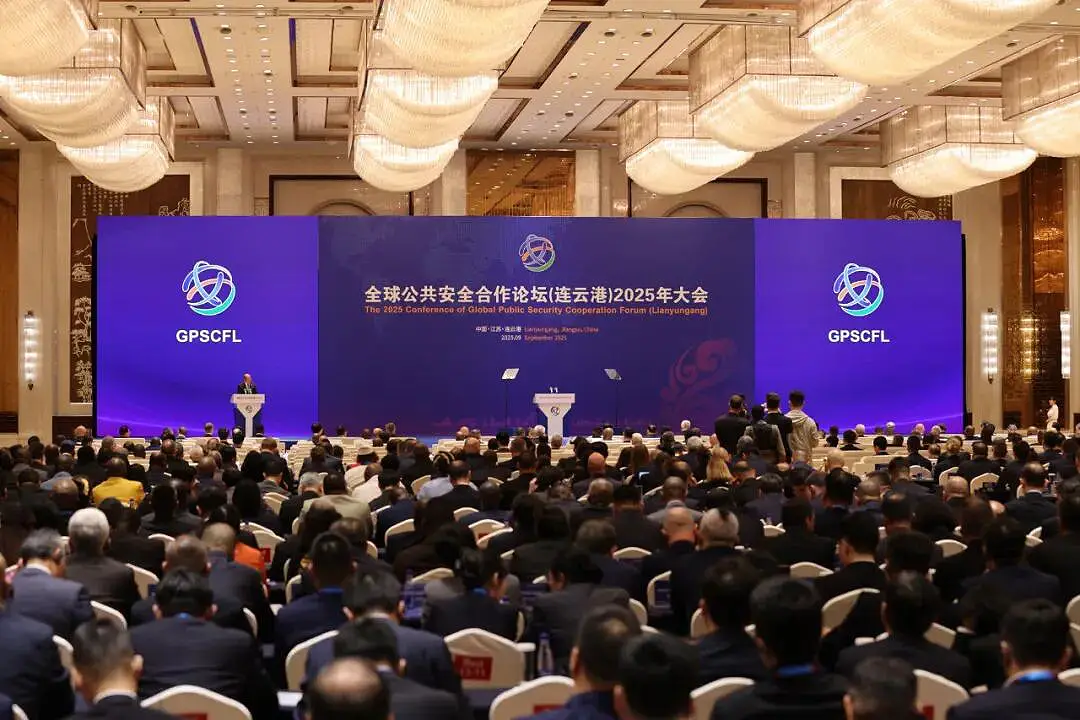
In September 2025, China hosted the Conference of Global Public Security Cooperation Forum in Lianyungang and proposed that relevant countries and regions work together to establish an international alliance to combat telefraud and online scams. The proposal aims to mobilize all stakeholders and the international community to jointly address the governance challenge posed by telefraud and online scams, push for more indepth integration of various security concepts, encourage exchanges and cooperation at a higher level, promote prevention and governance on a broader scale and build a new global framework of combating telefraud and online scams featuring coordinated action and widespread participation.
China looks forward to working with Canada and all the other countries to continue moving in the direction charted by the Global Security Initiative, deepen international law enforcement cooperation, and continue campaigns against new types of transnational crimes such as telefraud and online scams, so as to usher in a better future of lasting peace and universal security.