Recommended Articles
Canada’s pipeline system — the past and present

Are Tasers Giving Police More Power?

Mohamad Fakih; doing well by doing good.


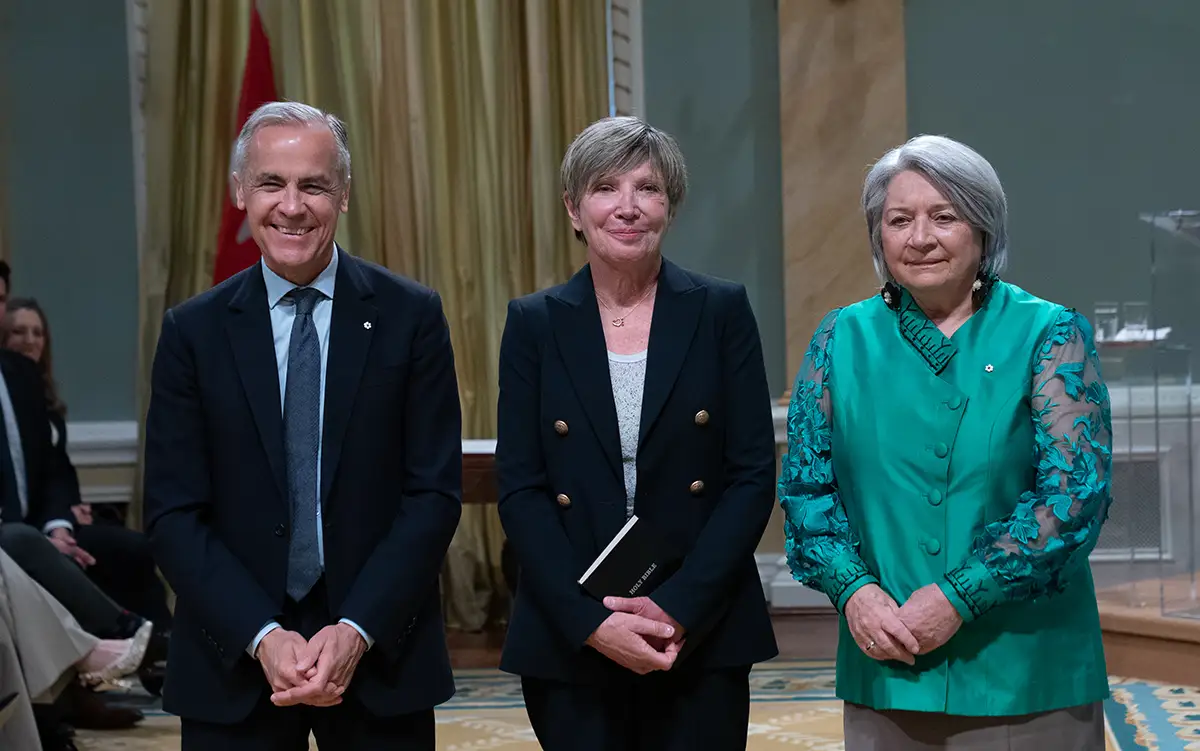
When Eleanor Angela Olszewski won Edmonton Centre last March under the Carney banner, she arrived in Ottawa as one of the most closely watched new MPs in the Prairies. A lawyer and former business executive with deep roots in Alberta’s civic and professional communities, she was quickly elevated to cabinet as Minister of Emergency Management and Community Resilience and Minister responsible for Prairies Economic Development Canada.
In the months since, Olszewski has emerged as one of the most capable and steady voices in the Carney government — particularly on files where federal–provincial tensions have historically run high. Her approach has been pragmatic rather than performative, and she has earned a reputation in both Ottawa and Alberta as a minister who understands the province’s economic realities and is willing to engage constructively to advance them.
In this wide‑ranging conversation with Ottawa Life Magazine, Minister Olszewski discusses the recent federal–Alberta Memorandum of Understanding, the future of Canada’s energy strategy, Indigenous economic participation, and the evolving landscape of emergency management across the country.
OLM: Last month, the Prime Minister and the Premier of Alberta signed a significant Memorandum of Understanding. As both a federal Minister and the MP for Edmonton Centre, could you share your perspective on how this agreement came together and which elements you believe are most beneficial for Alberta and for Canada?
Minister Olszewski: With respect to the memorandum, I was in the room when the Prime Minister and Premier Smith signed it, and for me — both as an Albertan and in my role as a minister — I don’t think I’ve ever felt more proud. There has been a long history of tension between the two governments, and this agreement felt like a genuine turning point. It reflects what the Prime Minister said early in his mandate about resetting the relationship with Alberta. From that starting point, this MOU is about building a stronger, more constructive partnership, grounded in shared ambitions and shared goals, and focused on delivering for people.
OLM: The MOU covers a wide range of issues shaping the federal–Alberta energy relationship going forward. After the announcement, much of the focus from the opposition — focused heavily on pipelines. From your perspective, how should that reaction be understood within the broader context of the agreement, and what do you think is important for people to keep in mind when looking at the full scope of the MOU?
Minister Olszewski: The MOU is far more than a discussion about pipelines. At its core, it’s about advancing this government’s broader mandate — strengthening Canada’s position as the strongest economy in the G7, reducing our dependence on the United States, and building a country that works for everyone. Economically, the MOU moves us forward with Alberta in a comprehensive way. Yes, it sets the conditions under which a pipeline could proceed, but it also covers a wide range of areas: nuclear development, environmental initiatives such as updating and amending methane regulations, and linking carbon capture projects to pipeline infrastructure, which advances both economic and environmental goals.
It also addresses the energy grid and the interests between provinces, which is particularly significant for the Prairie provinces. So from an economic perspective, this is really a framework that allows Alberta and the federal government to move ahead on shared objectives and shared ambitions — and those benefits extend not just to Alberta, but to the entire country.
OLM: You’ve noted that reducing Canada’s energy dependence on the United States is a priority the Prime Minister has raised at the cabinet table. What does that shift look like from your perspective? For example, would it involve processing more of our own oil here in Canada rather than exporting such a large share to the U.S. for refining? Given that roughly 60 percent of Alberta’s energy exports go to the U.S., where they’re refined and then sold on the global market, is the government looking at changing that model? Would this include expanding our ability to sell energy directly to other markets — Europe, Asia, or elsewhere? Is this the direction the Prime Minister and cabinet have in mind as they talk about reducing that dependency?
Minister Olszewski: Yes, and certainly a lot of this will depend on who ultimately steps forward as the proponent and what their plan looks like. As you know, the only proponent at this stage is the Province of Alberta. There isn’t yet a private‑sector proponent, and that will be a key factor. Once the Premier completes the study and the report she is commissioning — which will look at feasibility, engineering requirements, the potential route, and the possible terminus — we’ll have a clearer picture.
Presumably, at that point, a private‑sector proponent may or may not come forward. And the MOU is very clear that any pipeline would have to be funded by private industry, not by government. Many of the decisions ahead will ultimately be shaped by whoever the proponent is and the specifics of the proposal they bring forward.
OLM: You bring private‑sector and legal experience to this file, and the Prime Minister brings his own business background. One of the criticisms we hear from the Official Opposition is that, while the MOU sets out broad intentions on energy, existing federal legislation is still a major barrier to attracting private‑sector investment. They argue that the regulatory environment is too complex and that certain bills need to be repealed to draw investors back.
From your perspective, how do you see this playing out? Do you believe current rules and regulations are creating barriers to private investment, and is the government reviewing any of them? Put another way, what can the federal government do to create the conditions that encourage businesses to invest in major energy projects — whether pipelines, carbon capture, or other technologies — and strengthen Canada’s energy economy?
Minister Olszewski: I think a lot of the foundation for that has already been laid through what the Prime Minister has said — both in the platform and in his public comments since. He’s been very clear that while our government will continue making strategic public investments, attracting private capital is absolutely essential. He’s spent a lot of time in Alberta and across the Prairies meeting with business leaders, and I think there’s a real understanding on the part of business leaders now that the conditions he’s outlined for private investment are in place.
I also want to highlight the new federal Major Projects Office in Calgary, because it’s an important piece of this. It’s led by Dawn Farrell, who brings tremendous experience from the energy sector — including pipeline construction — and she’s exactly the kind of person you want guiding nationally significant projects. Her leadership is a huge asset for Alberta and for the country.
Business leaders in Alberta understand what this office is meant to do: it’s a one‑stop shop. If there are regulatory hurdles, that’s where they get addressed. And when you pair that with the MOU, which sets out a clear framework for how a pipeline or any major project can move forward, I think the signal to industry is strong. We’re saying: we’ll work with you, we’ll help attract capital, and we’ll help usher projects to move through the regulatory system as efficiently as possible — without unnecessary duplication or layers of red tape.
OLM: Minister, throughout your career you’ve consistently highlighted Indigenous issues — in your campaign, and again since arriving in Ottawa. Alberta has its own Indigenous Opportunities Corporation and an Indigenous partnership fund that supports participation in major projects. Can you speak more broadly to your views on the importance of Indigenous involvement in these kinds of projects, and how you see those partnerships working in practice?
Minister Olszewski: Through my department, Prairies Canada — (PrairiesCan), the federal regional economic development agency for Alberta, Saskatchewan, and Manitoba — we have a number of funding streams that support Indigenous‑led small and medium‑sized businesses. We help them scale up, diversify supply chains, and get their products to global markets. There is also significant support for Indigenous‑led businesses through the Major Projects Office, which is another key focus. And of course, both existing legislation and the MOU with Alberta recognize the importance of working with Indigenous peoples — ensuring not only that Section 35 obligations are met, but that Indigenous communities are true economic partners in major projects.
Last week, I announced the Prairies Partnership Initiative. It builds directly on legislation championed by the late Jim Carr, who really understood how challenging it can be for small and medium‑sized businesses to navigate federal programs and secure funding. His private member’s bill, passed in 2022, laid the groundwork for what we’re now able to move forward on, and I was really pleased we were able to build on his vision and finally put this initiative into action.
Here’s the gap we’re trying to fill: PrairiesCan typically funds projects up to $5 million. Then you have the very large, nationally significant projects handled through other mechanisms. But there’s a whole middle range — businesses that are beyond the start‑up phase but not yet large enough to access major‑project financing. That “desert” in the middle is exactly what the Prairies Partnership Initiative is designed to address. These are companies that could accelerate their growth if they had access to capital, and this initiative helps make that possible.
The initiative also acts as a window into the broader federal system. We now have 10 federal departments and four agencies participating. A business can bring a project forward, and the initiative convenes a table of officials from across those departments. If a project might receive funding from multiple departments, depending on whether they can support it. In some cases, a project might receive funding from three or even five departments, depending on how it aligns with their mandates and criteria. It’s an incredibly effective way for both Indigenous and non‑Indigenous businesses to access funding that fits their needs.
As for how it works on the ground: PrairiesCan has a portal where businesses can apply. A PrairiesCan official meets with them, gathers information, assesses the project, and determines whether it fits within that middle‑range gap. If it does, we help bring it forward to the interdepartmental table.
And to your question about who assesses these projects — these are federal officials based throughout the Prairie provinces. We have offices in Calgary, Edmonton, and several other locations. Our PrairiesCan officials are exceptional at what they do. They have a deep understanding of local business needs, and when I visited Edmonton and Calgary this summer, business leaders already knew them by name. The number of companies PrairiesCan has helped scale, diversify, and grow is really quite remarkable.
OLM: How would you describe the relationship today between the federal government — Prime Minister Carney and his cabinet — and the Premier of Alberta? The Premier signed the MOU, and from the outside it appears she sees real potential in this partnership, despite the usual political noise from opposition parties.
It reminds me a bit of earlier periods — during the Mulroney years, or even under the Pierre Elliott Trudeau era in the 70’s and 80’s — and later the Chrétien government in the 1990’s — when Ottawa and Alberta certainly clashed at times, but ultimately found ways to reach agreements and make them work. Do you get the sense that we’re in a similar moment now? Because it really does feel like we’ve moved from a fairly cold, even toxic, dynamic over the past decade to something quite different. How would you describe that shift since Mr. Trudeau left office?
Minister Olszewski: There’s been a palpable change, and that’s not just based on what I’ve heard — it’s what I’ve seen firsthand. I think there is absolutely a collaborative relationship between the Prime Minister and Premier Smith, and both of them are genuinely working in good faith toward shared goals and aspirations.
I’ve observed that directly, and I’ve also seen how people in Alberta have responded. I was at the Chamber’s lunch on the day the MOU was signed, and the atmosphere in that room was electric. It was full of Calgary and Alberta business leaders, and the Prime Minister was incredibly well received. When he said he wanted to reset the relationship with Alberta, I think he has done an exceptional job of doing that with the Premier.
And from what I can see, that’s something businesspeople across Alberta have noticed as well. Business leaders in Calgary, in particular, were very receptive to the Prime Minister. I think many people saw what happened that day as the beginning of a stronger, more collaborative relationship. In fact, I sensed a real feeling of relief — almost a collective exhale — that this reset was actually happening.
So yes, I think it’s accurate to say there has definitely been a reset.
OLM: As Minister of Emergency Management and Community Resilience your responsibilities span everything from events in the North and Inuit communities to emergencies on Indigenous lands and in major cities.
Minister Olszewski: When I started in this role after the election, it was already wildfire season — the seasons are starting earlier and lasting longer. Within a couple of days of being sworn in, I had my first emergency to deal with, and that continued essentially throughout the summer. So, my focus has been on identifying where the gaps are in the system so we can strengthen our federal emergency‑management response.
I did see some areas where we can improve quite quickly. One major issue is coordination — how we work with the provinces, how fast we act, and how effectively we can move resources from one province to another. In many ways, provinces cooperated very well and shared firefighting resources. But a lot of the real challenges were in very small and remote communities, especially those that had to be evacuated. Many of these were First Nations communities with small runways or limited access, where you can’t land a Hercules aircraft and have to rely on helicopters. It’s expensive, it’s slow, and you’re trying to move large numbers of people — often in rolling evacuations. In Saskatchewan and Manitoba, for example, one group would be evacuated and then very shortly after, another community would have to be moved.
Looking at all of that, my role is to determine where the system needs strengthening before the next wildfire season. One of the things we secured funding for in Budget 2025 is water bombers. We’ll be able to station them centrally in the country and deploy them quickly to provinces that are under‑resourced. That’s one step, but it’s only the beginning. There are several other short‑term measures we need to take before the next season, and longer‑term measures for the seasons after that. And over all of this is the broader goal of building community resilience. In emergency management, that’s a major priority for me.
One of the things I’ve done is open a process so people from coast to coast to coast can share their experiences from this wildfire season. We want to learn from what happened. Since becoming Minister, I’ve met with many stakeholders, including Indigenous leaders, to understand the gaps they experienced — whether in fire suppression, evacuation, or recovery. We’re compiling all of that information now.
One of the things I’m considering is whether Canada should establish a dedicated emergency‑management agency. We are the only G7 country without one. Such an agency would act as a central coordinating body during disasters — whether the emergency is in a northern community, in Alberta, or anywhere else in the country. It would ensure resources are deployed quickly and efficiently.
Right now, we do have the Canadian Interagency Forest Fire Centre (CIFFC) — a national coordination centre based in Winnipeg that helps provinces and territories share firefighting resources. For example, if Saskatchewan is short on water bombers and Quebec has capacity, CIFFC coordinates the transfer of aircraft or personnel. They do excellent work, but their mandate is focused on wildfires.
And wildfires aren’t the only natural disasters we face. Flooding, in fact, costs us more in damages than wildfires do. Evacuations from wildfires are incredibly disruptive, but floods cause enormous financial losses. So the question is: how do we build a stronger federal role across all types of emergencies, without duplicating what already works well, but improving coordination where it’s needed.
That’s what I’ve been focused on since being elected — not only responding to what happened this past wildfire season but looking ahead and asking: what do we need to do to ensure that next wildfire season, or the next major flood or disaster, we are better prepared across the country.
OLM: The Defence Minister has talked about expanding the reserves and possibly creating an emergency‑preparedness component so that not all disaster response falls on the Canadian Armed Forces. Given your role as Minister of Emergency Management and Community Resilience, how might a dedicated civilian or reserve‑type force fit into the work your department is doing?
Minister Olszewski: In the context of emergency management, we’ve been looking at whether Canada should have a dedicated civilian force to help respond to wildfires and other disasters, so that we’re not relying on the Canadian Armed Forces except as a last resort — those discussions are ongoing. It would be helpful to have some kind of dedicated force, whether that’s the Youth Climate Corps or whether Minister McGuinty develops a reserve‑type capability. What we don’t want is the Canadian Armed Forces dealing with wildfires or other disasters unless it’s absolutely necessary. These are highly trained soldiers whose primary role is to defend our country — to go on missions, to train other soldiers around the world, to participate in peace operations, whatever the mission happens to be.
When we pull them away from that work, it’s not that they’re unwilling — they absolutely want to step up for the country — but it’s simply more sensible to have another group dedicated to that kind of response. Especially when it comes to Type 3 firefighting work, which is after the fire is under control and you are doing mop‑up work. It’s hard, physical labour, but it has to be done, and it makes sense to have a separate force trained and ready for that.
Minister Eleanor Olszewski represents a new chapter in the relationship between Alberta and Ottawa — one defined less by confrontation and more by practical cooperation. In her first nine months in the Carney cabinet, she has taken a steady, disciplined approach to some of the country’s most complex files — energy, Indigenous economic participation, and emergency management. She is focused on building systems that work, partnerships that last, and a federation that functions more effectively for everyone. Whether this cooperative moment lasts will depend on the next wildfire season, the next round of energy negotiations, and the next test of federal-provincial trust.
As Olszewski says, “there has definitely been a reset.” The real question now is whether that reset turns into something people can see in their day‑to‑day lives over the coming year.
Photo: Lars Hagberg, photographer for Prime Minister Mark Carney.