Algonquin perspectives of local shorelines in the “Edge Conditions / Inawendiwin” exhibition at Âjagemô

By Leah Snyder

For those of us fortunate to live in this beautiful region, the waterways are part of the gift that the landscape provides. Along with the man-made construction of the Rideau Canal, a UNESCO World Heritage Site, there are three natural waterways with their defining presence. Their Algonquin names describe each river’s features: the Ottawa River, Kichi Zìbì is the great or big river. The Rideau River, Pasapkedjinawong Zìbì, is the ‘river that passes between rocks.’ As for the Gatineau River, Tenàgàdino Zìbì, there are several understood meanings. The late Algonquin elder William Commanda (1913-2011) said that the name could be translated as “the river that rises in steps.”

For thousands of years, the rivers have been travel routes, bringing First Nations to the area for provisions of nourishment, both physical and spiritual. Today, they offer natural respite from the urban sprawl of the municipalities lining both sides.

As the curator for the current exhibition at the Canada Council for the Arts Âjagemô space, Edge Conditions / Inawendiwin, it is the presence of these bodies of water that flow through the cities of Ottawa and Gatineau that I wanted to draw visitors’ attention to as their health is tied to our own. For this reason, the work of Algonquin artist Claude Latour was essential to the exhibition.

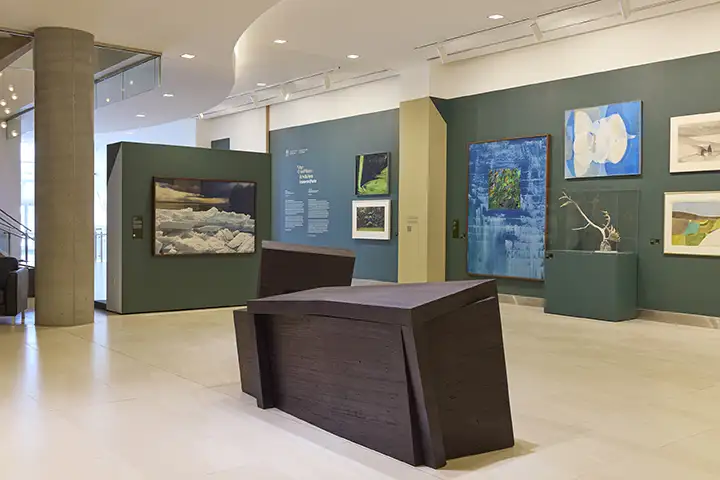
ABOVE: Roland Poulin’s En Présence (1986) in the foreground, with Claude Latour’s Sigwan on the Kichi Zibi (2024) displayed on the wall behind, to the left.


In Sigwan on the Kichi Zibi (2024), Latour depicts early spring (sigwan) on the Ottawa River as ice breaks up at the shoreline’s edge. The ice blocks pile up in the foreground, forming a large mass separating the viewer from the water beyond. As with many of the art works in Edge Conditions / Inawendiwin (Algonquin for relationship) the horizon line is a way to connect them as an ensemble speaking to notions of settlement along shorelines, human or non-human, and the species we share space with. In Latour’s, a dramatic sky with dark storm clouds looms, but the sun’s glow also makes an appearance, radiating on the surface of the water and providing luminosity to the ice. Taken from the Quebec side close to Alymer, power towers are barely perceptible above the shoreline on the Ottawa side, connecting to another theme of the exhibition: evidence of human settlement within the landscape and what this means with regard to the traces we leave and the impact we make.

In Âjagemô, Roland Poulin’s En Présence (1986) is situated in context with Sigwan on the Kichi Zibi. A large sculptural work, it arises as its own isle replicating obstructions encountered within a landscape. Its massive shapes echo the blocks of ice in Latour’s. Interestingly, Poulin was Latour’s professor while he was studying art at University of Ottawa in 1999. Another work in conversation is Vessel (2019) by Gillian King, also an U Ottawa art alumni. In her practice, King transforms plants and river sediment gathered from local waterways into the pigments that seep through her canvasses. For the exhibition, it was a way to bring the essence of the shoreline into the space through the natural materials she uses to create her abstractions.

Along with King’s work from the City of Ottawa Collection and Ottawa-based Iraqi-born artist Farouk Kaspaules’ The Return from the Ottawa Art Gallery’s collection, the exhibition also includes almost 40 works from the Canada Council Art Bank placing them all within the tradition of landscape art in Canada. Through the works, landscape art is expanded to include many voices that lead us to consider who or what is left out of the frame as well as how we encounter what surrounds us.

Exhibiting artists include Shuvinai Ashoona, Martin Borden, Michel Campeau, Lucie Duval, Tom Eneas, Jonathan S. Green, Jamelie Hassan, David Hlynsky, Anique Jordan, Farouk Kaspaules, Gillian King, Katherine Knight, Wanda Koop, Megan Krause, Claude Latour, Rita Letendre, Kenneth Lochhead, Shelly Low, Don Maynard, Max Maynard, Norval Morrisseau, Toni Onley, Marcel Piet-Hein Kerkhoff, Pinock, Roland Poulin, Pudlo Pudlat, Gordon Rayner, Ranjan Sen, Susan D. Shantz, Nick Sikkuark, Greg Staats, Takao Tanabe, Brendan Lee Satish Tang, Thomas Udjuk, Ruth Wainwright, Esther Warkov, Anna Williams, Lin Xu and Lan “Florence” Yee.

Edge Conditions / Inawendiwin, is a tribute to the local shorelines and the life within them. The exhibition runs until May 2027.

The Âjagemô exhibition space at 150 Elgin Street is free and open to the public 7 days a week from 7 am – 9 pm.

Claude Latour’s solo exhibition, Makwa’s Blessings, continues through to early August at Patrick Gordon Framing, 160 Elm Street, Ottawa.


About the Curator: Since moving to Ottawa in 2013, Leah Snyder has embraced the region’s shorelines and horizons. A digital designer, she collaborates with Indigenous artists to build online archives, and her writing has appeared in major art and architecture publications. When not immersed in art or technology, she can be found walking along and through the edge conditions.

Images: Brandon Clarida Image Services. Courtesy of the Canada Council Art Bank.