Best Commercial Cleaning Companies for Multi-Location Businesses in North America
Running multiple locations is hard enough. Your cleaning vendor shouldn’t make it harder.
Yet for most multi-site businesses, that’s exactly what happens. Different vendors in different cities. Different billing cycles. Different quality standards. No way to tell if any of it is working until a client walks into a messy office and says something.
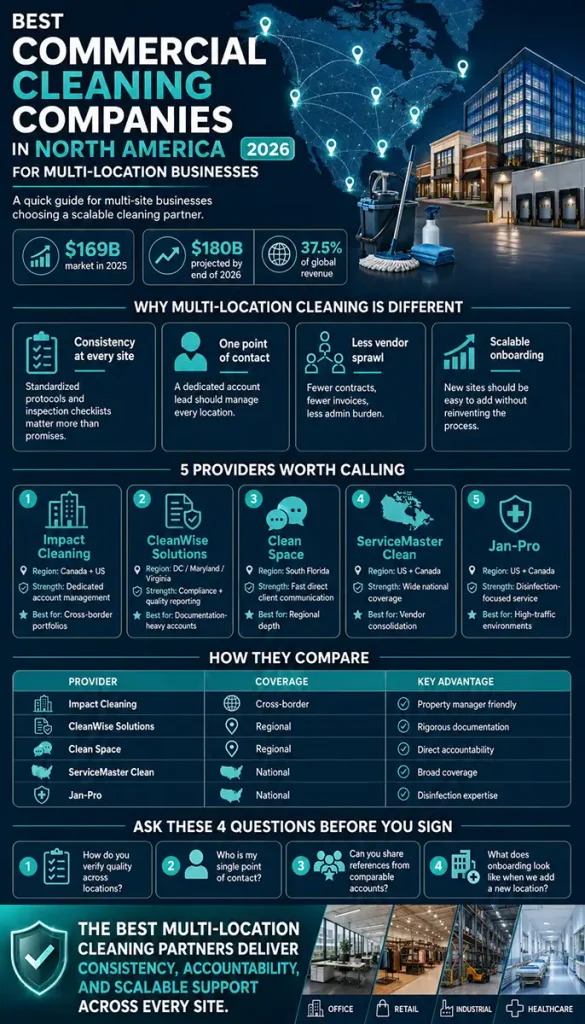
The commercial cleaning industry in North America is valued at $169 billion as of 2025 and growing toward $180 billion by the end of 2026, according to Fortune Business Insights. North America now holds 37.5% of global cleaning services revenue, the largest share of any region in the world. It’s a massive, fragmented industry, and that fragmentation is exactly the problem multi-site businesses run into.
The vendors who can genuinely handle multi-location accounts are a small slice of that market. This guide cuts straight to who’s worth calling.
Why Multi-Location Cleaning Is a Different Problem
Most cleaning companies are built for a single territory. Local crews. Local management. A phone number that rings one person in one city.
That works fine if all your offices are in the same building. It falls apart fast once you’re managing facilities across regions.
Here’s what actually changes at scale.
Consistency becomes the core problem. A standard set at head office means nothing if the crew at your satellite location never received it. Multi-location vendors need standardized protocols, documented inspection checklists, and someone accountable for verifying results across every site, not just the flagship.
One contact point becomes non-negotiable. Facility managers shouldn’t be tracking down a regional rep in every city. The right vendor assigns a dedicated account lead who owns the relationship across all locations, handles issues without escalation, and can make contract changes without three separate approvals.
Vendor sprawl is more expensive than it looks. Each local contract comes with its own overhead, onboarding time, and management burden on your side. Four vendors across four cities means four sets of contacts to manage, four invoices to reconcile, and four separate conversations every time a standard changes. That administrative cost adds up fast, and it rarely shows up in anyone’s line-item cleaning budget.
That’s the case for getting this right from the start.
The Comparison: Top Commercial Cleaning Providers for Multi-Location Accounts
| Provider | Best Region | Multi-Location Support | Specialty | Notes |
| Impact Cleaning | Canada + US (expanding) | Dedicated account management | Cross-border portfolios | Strong for property managers |
| CleanWise Solutions | Washington DC / Virginia | Single point of contact | Government-adjacent / compliance | Rigorous documentation |
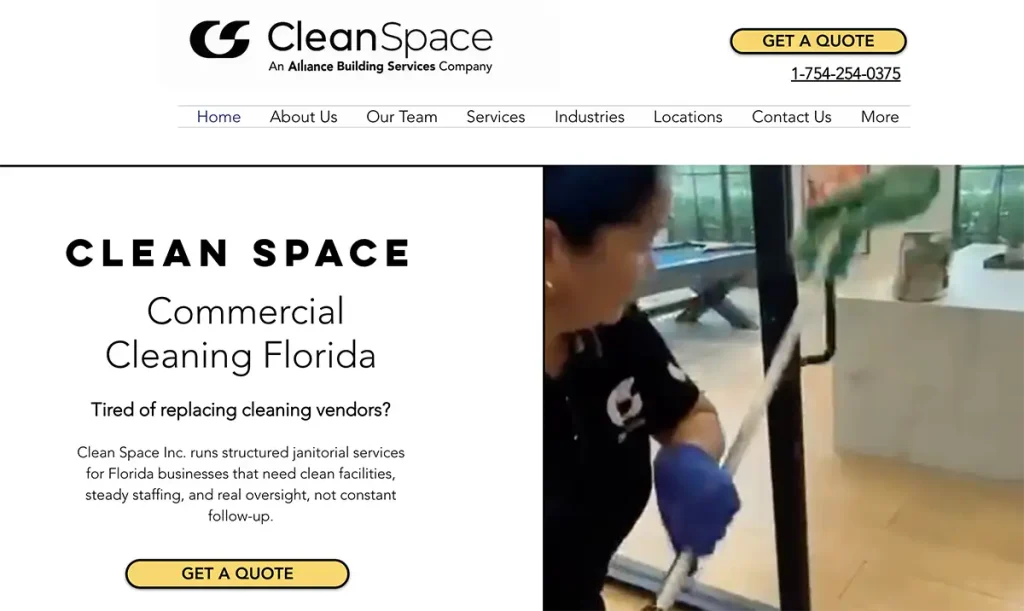
| Clean Space | South Florida | Direct client access | Miami / Fort Lauderdale commercial | Regional depth |
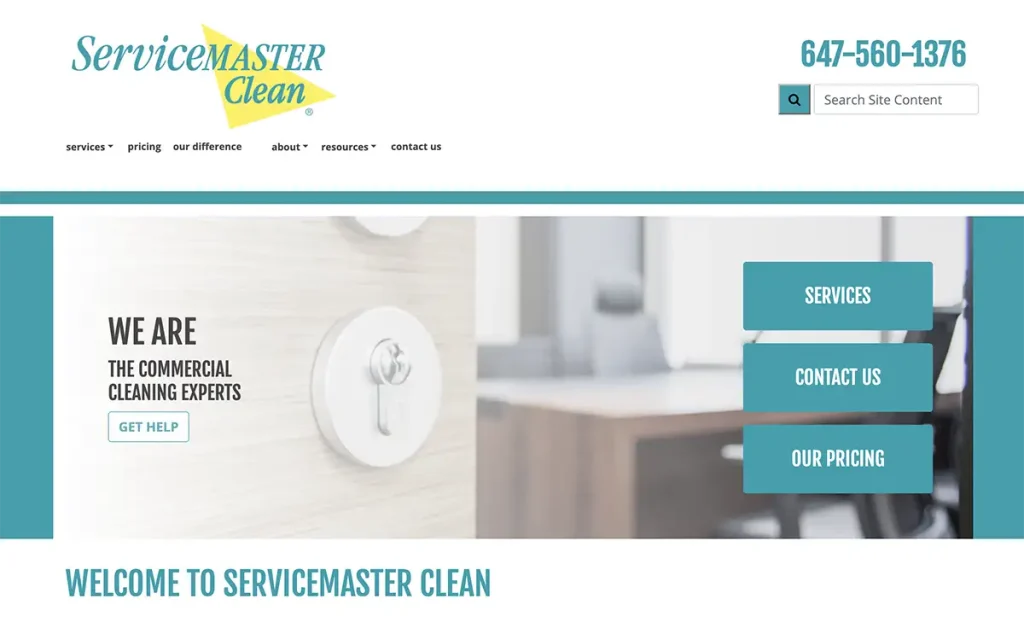
| ServiceMaster Clean | US and Canada (national) | Franchise network | Wide geographic coverage | Quality varies by franchise |
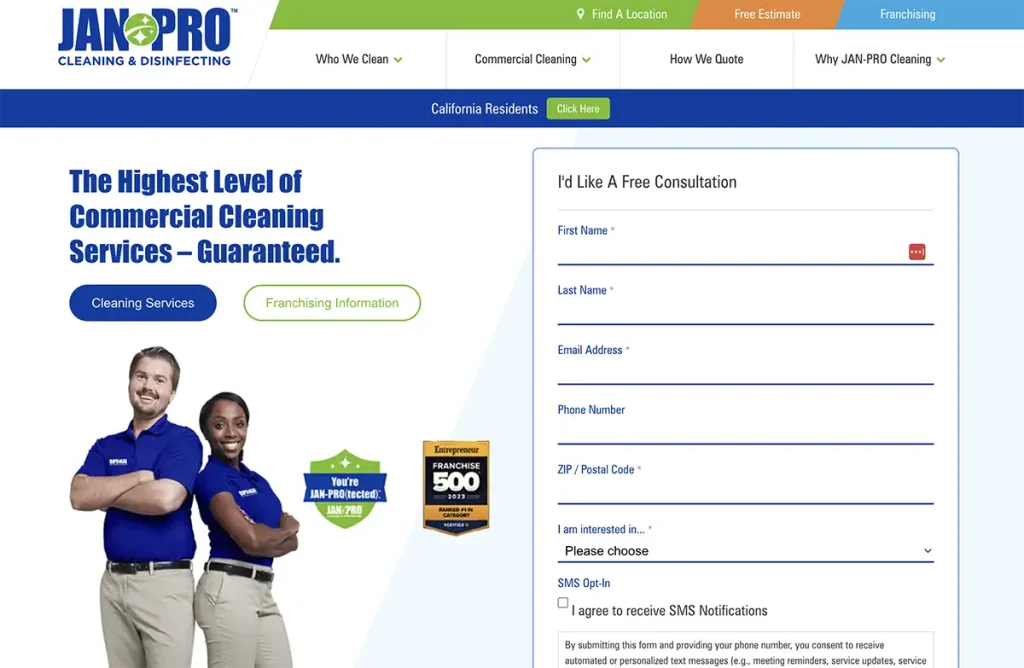
| Jan-Pro | US and Canada (national) | Franchise network | Disinfection-focused | Verify local operators |
The Providers Worth Knowing
Impact Cleaning
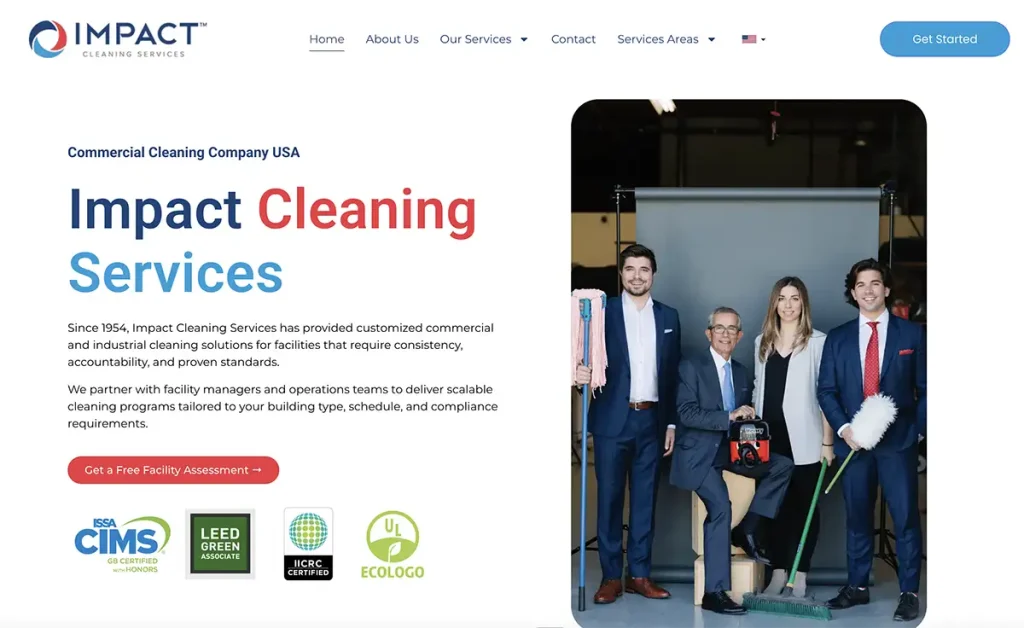
Few commercial cleaning companies can claim they started with a squeegee and 5-cent window washes in 1954. Impact can. What began as a father-and-son operation on the streets of Toronto has grown over 70 years into a national cleaning and facility services team trusted by the city’s top commercial property managers.
That history matters for multi-location clients because it signals operational depth. Impact isn’t figuring this out as they go.
For businesses straddling the Canada-US border, they solve a problem most vendors pretend doesn’t exist: the moment you have locations on both sides of the border, your cleaning program fragments into separate vendors, separate contacts, and separate quality standards.
Operating under impact.ca in Canada and impact.co in the US, they function as a true single-vendor solution for cross-border portfolios. Their customer service portal lets clients flag issues for real-time response rather than waiting on email, and their cleaning plans are built around each facility’s size, hours, and industry requirements. They serve offices, retail environments, warehouses, industrial sites, and healthcare facilities across Ontario and beyond, with Health Canada-approved eco-friendly products available for clients with sustainability mandates. All staff are bonded, insured, and vetted before deployment.
For property managers overseeing multiple buildings, Impact’s decades of account management experience across the GTA is a meaningful differentiator from vendors still building their systems.
Best for: Canadian businesses expanding into the US, cross-border multi-site accounts, property management companies with mixed portfolios, GTA-based commercial and healthcare facilities.
CleanWise Solutions
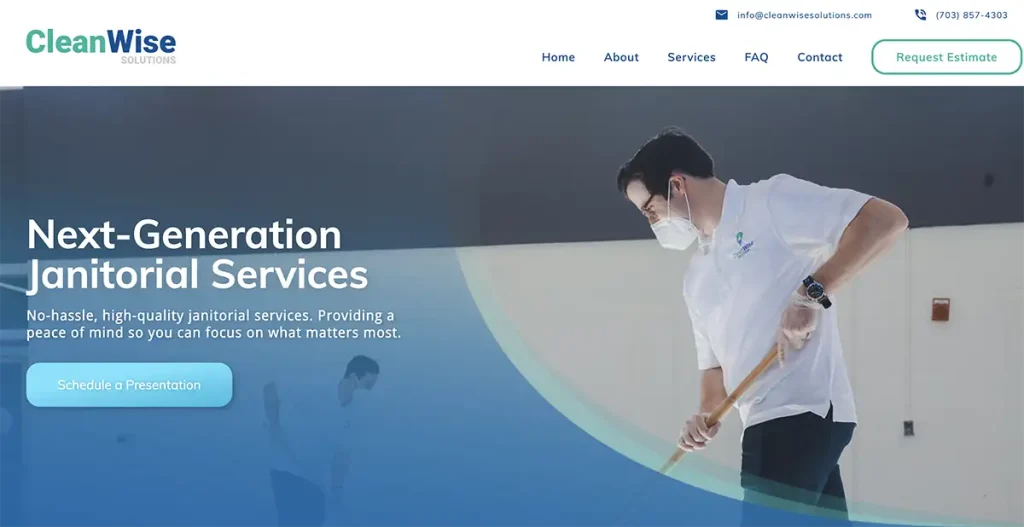
CleanWise Solutions was founded in 2020, built specifically to serve the DC Metro commercial cleaning market at a moment when most businesses were scrambling to figure out post-COVID hygiene standards. That origin shaped the company: CleanWise came in with documented protocols, compliance awareness, and a seriousness about quality control that most regional competitors hadn’t developed yet.
They serve Class A and B office buildings, outpatient and medical facilities, and apartment buildings across DC, Maryland, and Virginia. They are also union-capable, which matters for certain government-adjacent and institutional accounts in the region.
What sets them apart operationally is their Quality Control Program, an active scoring system where experienced site managers assess and report on cleanliness across specific categories. Clients receive those reports directly, giving full transparency into what’s being measured and how the service is performing over time. That kind of documentation is something most national franchise operators simply don’t offer at the local level.
CleanWise runs an employee profit-sharing model and invests heavily in staff retention, which translates to lower turnover and more consistent crews. They have since expanded into the Tysons market, one of the largest office submarkets in the entire DC region.
Best for: DC, Virginia, and Maryland multi-site accounts, medical and outpatient facilities, professional services firms, data center facilities, compliance-sensitive buildings that need documented quality reporting.
Clean Space
Clean Space has been operating in South Florida since 2011, making them one of the more established independent commercial cleaning companies in the region. They are family-owned, not a franchise, which is a meaningful distinction when you need someone accountable for your account rather than a regional rep fielding calls on behalf of a national brand.
Their footprint covers Miami, Fort Lauderdale, West Palm Beach, Tampa, and Orlando, with the same documented scope and quality checks applied across all locations. For a multi-site business whose Florida properties need to match the standard set everywhere else in the portfolio, that consistency is the core value proposition.
The communication infrastructure is more developed than you typically find at this market tier. Clients get a dedicated app where questions, requests, and concerns receive a response within 10 minutes. For facility managers juggling multiple properties, that kind of responsiveness reduces the time spent chasing vendors considerably.
Clean Space serves corporate offices, medical groups, multi-family communities, industrial buildings, hotels, retail stores, government facilities, and schools. Their service depth is notable for a regional operator: janitorial, floor care, carpet cleaning, tile and grout, pressure washing, electrostatic sanitization, air duct cleaning, marble and stone polish, and 24-hour water extraction, which is particularly relevant in a high-humidity, storm-prone market like South Florida.
Best for: South Florida commercial properties across Miami, Fort Lauderdale, and the broader Florida market, multi-location businesses with a Southeast US presence, clients who want direct accountability and fast communication over a managed-services layer.
ServiceMaster Clean
With franchise locations covering most major markets across the US and Canada, ServiceMaster is the easiest vendor to consolidate under when geographic spread is the primary concern. The national brand recognition and broad coverage make them a practical option for businesses with a wide, spread-out footprint.
The trade-off is variability. Franchise operators differ significantly in quality and management depth. Vetting at the local level before signing a national agreement is strongly recommended.
Best for: Businesses with wide geographic spread, accounts that prioritize vendor consolidation under a single brand umbrella.
Jan-Pro Cleaning and Disinfecting
Jan-Pro built a strong differentiator in the post-2020 period around disinfection protocols, and that capability has held into 2026. Their certified franchise system is designed to deliver standardized results, and their disinfection-focused service lines are worth evaluating for healthcare-adjacent, food service, or high-traffic environments.
Like ServiceMaster, franchise quality varies by market. Direct reference checks with comparable accounts are worth the extra step before committing.
Best for: Healthcare-adjacent facilities, controlled laboratory peptide provider facilities, high-traffic commercial environments, automotive services, clients with active disinfection requirements.
What to Ask Before You Sign Anything
More growth means more vendors making promises they can’t keep to win multi-site contracts. North America is projected to hold the largest share of global cleaning services revenue through 2035, according to Research Nester, so the field is only getting more crowded.
Before committing to any provider, four questions separate serious operators from the rest:
1. How do you verify quality across locations? If the answer involves waiting for client complaints, that’s a red flag. Proactive audits and documented inspection reports are the baseline expectation at this level.
2. Who is my single point of contact, and what decisions can they make without escalating? A dedicated account lead who can’t resolve issues without approval from three people above them isn’t really a single point of contact.
3. Can you provide references from accounts with a comparable number of locations in comparable markets? Not just happy clients. Comparable accounts, comparable geography.
4. What does onboarding look like when we add a new location mid-contract? A vendor who figures this out each time is not built for scale. A vendor with a documented onboarding process is.
The right answers to all four tell you more than any sales deck.
Photo: iStock