
• By: Don MacLean

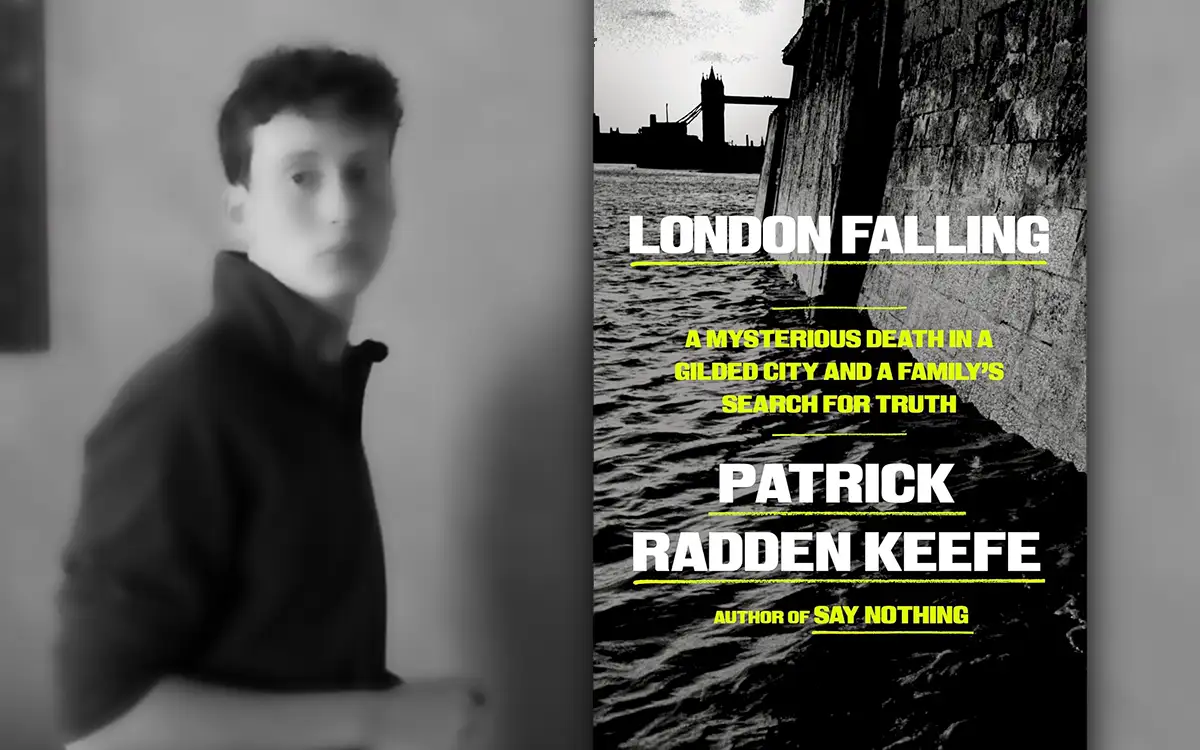
Book Review: The Dark Mystery at the Heart of ‘London Falling’

A young man’s mysterious death in London exposes some darker truths about both the city and the world in which we live.

The premise of London Falling by Patrick Radden Keefe is every parent’s worst nightmare. The year is 2019. Zac Brettler, a nineteen-year-old Londoner, was missing. His mother and father were frantic with worry, but still hopeful their son was fine. It wasn’t so much that he didn’t return home that night. It was that he couldn’t be reached by phone and he wasn’t responding to text messages. He also had been acting strangely. A distance had crept into their relationship. There was concern he might have fallen in with the wrong crowd. Perhaps whatever issues he was having were drug related. Days later, the police shared with the parents the news they feared the most: Zac’s body had been found in the River Thames. Soon, they would learn that video footage captures the young Zac on a 5th-floor balcony of a posh apartment in the heart of London, moments before he leaps to his death. That Zac is alone and is seen to jump suggests his death was a suicide. Tragic, to be sure, but also plain and straightforward. The eyes don’t deceive.

Or do they? Even a cursory examination of the circumstances of the night in question presents a different possibility. There was at least one other person inside that apartment, he with a dubious past and a terrible reputation for violence. As Keefe suggests, perhaps Zac’s jump wasn’t a successful suicide, but rather a failed bid to escape a most dangerous situation. What if Zac was attempting to leap into the Thames from what he thought wasn’t too risky a height? As Keefe remarks, a nineteen year old’s sense of height and distance and his own athletic abilities might have given him an exaggerated sense of possibility. If that is what Zac thought, he would not have been far from the truth. Indeed, he might well have survived the fall had he not clipped the bank on his way down.

The loss of their son was, naturally, a shattering experience for Rachelle and Mathew Brettler. It’s not simply that he died in mysterious circumstances. They discover, to their infinite sadness, that they did not really know Zac, not like they thought. There were sides to him about which they had no idea. He was discontent in ways they did not appreciate or even understand. They scour the recent past searching for missed signs of struggle or unrecognized pleas for help. Amidst their anguish and endless questions, however, one shared certainty remained: Zac did not to want to take his own life. Even in retrospect, there were few, if any, signs that he was on such a tragic trajectory. On the contrary, their son had a lust for life.  This conviction initiated a search for the truth about Zac’s death that continues to this day.

London Falling is about a senseless tragedy. But the book would not have been written if not for a serendipitous encounter. Keefe was working in London on another project when, by chance, he found himself chatting with an acquaintance of the Brettlers. The man tells Keefe about Zac’s passing and the many unanswered questions surrounding his death. There’s a story here, he suggests to Keefe. Off Keefe went, keen to investigate and to follow various trails to see where they might lead. This was a fortuitous decision, not only for Keefe himself and for Zac’s family but for readers as well. For Keefe has many gifts as a writer. He writes with empathy and insight. He is a master of style and pacing: almost every chapter ends with the sort of unanticipated and occasionally jaw-dropping revelation that compels the reader to keep reading. His greatest gift, however, is his ability to trace the various threads that together comprise a person, a life. In so doing, investigating the life and death of Zac Brettler becomes a much bigger story about the world in which we live and about how the past is forever bearing down on the present.

In the years leading up to his death, Zac had undergone a deeply unsettling transformation. He had become enamoured with wealth and not the sort of wealth to which many people might normally aspire. Mathew and Rachelle, for example, are wealthy by most people’s standards. Rachelle writes, mostly for magazines. Mathew, we learn, is good with numbers and has an eye for finance. He is meticulous, analytical and well organized. These skills and traits have been conducive to a successful career in money management. He started his own firm and now has offices in both London and New York. His success in particular gave him and Rachelle options where their two sons — the older Joe and Zac — schooling was concerned. They wanted Zac to get into the same private school Joe attended. But Zac didn’t qualify. There were other options, however, even if they weren’t quite as prestigious.

To aspire is foundational to the human experience. Aspiration is why parents want their children to have the best education. Aspiration is why young people choose to work hard at whatever it is that lights a fire in their belly. Alas, it can also be the basis for some unhealthy, even demented, preoccupations. Zac was fascinated by Vladimir Putin and others like him: those who acquire vast sums of wealth in ways nefarious and corrupt. Putin lives his miserable life as though rules do not apply to him. Laws are for other people. But it wasn’t just Putin with whom Zac was enamoured. He was seemingly in thrall to the entire billionaire class, if it can be called that. This is the sort of person, apparently, who Zac aspired to be. He was so consumed by the idea that he manufactured a new persona designed to manifest it. To some who knew Zac, he was not Zac Brettler, son of Rachelle and Mathew Brettler. He was instead the son of a recently deceased oligarchic father and a mother living in luxury in Dubai. He lived at One Hyde Park, he told people, one of London’s most prestigious residential locations. He had been heir to a family fortune worth billions. He helped his father run their business empire. Now that his father died suddenly and unexpectedly, he has control over that family fortune.

What sort of people would Zac’s claims of vast riches draw to him? What would such people do if and when they discovered such claims were all fanciful nonsense?

Zac’s preoccupations and aspirations and his readiness to manufacture an alter ego seem distinctly modern. This is due, perhaps, to the existence of billionaires being a relatively recent phenomenon. Zac’s susceptibility to what can be called the toxic masculinity virus also feels modern, especially given the role of social media in spreading the most noxious ideas with which it is associated. Yet what Keefe brilliantly demonstrates is that Zac’s capacity for such deliberate fraudulence is nothing new. This is one of the ways Keefe traces the connections among the various characters that populate this incredible story. There is not only Akbar Shamji, an acquaintance of Zac who also happens to be a suave, smooth-talking entrepreneur with seemingly oodles of cash and business interests that span the globe. There is his father, Abdul Shamji, a second-generation Ugandan of Indian descent. He and his family, as well as any other citizens of Indian background, were given three months to leave Uganda shortly after Idi Amin came to power in 1972. They were forced to exit the country but could do so with no more than two suitcases and less than 60 pounds. Shamji complied with the order. Soon enough, he along with his wife and five kids were living in London. As Keefe describes and the reader might expect, Shamji’s family had to contend with racism in their new home, which was often expressed openly by Conservative Party politicians in particular. Shamji was never deterred. He was instead a relentlessly driven businessman who scoffed at the shoddy work ethic of most Londoners and who aspired to be among the wealthiest of Britain’s establishment. He seemingly succeeded in doing so, even though there is every indication his fortune was little more than a house of cards. His empire was financed by excessive debt. His business practices were typically unscrupulous: vendors would go unpaid, promises to workers and entire communities more often than not unkept. In many ways, he and Zac bore little resemblance. But in their shared propensity to project success, confidence and extreme wealth, there was a definite affinity.

London features prominently in the tale Keefe is telling. The city, like much of England, had not fared all that well in the post-World War Two period. England in the 70s was characterized by high inflation, labour strife and simmering discontent. The failure of successive Labour governments to steady the ship led to Margaret Thatcher and the Conservative Party’s rise to power in 1979 and, by the mid 1980s and early 1990s, to an altogether reshaped England and a different capital city. London, as though desperate for a new identity and renewed purpose, transformed itself into one of the high-finance capitals of the world. Money was welcome; questions as to the origins of such wealth were typically not asked. This was a particularly convenient approach after the collapse of the Soviet Union, when Russia was suddenly home to as series of billionaires looking to invest their recently acquired wealth. London’s financial institutions were only too happy to help.

It’s within this context that a strained but nevertheless symbiotic relationship between London and Russia’s billionaire class emerged. England’s capital city might be a safe haven for their untold riches, but not necessarily such a safe place for themselves. Getting fabulously rich overnight can come with strict conditions, none more dangerous or onerous than the one requiring constant fealty to Putin. To breach that unspoken contract is to risk one’s life. Keefe highlights a number of deaths of wealthy, expat Russians in London that can, at the bare minimum, be deemed suspicious but in fact suggest something far more sinister. One man who repeatedly told people he feared for his life makes the bizarre decision to fly in his personal helicopter. It blew up in the skies over London, instantly killing both him and his pilot. Others suffer a fate that has become one of the Kremlin’s hallmarks: poisoning surreptitiously administered via something like a pen or a drink.

Ahh, but surely all those sharp minds at Scotland Yard and London’s The Met would not rest until such murders were solved. Justice needs to be served. This is the sort of confidence Rachelle and Mathew initially share in those tasked with investigating their son’s death. It goes without saying that those trained to tease out anomalies and probe suspicious deaths can see what they plainly see: there was more to Zac’s death than meets the eye. Just consider the unsavoury types with whom he unwittingly got involved. Or the inconsistencies in the testimonies of those who were with Zac the night he died. Something is amiss. What the Brettlers failed to appreciate at the time is that London is a city of competing and often conflicting priorities, one insidious consequence of which is that justice can be compromised. Indeed, for those with the most money and power, justice is often something to be avoided as opposed to upheld. For them, some crimes are best left unsolved.


Title: London Falling: A Mysterious Death in a Gilded City and a Family’s Search For Truth
Author: Patrick Radden Keefe
Publisher: Penguin/Random House
Publication date: April 2026
ISBN: 9780385675482