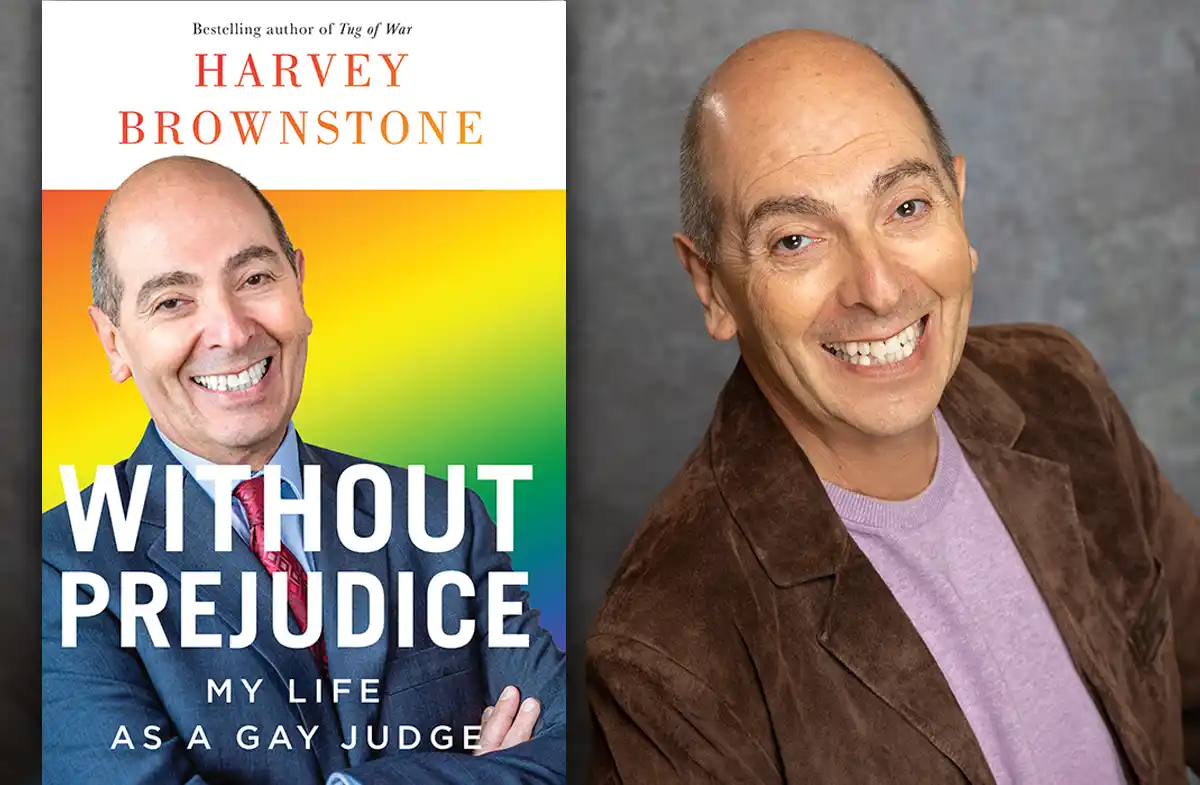
Book Review: ‘Without Prejudice’ Offers an Unfiltered Look at the Life and Career of Harvey Brownstone
Harvey Brownstone, Canada’s first openly gay judge, has released Without Prejudice: My Life as a Gay Judge, a memoir that chronicles his journey from a bullied and rejected young man to a lawyer, judge, author, and broadcaster. The book examines the impact of family rejection, poverty, depression, homophobia, and the realities of working within Canada’s justice system.
Brownstone’s memoir traces his life from his upbringing in Hamilton, Ontario, through law school and legal practice, to his eventual appointment to the judiciary. He served on the Ontario Court of Justice and uses the book to recount the personal and professional experiences that shaped his career. The memoir also follows his evolution from a young lawyer navigating both professional and personal challenges to a judge who would go on to become one of the most recognizable figures in Canada’s legal community.
A central focus of the memoir is Brownstone’s experience as a gay man coming of age during a period when acceptance was far less common than it is today. He has spoken openly about being rejected by his family after coming out and the challenges that followed. After revealing his sexual orientation to his parents, Brownstone said his mother’s reaction was “beyond volcanic,” and he subsequently found himself without a home, financial support, or a place to live.
Brownstone draws on those experiences throughout the memoir, connecting personal hardship with later achievements in law and public service. His story details many of the obstacles he confronted, including parental rejection, poverty, depression, homophobia, institutional inertia, and professional sabotage.
He also devotes considerable attention to his years on the bench. Brownstone reflects on judicial life, court administration, and his observations of Canada’s criminal and family justice systems. He discusses aspects of the legal system that he believes worked well, as well as areas where he felt reform was needed. Among the topics addressed are the practical realities of decision-making in the courtroom and the challenges faced by judges responsible for resolving matters that can have profound consequences for individuals and families.
In this respect, the book stands out for its candid examination of Canada’s criminal and family courts through the eyes of someone whose own experiences with discrimination, adversity, and perseverance inevitably shaped his perspective as a judge. Brownstone has said that many of the stories and reflections contained in the memoir were drawn from journals he maintained throughout his life and career. Those journals provide the foundation for a narrative that spans several decades, allowing Brownstone to recount both personal milestones and professional developments with a level of detail that might otherwise have been lost to time.
Another recurring theme is resilience. During a 2026 interview on The Avrum Rosensweig Show, Brownstone described rejection as “the greatest gift” he ever received, explaining that adversity became a motivating force throughout his life and career. That perspective appears repeatedly throughout the memoir’s account of his personal and professional development. The book frequently returns to the idea that setbacks and disappointments can become catalysts for growth, a theme that aligns closely with Brownstone’s public comments about the role adversity played in shaping his ambitions and determination.
The publication of Without Prejudice comes as Brownstone’s story reaches a broader audience beyond the page. A feature film adaptation of the memoir, also titled Without Prejudice, is directed by Shane Stanley. According to publicly reported information, the film stars David Arquette as Brownstone and is scheduled for release in 2026. The adaptation reflects the broader public interest in Brownstone’s life story, which spans the worlds of law, public service, publishing, and broadcasting.
At 232 pages, Without Prejudice combines personal history with reflections on law, public service, and social change. For readers interested in the experiences of LGBTQ+ Canadians, the evolution of Canada’s legal system, or the life of one of the country’s most recognizable judges, the memoir offers Brownstone’s account of the events that shaped his journey from social outcast to public figure. It also serves as a firsthand account of a period of significant social change in Canada, documenting how attitudes toward sexual orientation evolved over the course of Brownstone’s lifetime and career.
More than a personal memoir, Without Prejudice serves as a record of perseverance, professional achievement, and social change while providing readers with Brownstone’s own perspective on the experiences that shaped both his life and his contribution to Canada’s legal landscape. Whether readers approach the book for its legal insights, its account of overcoming adversity, or its perspective on a changing Canada, the memoir offers a detailed and deeply personal account of a life lived at the intersection of public service and social progress.
In sharing that story, Brownstone has created not only a memoir of personal significance but also a valuable record of a journey that helped break barriers and expand representation within one of Canada’s most important public institutions.
Without Prejudice: My Life as a Gay Judge, published by ECW Press, is available from major retailers and online stores.