
• By: Dan Donovan

Budget 2025: Carney’s Visionary Reform or Bureaucratic Overreach in a Government That Talks Big but Struggles to Execute

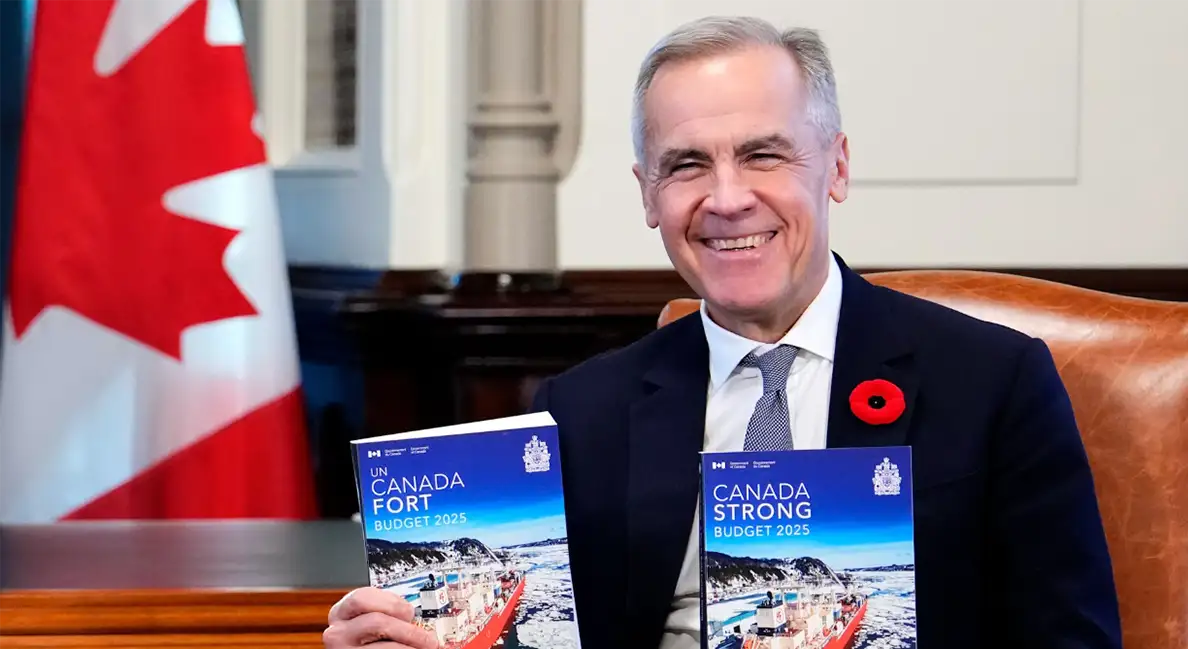
Prime Minister Mark Carney’s first federal budget arrives at a moment of economic anxiety and political fragmentation. With affordability worsening, investment fleeing, and public trust in government delivery at a low ebb, Budget 2025 attempts to reset Canada’s economic trajectory with $141.4 billion in new spending, five new federal agencies, and a sweeping vision of long-term transformation. But beneath the ambition lies a deeper question: can a government that has struggled to execute now deliver on its most complex agenda yet?

Overview: Ambition Without Guarantees

Tabled on November 4, 2025, Budget 2025 outlines a 406-page economic blueprint focused on investment-led growth rather than short-term deficit control. It includes:

• $78.3 billion projected deficit for 2025–26
• Nearly $90 billion in new investments over five years
• Modest cuts to federal operations and staffing

The budget aims to reposition Canada amid global trade instability and declining investor confidence. Economist Kevin Page told Global News on November 4, “It’s a bold shift toward investment-led growth, but implementation will be the biggest challenge.”

Affordability and Housing: Still Missing the Mark

Despite its scale, the budget fails to address the top concern of Canadians: affordability. Grocery prices rose 4 percent year-over-year, and food insecurity is rising. Sylvain Charlebois, food economist at Dalhousie University, told CHCH News on November 4, “There is nothing in this budget that will reduce food inflation.”

On housing, the budget funds new construction incentives, but Canada needs 3.5 million new homes by 2030. The Canadian Home Builders’ Association says the measures “fall short of the scale required.” The newly announced National Housing Accelerator Office is intended to streamline approvals, but its impact will depend on provincial cooperation and execution.

Climate Policy: A Mixed but Stabilizing Signal

The government maintained industrial carbon pricing and expanded green investment tax credits, though it backed away from stricter emissions caps and greenwashing rules. Yrjö Koskinen of Queen’s University’s Institute for Sustainable Finance told CBC News on November 5, “The budget emphasizes that climate policies are an economic necessity.” The result is a climate policy that stabilizes rather than accelerates Canada’s green transition.

Civil Service Cuts: Tepid Compared to the Past 

The budget proposes a reduction of 16,000 federal positions over three years—about 4.5 percent of the current workforce. Since 2015, the federal civil service has grown from approximately 233,000 employees to 340,000 today—a 46 percent increase. Annual personnel costs rose from $47 billion in 2015 to nearly $79 billion in 2025. By comparison, the 1996 Program Review under Prime Minister Jean Chrétien eliminated over 45,000 positions and cut departmental budgets by 20 percent. Carney’s proposed cuts are modest and unlikely to meaningfully reduce the cost or size of government.

Bureaucracy Expands: Five New Agencies, $13.2 Billion, and a Delivery Dilemma

The budget creates five new federal agencies:

• Canada Innovation Growth Fund ($2.5B)
• National Housing Accelerator Office ($1.8B)
Build Communities Strong Fund ($3.2B)
Public AI Infrastructure Agency ($1.1B)
Clean Growth Investment Canada ($4.6B)

Totalling $13.2 billion over five years, these agencies have distinct mandates but overlap with existing departments, including ISED, CMHC, Infrastructure Canada, and Environment Canada. Without clear integration, they risk duplicating efforts and deepening delivery delays.

This expansion raises a fundamental concern: more government is not the solution to problems created by the government. Canadians are not asking for more offices—they’re asking for results. The success of these agencies will depend not on their creation, but on whether they can deliver measurable outcomes without becoming silos of administrative inertia.

Investor Confidence: Still on the Decline

Foreign direct investment in Canada fell 5.5 percent in 2024, and early indicators suggest further decline in 2025. Since Carney’s election, capital flight has accelerated amid concerns over high taxes, regulatory complexity, and bureaucratic inertia. Desjardins Chief Economist Jimmy Jean told Global News on November 4, “I would’ve hoped to see something much bolder to stimulate the private sector.”

Without structural reform, Canada risks reinforcing its reputation as a difficult place to do business. The budget’s emphasis on long-term investment is welcome, but unless it is paired with tax competitiveness, regulatory clarity, and faster permitting, investor sentiment may continue to deteriorate.

Defence, Immigration, and Youth: Targeted but Incomplete

Military: Budget 2025 allocates $81.8 billion over five years to rebuild and rearm the Canadian Armed Forces. This includes $20.4 billion for recruitment and pay, $19 billion for infrastructure upgrades, and $10.9 billion for equipment modernization. However, the plan lacks detailed timelines, procurement schedules, and project breakdowns. Critics note a recurring credibility gap: large defence announcements without execution plans undermine trust in Canada’s ability to meet NATO commitments or modernize its forces.

Immigration: The budget freezes permanent resident admissions at 395,000 for 2025 and reduces targets to 380,000 annually from 2026 to 2028. Temporary immigration will be cut to 370,000 by 2028. While the government says this aligns immigration with housing and healthcare capacity, critics argue the numbers remain too high. With youth unemployment at 14.7 percent and general unemployment at 6.4 percent, some economists and provincial leaders have called for a cap closer to 200,000 annually to ease pressure on social services and infrastructure.

Youth: Budget 2025 commits over $1.5 billion over three years to youth employment and training. This includes $594.7 million for the Canada Summer Jobs program (100,000 placements), $635.2 million for the Student Work Placement Program (55,000 opportunities), and $307.9 million for skills training in the trades and climate sectors. However, with youth unemployment reaching 14.7 percent in September 2025 and 20.8 percent among teens aged 15–19, critics say the measures are insufficient to address the scale of the crisis. Economist Jenna Benchetrit told CBC News, “Ottawa will have to go deeper to address root issues impacting youth.”

Political Outlook: Minority Manoeuvring

The budget faces a fractured Parliament. Opposition parties are voicing strong critiques, but analysts expect it to pass with minor amendments. Public sector unions are mobilizing against staffing cuts, and the political cost of austerity may rise.

Final Assessment: A Budget of Contradictions

Budget 2025 is expansive, ambitious, and deeply polarizing. It offers long-term investments, a pivot toward competitiveness, and a break from short-termism. But it also expands bureaucracy, underdelivers on affordability, and leaves critical gaps in defence credibility, immigration sustainability, and youth opportunity.

Supporters call it visionary. Critics call it reckless. What’s clear is that the government’s credibility no longer rests on how well it can announce—but on whether it can deliver. Canadians have heard the speeches. They’ve seen the plans. What they need now is execution—clear, measurable, and fast.

Without it, Budget 2025 risks becoming not a turning point, but a cautionary tale — a government that mistook motion for progress and ambition for achievement.

Photo: Courtesy thecanadianpress.ca