Recommended Articles
Naming names without naming them
Canada Skips Dialogue of Leaders of World Religions in Astana
Justin Trudeau and the Peter Principle



By Wen Ying
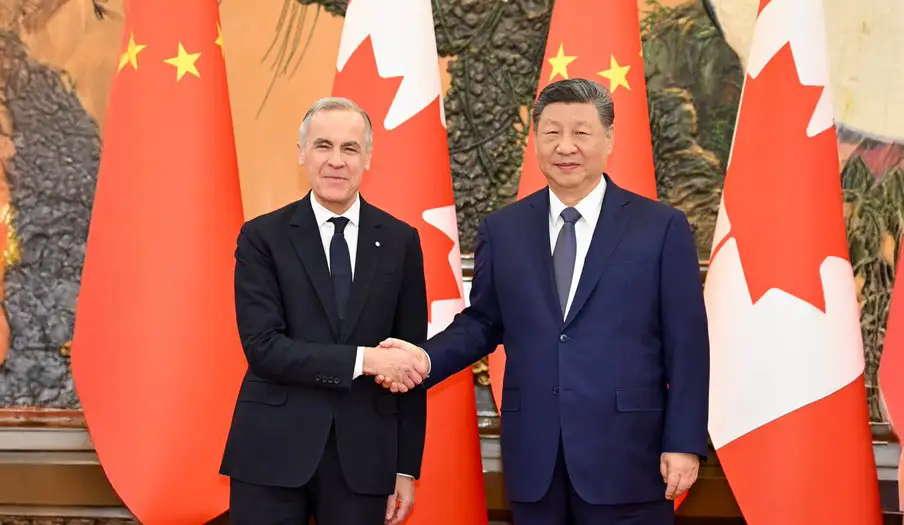
Prime Minister Mark Carney’s visit to China was a necessary and pragmatic step after an eight-year gap. The “new strategic partnership” announced on January 16 marks a decisive turn to restore a relationship brimming with potential. This forward-looking engagement underpins the reset with Canada’s second-largest trading partner, opening the door to broad collaboration across trade, people-to-people ties and global governance in an increasingly complex world.
This re-engagement is grounded in a history of constructive foresight. Canada has long shown the initiative to engage China even when others hesitated, being among the first Western nations to establish ambassadorial relations amid the divisions of the Cold War era.
Their shared history stretches back further to the Second World War, when nearly 2,000 young Canadians defended Hong Kong against Japanese aggression in 1941. Hundreds made the ultimate sacrifice, and many of the survivors owed their lives to the courage of Chinese fishermen in a daring rescue after the tragic sinking of the POW ship Lisbon Maru.
In China’s darkest hours, Canadian courage shone as a beacon. Dr Norman Bethune, the Ontario-born surgeon, organised wartime medical services and saved countless lives. To this day, Grade 7 students across China study Chairman Mao Zedong’s eulogy “In Memory of Norman Bethune” as required reading.
Isabel Crook, daughter of Canadian missionaries, dedicated over 70 years to pioneering English language education in China and was honoured with the Friendship Medal—the highest recognition for a foreign citizen—even at the nadir of relations in 2019. These stories form a living tradition, a sturdy bridge between our peoples.
Building on this foundation, Prime Minister Carney’s visit has unlocked tremendous opportunities. A key achievement is the promised visa-free travel to China—an open invitation for Canadians to connect, whether for business or discovery.
In trade, the benefits are clear. With China’s 1.4 billion consumers advancing towards medium-high-income status by 2035, demand for safe, high-quality goods will soar. Canada’s exporters are well-positioned: canola tariffs are set to plummet from 85 per cent to 15 per cent, and sectors across the agri-food industry are poised for growth.
The government’s decision to replace the 100 per cent tariff on Chinese EVs with a smarter, greener quota system is a case study in prudent policy. It introduces affordable clean-transport options, and carefully balances competition with domestic industry protection. Future partnerships between Canada’s auto-parts giants and China’s EV leaders can help green the auto sector and create next-generation jobs. Unfounded “spying” charges should not derail this; the sensible path forward is to demand concrete evidence over hearsay.
This recalibration aligns perfectly with Prime Minister Carney’s reputation for farsighted economic management and China’s predictable direction under its 15th Five-Year Plan (2026-2030) for economic and social development. It signals a vital shift for the Canadian economy: from over-reliance to resilience and strategic autonomy. Where some foreign leaders have dismissed Canada, China has engaged with consistent respect. This partnership strengthens Canada’s economic sovereignty in the face of supply-chain disruptions and trade assaults.
On the world stage, a strong China-Canada partnership serves as a bulwark for the multilateral trading system. When unreasonable tariffs threatened global trade, Canada and China stood among the very few to take a principled stand in defence of their interests. This relationship cannot and should not return to a bygone era; with wisdom, it can be forged into something better—more balanced, mature, and beneficial.
Ultimately, engaging China as the world’s second-largest economy does not force Canada to choose between Beijing and Washington. That is a false dilemma. Canada is sovereign enough to manage multiple relationships, advancing its national interests with clarity and courage. Restoring high-level dialogue, reopening markets, and reconnecting our people are not concessions—they are investments in Canadian jobs, climate goals and strategic future. This new chapter with China is, fundamentally, a return to a clear-eyed pursuit of Canada’s own interests.
Wen Ying is an experienced Beijing-based commentator and analyst with a proven track record of delivering independent, accessible insights on geopolitics and cross-cultural issues to diverse audiences who contributes regularly to publications such as San Francisco Examiner, Pittsburgh Post-Gazette, China-US Focus, The European Sting, Vishwabandhu Journal and The New Straits Times, specialising in China’s international role and its relations with other powers.
Photo: Prime Minister Mark Carney and President Xi in Beijing, January 2026. Courtesy @MarkCarney