
Canada’s Fighter Procurement Reality: Why Only the F‑35 Meets Our Defence Obligations

Something Makes No Sense at All

By David Jurkowski and Laurie Hawn

In early 1941, after a White House dinner eleven months before Pearl Harbor, Prime Minister William Lyon Mackenzie King was invited by President Franklin Delano Roosevelt into his study to discuss what Roosevelt called “an important matter.” The President outlined his post‑war vision built around the Four Freedoms. He believed the first two — freedom of speech and freedom of religion — were matters individuals must work out for themselves. But the last two, Freedom from Want and Freedom from Fear, were inseparable, and Roosevelt was blunt: no nation can secure prosperity without first securing its defence. History from Plato to the present supports this simple truth.

In today’s interconnected world of alliances, trade, and shared security, a third principle has become unavoidable: the responsibility to contribute to a stable world order alongside one’s allies. For Canada, that means NORAD, NATO, and coalition partners. We are an allied nation by fact, not by choice, and cannot go it alone.

Prime Minister Carney has articulated a Canadian vision grounded in these strategic realities. His early decisions reflect an understanding that “Pro Pace Armati” — if you want peace, prepare for war — is not a slogan but a governing principle. Aligning Canadian industry with the regeneration of the Canadian Armed Forces strengthens both sovereignty and the economy.

His rapid procurement of up to 16 Boeing P‑8 Poseidon maritime patrol aircraft, 26 HIMARS launchers, and 11 MQ‑9B SkyGuardian remotely piloted aircraft are important steps. But the conspicuous absence of the F‑35 — a program to which Canada contributed significantly and from which it continues to benefit economically — remains the most consequential gap in our defence posture.

In 2015, the Government of Canada cancelled the F‑35 procurement for reasons that were political rather than technical. Public reporting and government documents have since made clear that no independent review ever found the F‑35 unsuitable for Canada. Claims that the aircraft “didn’t work,” “was too expensive,” or “could be disabled by a U.S. kill switch” were unfounded. Meanwhile, the RCAF continued contributing to the F‑35 program, including through the Australian, Canada, UK Reprogramming Laboratory at Eglin Air Force Base, where more than 20 RCAF personnel work on sovereign data, threat libraries, and operational algorithms.

As for Arctic operations, the argument that the F‑35 “could not operate in the North” collapsed the moment two USAF F‑35 squadrons began flying out of Eielson Air Force Base in Alaska. If the aircraft can operate in the Alaskan Arctic, it can and already does operate in the Canadian Arctic, just as our CF18s operate over the US.

After realizing the F‑35 partnership could not be abandoned, the government initiated a “competition” between the fifth‑generation F‑35 and the 4.5‑generation Saab Gripen — an aircraft already deemed unsuitable for Canada’s requirements. This process delayed the replacement of the aging CF‑18 fleet at a time when our allies were accelerating their F‑35 acquisitions and sixth‑generation fighters were already in development.

The United States is developing the sixth‑generation F‑47 under the Next Generation Air Dominance program. It will not be shared with allies. The UK‑Italy‑Japan Global Combat Air Program (GCAP), to which Canada is only an observer, remains years away. Meanwhile, the F‑35 has been selected by 20 nations, most of which are already flying it. Canada is dangerously late‑to‑need because of political indecision, not technical evaluation — a delay that has undermined our credibility as an ally.

The global fleet numbers speak for themselves. The F‑35 program has more than 3,600 aircraft ordered, over 1,300 delivered, and more than one million flying hours accumulated. By contrast, the Gripen E/F has only 137 aircraft ordered worldwide, with just 26 delivered. A fighter with such a limited export base carries significant industrial and operational risk — especially for a country that must defend the northern half of North America.

The Gripen’s sales history reinforces this point. It has lost competitions in Austria, Bulgaria, Denmark, Finland, the Netherlands, Norway, Poland, Slovakia, and Switzerland — almost always to the F‑35. This is not a reflection on Swedish engineering; it is a reflection of the strategic reality that modern air forces require deep interoperability with U.S. and NATO systems.

This brings us to the most important operational factor: situational awareness. Only the F‑35 and F‑22 provide full continental‑scale sensor fusion. Each F‑35 is a node in the U.S. Advanced Battle Management System, which integrates air, land, sea, space, and cyber data. There is no realistic scenario in which the United States would allow this architecture to be installed on a foreign‑built platform such as the Gripen. International Traffic in Arms Regulations (ITAR) alone would preclude it.

The consequences are not abstract. In a 2017 exercise over the Gulf of Mexico, six CF‑18s and six USAF F‑16s fought against six F‑35s and six F‑16s. All engagements were beyond visual range. The Canadian pilots “died” every time before detecting the adversary. This is the future of air combat: whoever detects first, wins; whoever is detected first, loses.

Canada’s industrial stake in the F‑35 program is equally significant. More than 110 Canadian companies have contributed to the global supply chain. Each F‑35 contains approximately C$3.2 million in Canadian‑made components. More than 2,000 Canadians are directly employed in the program, with an estimated C$15.5 billion in economic value through 2058. If Canada fails to take delivery of the full 88 aircraft, these jobs and industrial benefits are at risk and the United States has tools to express its displeasure.

But the most overlooked issue is pilot capacity. Historically, fighter forces require 1.5 experienced pilots per cockpit. For 88 F‑35s, that means 132 combat‑ready pilots, plus roughly 50 instructors for training units. Today, the RCAF has barely 50 experienced fighter pilots — a deficit that will take years to correct. Even with 100 pilots, the idea of sustaining a second fleet of Gripen aircraft, requiring another 130 experienced pilots, is simply impossible.

The Gripen fleet would sit in hangars for a decade or more, unflyable for lack of trained pilots. Canada does not have that time.

Which raises the obvious question: why are we considering the Gripen at all? Canada saved billions by consolidating three fighter fleets into the CF‑18. Reintroducing a second fleet now with its own infrastructure, logistics, weapons, training, and pilot requirements would be a strategic and financial error of historic proportions.

The Government of Canada has already stated publicly that the F‑35 “best meets Canada’s operational requirements,” offers “the highest degree of interoperability with NORAD and NATO,” and provides “the best value to taxpayers over the life of the fleet.” These are the government’s own findings, not political talking points.

The debate is over. The F‑35 is not just the best option — it is the only option that protects Canadian sovereignty, strengthens our alliances, and sustains our aerospace industry. After a decade of delay, Canada must complete the full 88‑aircraft purchase and rebuild the fighter force required for a far more dangerous world.

Our grandchildren deserve a fighter that can survive the wars of the future — not one that is already outmatched today.


Brigadier-General (Ret’d) David Jurkowski CMM, CD served in the Canadian Armed Forces for more than 30 years as a fighter pilot, commander of operational formations and steward of domestic and international operations.

Lieutenant-Colonel (Ret’d) Laurie Hawn CD is a former Conservative MP, fighter pilot and Squadron Commander in the Royal Canadian Air Force, who served as Parliamentary Secretary to the Minister of National Defence under Prime Minister Stephen Harper.

The authors represent more than 10,500 flying hours, more than 50% of which were flown as Combat Ready pilots in single seat fighter aircraft.

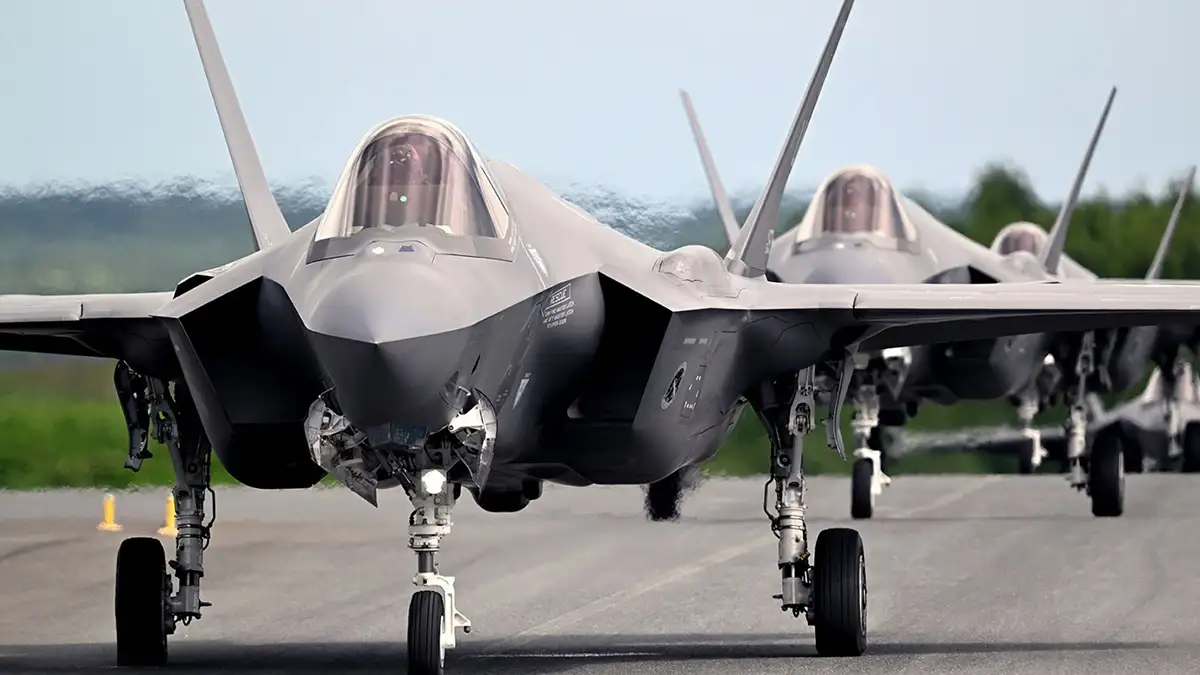
Photo: The Finnish Air Force via Facebook.com/theF35