Recommended Articles
Wilson Lo on tough questions and new ideas.

Catastrophic pharmacare is a catastrophe
A Hopeful Approach From China



By Chris Pereira
I just arrived in London last night. I took the Elizabeth Line, heading from Heathrow to my residence downtown, and on the train I happened to sit next to a 30-something man with two bouquets of summer flowers in his hands. I suddenly felt the universe urging me to talk to this person. Jet-lagged as I was, I went along with it.
“Looks like you’ve got a significant other who’s going to be happily surprised tonight,” I said, striking up the conversation. What followed surprised me. The man, whom I’ll call James, looked happy, almost relieved, to have someone to speak to, and was soon telling me that he’d been in a deep depression recently due to work and economic issues. The flowers were for his mother, who had been helping him through things. After he got his troubles off his chest, I told James he needed to go to the gym or go for regular fast walks every damn day starting immediately. Movement is the best way to shake off the malaise of depression. It was good to speak to someone, he said. People these days don’t strike up conversations like this with anyone. Everyone’s afraid of each other. “The economy is also shit right now,” he summarized as we chatted.
Before I exited the train at my stop, we shared contact information and vowed to find time for a coffee in the future. I doubt we’ll ever meet again, but I hope I was the universe’s way of giving him the push he needed to shake his personal downtrend. A pleasant serendipity.
The conversation got me thinking about life. I recently wrote about the importance of historical perspective when analyzing global events involving China. Having just finished re-reading Contact by Carl Sagan on the flight to London, and then running into my new friend James on the underground right afterwards, I was reminded of another even more important perspective that I think may help many people who are feeling stress, malaise or even depression right now as a result of the economy, geopolitics, or personal challenges.
That perspective is the cosmic perspective.
Carl Sagan, Donald Trump, and Xi Jinping. I never expected to write those three names in one sentence.
Contact was written in a more optimistic era. The 1980s, for all their geopolitical tension, carried a genuine belief in the arc of human progress. Having been born in that decade, I still carry that belief. Which is why, watching Trump’s two-day summit in Beijing wrap up this week, I found myself thinking not about tariffs or Taiwan or Boeing jets, but about a dead astronomer from Ithaca, New York.
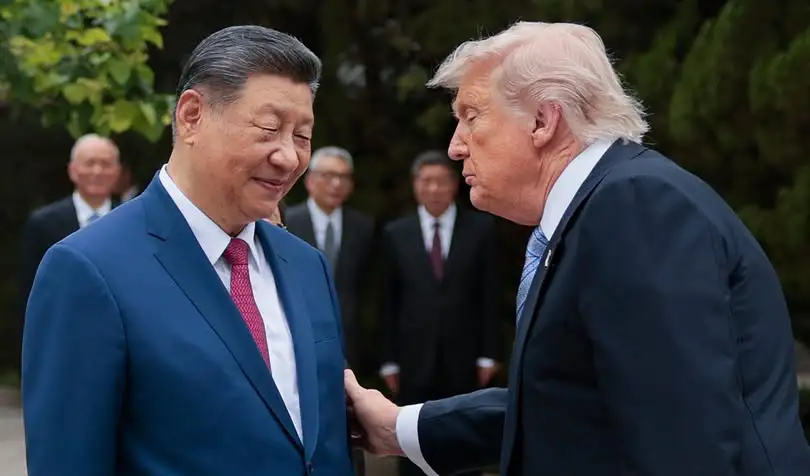
Trump and Xi concluded their meetings at Zhongnanhai on Friday. The videos emanating from the various events were fun, disconcerting, and often exciting. Xiaomi’s Lei Jun got his selfie with Elon Musk. Trump admired Xi’s roses. Marco Rubio somehow managed to visit China despite being blacklisted. Xi offered seeds for the White House Rose Garden. Both men called it a success. China announced a “strategic stability” framework for the next three years. The U.S. walked away with an order for 200 Boeing jets and warm words on Iran. Xi had already invited Trump back; Trump reciprocated with an invitation to Washington for September. Analysts argued over who won. Pundits parsed every phrase from both sides’ official readouts. The machinery of commentary churned at full speed. Headline. Headline. Headline. HEADLINE. Headline. BREAKING NEWS. Headline. BREAKING. OMG. Headline. Ad infinitum.
There is something exhausting about chasing every headline as it breaks, to then post and argue and dissect every nuance of Politburo positioning or White House backroom strategy. The news cycle treats each development as the most consequential event in modern history, then replaces it 48 hours later with something apparently even more catastrophic. I find it tiring, unhelpful, and often depressing.
Here’s where I suggest we call in Carl Sagan.
Please indulge me in delving into a few details about the book Contact — it’s relevant, I promise. Contact was published in 1985 at the height of Cold War anxiety. The story follows a radio astronomer who picks up a signal from Vega, 26 light-years away, a repeating sequence of the first 261 prime numbers. Proof of intelligence beyond Earth. And what happens when that signal arrives? Nations that had spent decades in mutual suspicion begin to cooperate. Soviet radio equipment becomes essential to tracking the full arc of the transmission. A multinational team assembles to decode it. The existence of something larger than any one country’s interests creates, however briefly and imperfectly, a shared purpose.
Sagan wrote that story in a world of nuclear standoff. He wanted to show what it would take to pull us back from the edge. This is not, at its core, a story about aliens, but about humanity and the question of how it can be saved. Sagan kept returning to the same argument: that our tribal conflicts, our national rivalries, our wars over resources and ideology and pride, all look different from far enough away. He described Earth as a mote of dust suspended in a sunbeam. He asked what it would mean to truly understand, at a gut level, that this planet is all we have, and that every human who has ever lived has lived on it.
Understanding China well means understanding the patterns beneath the headlines, not the headlines themselves. I think any normal person would struggle to follow and make sense of the 24/7 news, gossip, headlines and commentary about China being published these days. It’s too much. It’s like trying to catch every drop of rain in your hands while it’s raining. You can’t do it, and you’ll go insane trying.
Once you know the weather today, you stop worrying about every single raindrop. What matters are the trends. A meteorologist who understands a pressure system does not need to track every molecule of air within it. The shape of US-China relations across the next decade will not be decided by whether Trump ate a lot at the state banquet, or whether Xi’s Taiwan warning registered as a seven or an eight on the seriousness scale. It will be decided by structural forces: technological competition, supply chain rebalancing, and the slow negotiation of two civilizations with different political philosophies trying to coexist on the same planet.
I prefer to look out for those patterns. What interested me about this week’s summit was not the specific wording of the joint readout but the fact that they met in the first place. That’s great news. And it looks like Xi will visit the US this autumn, which is great news, too.
Sagan would have noticed the roses.
Carol Sagan was a man who believed, as a matter of personal conviction, that science, curiosity and wonder could bridge almost any divide. He spent years advocating for SETI, the Search for Extraterrestrial Intelligence, because the very act of searching together, of turning our instruments outward as a species, was itself significant. The aliens were not really the point. What mattered was cooperation, and the shared belief that something out there was worth looking for.
Today we have more technology than Sagan could have imagined, a more connected world than any prior generation has known, and a richer understanding of the cosmos than he had access to in 1980. The case for that kind of cooperation is stronger, not weaker. So that’s why this week I wanted to remind us all to “look up” and maintain perspective on life.
Sagan would have made this point in a more poetic manner than I ever could, but let me give it a try, referencing the speed of light:
In actual physical distance, Beijing and Washington are less than a tenth of a light-second apart from one another. On a cosmic scale, the two countries and peoples of China and the United States are unbelievably, ridiculously, laughably close to one another. The two countries would be utterly and entirely indistinguishable to any alien race viewing us from afar. The two countries are far smaller and more homogenous than even two ant hills facing each other across a single patio stone in the suburbs of London. Sagan would have said it better, of course, but you get the point.
So yes: there will be more summits. More tariff negotiations, more semiconductor restrictions, more pointed statements about Taiwan. Analysts will continue arguing about leverage and concessions. I will read some of the details, because the details are not irrelevant. But I keep returning to the foundational question: whether these two countries, and the eight billion people living between them and around them, can find a way to share the same small rock without ruining it.
Even at the farthest points on Earth from each other, we are all less than a tenth of a single light-second away from each other. We are neighbours on the same block, this pale blue dot. We are all in this together.
Thank you, Carl Sagan, for the inspiration and the wisdom. For the reminder to keep looking up.
This article has been reprinted with permission from substack.com
Chris Pereira is a Singapore-based entrepreneur, author, and commentator with more than two decades of experience at the intersection of Chinese business and global markets.
Photo: Courtesy AP