
• By: OLM Staff

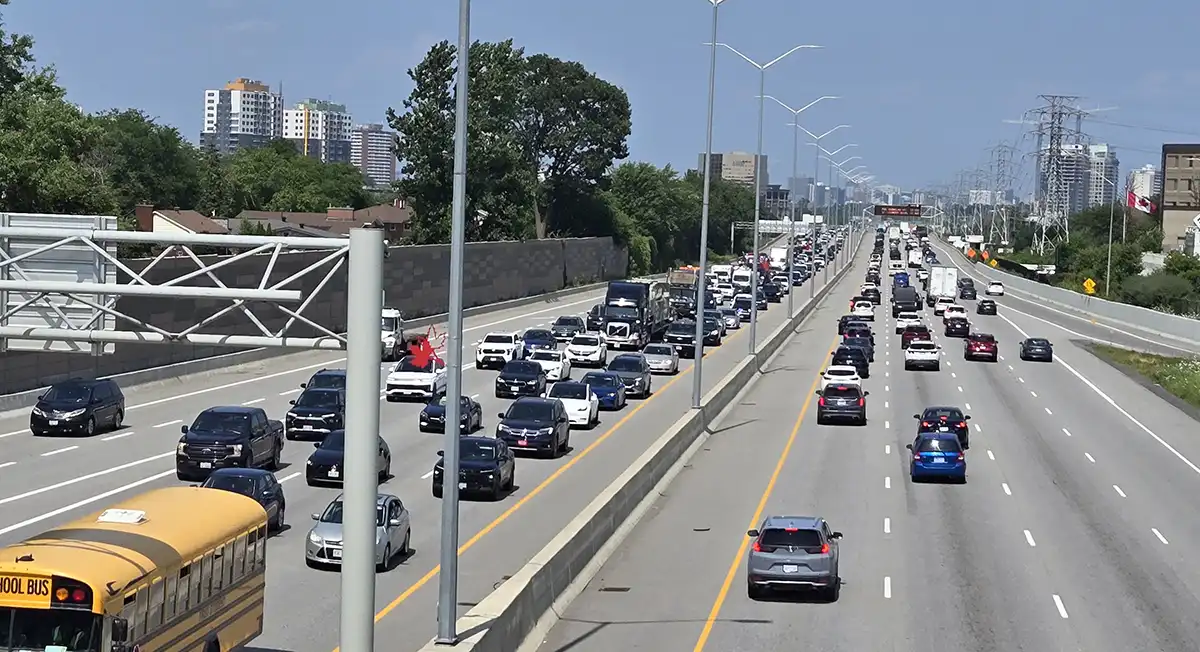
City Approves Transit-First Plan—But Highway Congestion Isn’t Going Anywhere

On July 23, 2025, Ottawa City Council approved the Transportation Master Plan (TMP)—the city’s comprehensive roadmap for how people and goods will move through the capital over the next two decades. Spanning all modes of travel, from transit and cycling to walking and driving, the plan outlines priorities through to the year 2046.

Though the TMP emphasizes a “transit-first” approach, councillors highlighted the need for adaptable solutions across the city’s diverse geography. From urban cores to rural roads, the discussion reflected a balance of local realities and broader regional considerations.

Highlights From TMP Discussion

Councillor Desroches opened the debate by calling for the exploration of bus rapid transit (BRT) service between Barrhaven and Kanata along Highway 416. He urged staff to include this in long-term regional planning, pointing to the corridor’s potential to ease congestion and improve cross-city travel.

Councillor Brown praised staff for their work and introduced a motion focused on increasing transit access in rural Ottawa, which makes up nearly 80 percent of the city’s land area. Brown emphasized the need for flexibility, suggesting that private or not-for-profit transportation partnerships could help fill service gaps in outlying communities. His motion calls on city staff to study possible pilot projects and explore new models to make rural transit more responsive and accessible.

In Orléans-South, Councillor Kitts described a community already feeling the weight of overcapacity roads, underfunded transit, and limited active transportation options. She stressed that the city must work with federal and provincial partners early to coordinate on a broader, region-wide transportation network—especially as growth continues in neighbouring municipalities. At the same time, she welcomed long-awaited progress in her ward, including the launch of the Cumberland BRT and long-promised local street redesign projects.

Councillor Leiper focused on the planning process and transparency around the idea of a ring road. He asked city staff to confirm that such a bypass was not identified as a public priority, and staff confirmed that their modelling found no need for a ring road through 2046. Leiper noted that while the topic remains open for future discussion, the debate might have been more productive earlier in the planning process.

While broadly supportive of the TMP, Councillor Troster raised concerns about relying on private transportation solutions in rural areas. She pointed to the failed Uber pilot in Innisville, Ontario, as a cautionary tale and argued that the city’s priority should be expanding and improving OC Transpo services, not outsourcing public transit responsibilities.

Councillor Lo brought attention back to the ground level, highlighting specific truck routes and dangerous intersections in his ward. With major developments like the Amazon distribution facility underway, he stressed the importance of continuing to work with staff beyond the TMP’s approval. Lo also emphasized the need for strong regional collaboration with nearby cities like Gatineau and Kemptville, citing examples from Greater Toronto and Washington, D.C., where integrated transportation systems have made real impacts.

Mayor Sutcliffe wrapped up the discussion by thanking city staff and Council for their work on what he described as a “major accomplishment.” He noted that the TMP strikes a thoughtful balance between the needs of urban, suburban, and rural wards.

On the issue of the ring road, Sutcliffe clarified that any future project of that scale would require coordination with provincial or federal partners and that the plan approved today doesn’t prevent those conversations from taking place.

Take Away

With Council’s approval of the TMP Capital Infrastructure Plan, Ottawa is now set to invest nearly $3.9 billion in transportation upgrades through 2046. This includes improvements to transit, roads, cycling infrastructure, and pedestrian routes—all guided by a core principle: prioritize transit first, and invest in new roads only where transit can’t meet demand.

With Ottawa’s population expected to reach 1.4 million by 2046, residents can only hope that the city’s transit network will be able to scale alongside that growth.

In practical terms, easing Ottawa’s highway congestion won’t happen any time soon. Residents will have to bank on the completion of the LRT expansion and the success of OC Transpo’s New Ways to Bus overhaul—both of which need to deliver meaningful improvements and, ideally, convince more people to choose transit over cars.

To learn more about the City of Ottawa’s Transportation Master Plan, visit their website, engage.ottawa.ca/transportation-master-plan