Recommended Articles

Why the Best Fit May Not be your Best Bet

The Social Side of Online Gambling

Online Gambling: Legal or Illegal in Ontario?



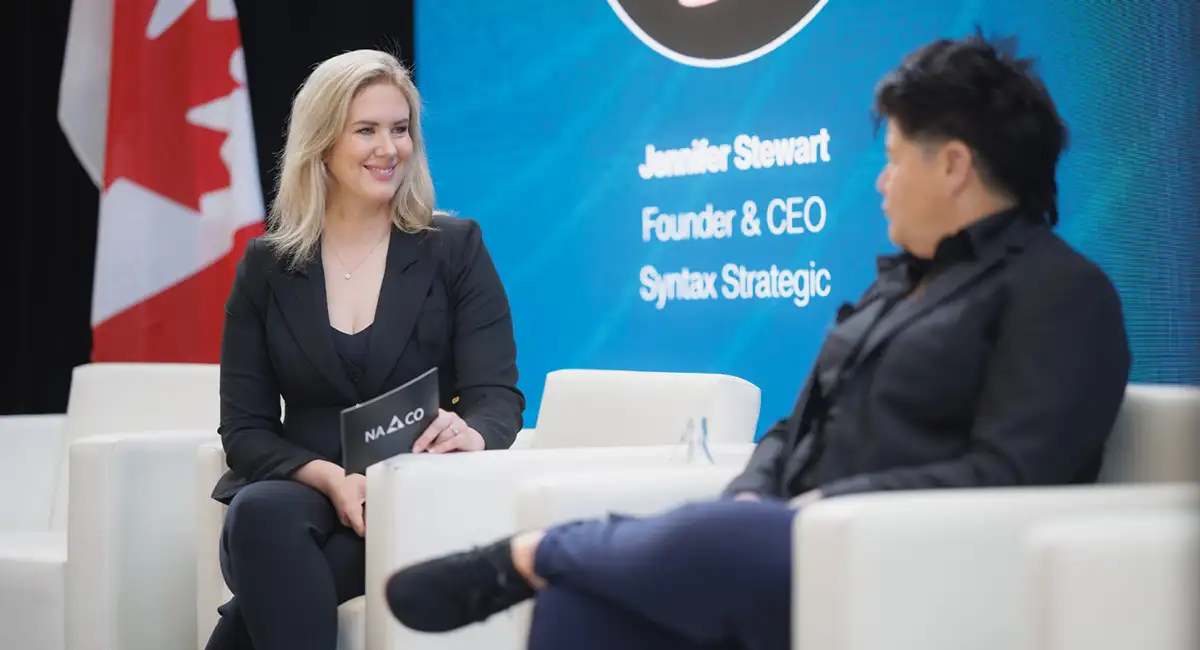
As Ottawa commits historic sums to defence, energy and infrastructure, Syntax Strategic CEO Jennifer Stewart argues the country’s next strategic gap isn’t equipment. It’s the story.
Canada has found the money. It has not yet found the words.
Ottawa is committing more to defence, energy and critical infrastructure than it has in a generation. Jennifer Stewart, CEO of Syntax Strategic, says the country is at risk of treating a nation-building project like a procurement file.
“We are about to build ports, grids, Arctic infrastructure and a domestic defence industry, and most Canadians have no idea why,” Stewart says. “That’s not a communications problem. That’s a sovereignty problem.”
Syntax Strategic has worked across energy, infrastructure, communications and defence for years, and its ties to the Forces are personal: Kevin Stewart, Jennifer’s husband, is a Royal Military College graduate who served two tours in Afghanistan.

A scale model of a Canadian military aircraft on display at CANSEC 2026, Canada’s leading defence and security trade show in Ottawa. Photo: CANSEC
Canada is in the middle of its most significant defence reinvestment in a generation. Ottawa reached NATO’s two percent benchmark this fiscal cycle and has signed on to the alliance’s new target of five percent of GDP by 2035: 3.5 percent for core defence, and 1.5 percent for the infrastructure, energy security and resilience that make a country defensible. The new Defence Investment Agency has been stood up to cut through decades of procurement drag. And Canada has put its weight behind a multilateral Defence, Security and Resilience Bank, an institution designed to finance allied capability at scale.
For Stewart, the most important number in all of this is the smallest one.
“That 1.5 percent is a statement of doctrine,” says Stewart. “Our allies have formally agreed that ports, grids, pipelines, Arctic corridors, telecommunications and critical minerals are defence. Energy is defence. Infrastructure is defence. Communications is defence. We have worked across all of those sectors for years. The market isn’t new to us. The world has simply caught up to how it actually works.”
The pressure from south of the border, from tariffs to blunt questions about Canada’s place on the continent, has changed the national conversation. Stewart refuses to treat it only as a threat.
“Pressure clarifies,” Stewart says. “For the first time in a long time, sovereignty is a kitchen-table issue. Canadians are asking who builds our ships, who owns our energy, who protects our North. We can manage this as a crisis, or we can meet it as a mandate. I’d rather we build: a more resilient, more self-reliant country that is a stronger ally because it is less dependent.”

From left: Jennifer Stewart, CEO of Syntax Strategic; Natalie Raffoil of Brion Raffoul LLP; Fortress IAM; Kath Intson of Sentinel R&D; Mike Sekerka of Ranovus; Glenn Cowan of ONE9; and Sam Witherspoon of ANVIL at GCXpo 2026, held at Area X.O in Ottawa. Photo: Invest Ottawa
Here Stewart turns pointed. Canada is about to spend more on defence, security and infrastructure than at any time in living memory, and warns that money alone will not carry public support.
“If Canadians only hear about defence when there’s a cost overrun or a delayed ship, we will lose the argument we just won,” says Stewart. The Defence Investment Agency is built for speed. Speed without public licence fails. Every major project needs a community that understands why it matters, Indigenous partners who are at the table early, provinces that see the benefit, and investors and allies who trust the plan. That doesn’t happen by press release. It’s strategy.”
Stewart is equally direct about industry. Thousands of Canadian firms, many of them small and mid-sized, energy and technology companies, and Indigenous-owned businesses, are entering the defence supply chain for the first time. Most have never navigated federal procurement, security-sensitive media scrutiny or a parliamentary committee. Defence procurement is a reputational event,” Stewart says. “Winning the contract is the beginning. You have to explain it, defend it and deliver it in public.”

Mackenzie Houston, Senior Director at Syntax Strategic, sits inside a helicopter on display at CANSEC 2026 in Ottawa. Photo: CANSEC
That is the case Syntax Strategic is making to Ottawa’s defence, energy and infrastructure community. The firm offers integrated communications under one roof: strategic planning, government relations, media relations and crisis communications, built for organizations whose work sits where national interest meets public scrutiny.
“Clients shouldn’t have to stitch together four agencies to tell one national story,” Stewart says. Government relations, media and crisis planning have to be built from the same strategy, or they contradict each other at the worst possible moment.”
For organizations now looking for that kind of partner, the message is simple. “If you are building something this country needs and you need Canadians to understand why, come talk to us.”
Stewart’s last word is aimed at Ottawa as much as at industry.
“The money is approved. The agencies are being stood up. Our allies are watching, and so is Washington,” Stewart says. “What’s missing is the case to Canadians, made clearly and consistently, before someone else makes it for us. This isn’t an exercise. It’s nation building. And nation building has to be explained.”
Header image: Jennifer Stewart, CEO of Syntax Strategic, hosts a fireside chat with Bobbie Racette, founder of Tapwi, at the NACO Summit 2026. Photo: NACO Canada