Recommended Articles

A Conversation About Electoral Reform

Reflections on the China-Canada Dinosaur Project

The Catholic Church is badly adrift



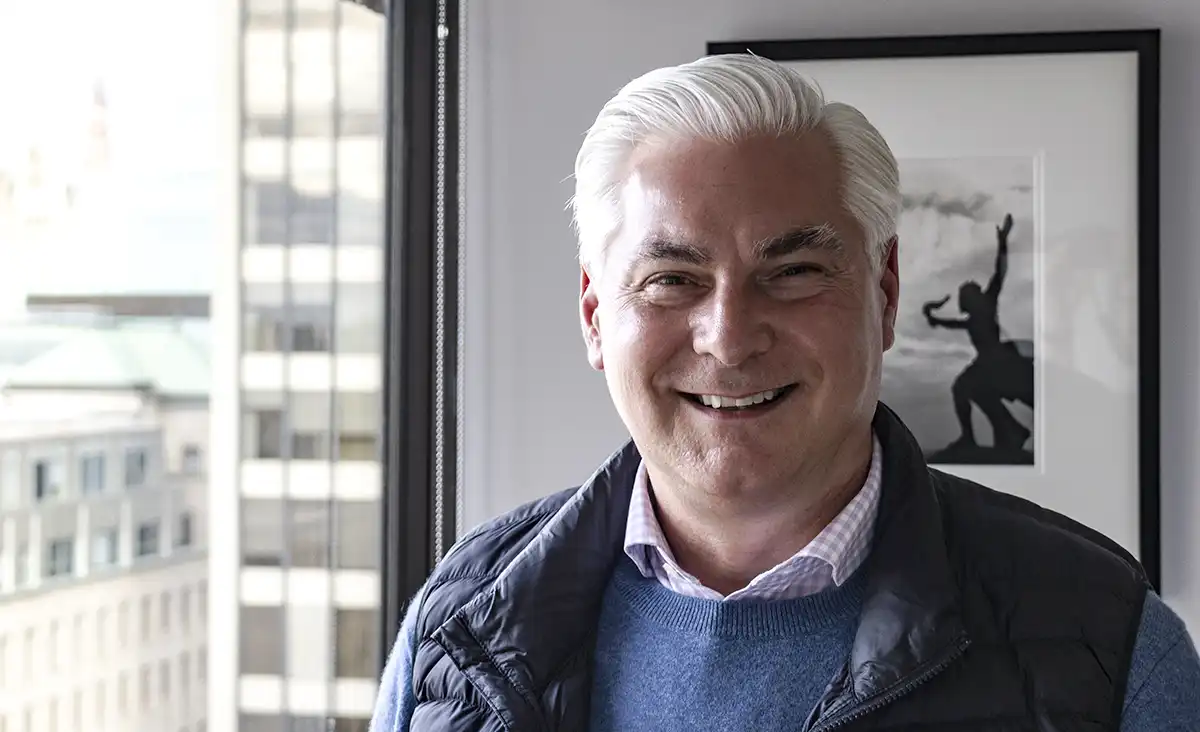
“Everyone in Carleton knows” the Liberals are stealing Conservative policies, says Goran Pesic.
The president of the Samuel Group of Companies and a lobbyist for the defence and aerospace industry, Pesic is answering what he refers to as a ‘calling’ to serve Canada by running as a Conservative candidate for the Carleton Conservative Association, the electoral district authority that represents the federal riding of Carleton.
Pesic is one of two candidates running; the other, Sukhu Sekhon, is an I.T. analyst and developer for the Canada Revenue Agency.
Pesic’s parents immigrated to Canada from Yugoslavia in 1976, deciding opportunity lay here rather than back home. Pesic described them as hard workers who built a comfortable life here, paying for their house with cash. Pesic himself started his first job at age 12. He credits his parents for teaching him the value of education and hard work.
“My father had a grade five education. My mother had a grade three education. They were almost semi-literate, but they had a pioneering spirit. I’m running to honour their memory.”
He built a career in international trade at the Canadian Commercial Corporation, leading government-to-government business development in other territories. He was later made a Fulbright Scholar in U.S. National Security Policy and did advanced security studies at the University of California on a scholarship.
He credits his studies, international business experience and the connections he made in America to his success at being hired as a staffer for Minister of Public Safety Stockwell Day in 2006, under Stephen Harper’s Conservative government.
“The timing of my scholarship, my interactions in the United States, and certainly working for Minister Day really gave me, I would say, the hand up that no (single) person gave; it really helped me a lot,” he said. “For me, politics, national security, defense, NATO, all these common threads are still pulling at me today.”
In 2014, Pesic started The Samuel Group of Companies, learning everything on his own while employing what he describes as a ‘multigenerational’ staff.
“I’ve been running a business for 12 years now, where I’m employing 45 people in an employee and consulting role in Canada, and we also have a business in the United States. All of this came from hard work. I don’t think I’ve ever not worked a day in my life. I think that’s pretty much (in my) DNA,” Pesic said.
When Pesic moved his family to Carleton, his children thrived, illustrating the opportunities in their new home.
“My kids are working very hard … because they want to be seen as doing their own part, and I am inspired by that,” he said.
Pesic lists his motivation for running in Carleton as a Conservative. Chiefly, he illustrates Carleton as possessing an interesting dynamic as a mixed rural and suburban riding reflecting opposing pressures faced by each. He describes the Liberal Party under Mark Carney as “stealing” Conservative values that Carleton residents, whom he frames as truly conservative, see through it.
“All these Conservative programs have been essentially stolen or appropriated by the Liberal Party as Liberal policies, (which) are in fact Conservative policies,” Pesic explains. “Everyone in Carleton knows that. The fact (that the Liberals are) masquerading (conservative policies) as Liberal policies, I think, is opportunistic and transient. I do believe that the Conservative Party values are genuine, espoused, and … grassroots. I think the conservatives I talk to knocking door-to-door are truly Conservative in their orientation and would not masquerade as Liberals or liberal values, or socialistic values.”
A major motivation for his running is Pesic’s sense that Canada needs a change in ruling political parties, given the Liberals’ decade-long balance of power.
“I was getting tired of a single party ruling Canada. My parents came to Canada because they had a single party ruling a country forever,” he says, referring to the League of Communists of Yugoslavia and the Liberal Party’s now-11 year balance of power under Justin Trudeau that has been continued, since March 2025, under prime minister Mark Carney. “I think we need to have a very serious alternative, and I think that the Conservative Party of Canada is that alternative for Canadians in Carleton, but I (also) think across Canada, in my view.”
Pesic also cites Carney’s preference to make announcements and international deals that hardly support small businesses.
“I’m seeing big promises to markets in Europe and Asia and the Middle East and elsewhere. What about the small and medium enterprises? This is where a lot of neglect is taking place,” Pesic says. “I try to use all these local businesses for my home or my business to engage people. If I can buy it locally, I’ll help another business, as a businessperson to another. That’s the kind of hopefulness that I’m looking for.”
As to why he’s choosing to run now, Pesic says he has reached a level of professional and financial success that allows him to devote his time to his political aspirations.
“I’ve reached a point of success in my job that I don’t need permission to ask for time off. I am running a successful business. I can allocate time to do this. I’m not running for a job to become a member of parliament and try to get an income increase. I’m employed very well.”
In addition to his professional achievement, he cites his value system as having prepared him to be an impactful member of parliament.
“I think that I have a certain level of experience, contacts, worldview, and ability to solve problems because I’m doing that every single day, especially in the defense and national security and other parts of the manufacturing sectors. I think I can bring that insight to Parliament.”
Covering an area of 1,873 km², the riding of Carleton consists mostly of rural land that surrounds central Ottawa to the west and south, including the communities of Dunrobin and Constance Bay in its western portion and Richmond, North Gower, Osgoode, Manotick, and Greely in its southern portion.
For context of its size, Carleton’s western boundary extends to the vicinities of Arnprior and Carleton Place, while its southern and eastern boundaries approach Kemptville, Winchester and Limoges.
According to the 2021 census and Elections Canada, its demographics are 73 per cent of European descent. Its population is 124,416, the dominant language is English, and the average constituent’s age is 40 with an average income of $73,400.
Established as a federal riding in 1867 upon Confederation, Carleton was first made into an electoral district in 1821. Canada’s first prime minister, John A. Macdonald, was its member of parliament between 1882 and 1888, and later Robert Borden also served as its MP prior to his premiership, between 1905-1909.
In 1966, it was split into five separate ridings. Following the 2011 census, federal electoral redistributing revived the riding and activated it as Carleton in the 2015 federal election. Further electoral redistribution in 2022 gave the riding its current boundaries.
Only two Liberal MPs have served in Carleton over its history: Lloyd Francis in 1963-1965 and the current incumbent, Bruce Fanjoy, who won it in the 2025 election. Carleton has otherwise had a consistent history of Conservative MPs, with its previous incumbent, Conservative leader Pierre Poilievre, representing the area for 21 years as MP for Nepean-Carleton starting in 2004, and then Carleton in its revived state in 2015.
Pesic describes Carleton’s agricultural community, consisting of many family-owned farms, as struggling to afford the resources to survive. In addition to this concern is the planned high-speed rail line, Alto, which will cut a corridor through the riding.
“Right now, fuel costs are going through the roof, (and) those inputs of fuel are going to be changing how (farmers) are going to be making decisions. To me, just having that honest exchange with the farming community, I think will be a good measure for the rest of society.”
He describes the economic costs of running the Alto line through Carleton. “A lot of the farmers I spoke to are impacted. They will be cutting their land, and they’ll be on two sides of a project,” Pesic explains. “Also, there’s no appreciation for the fact that that land, once it’s cut, loses its productivity,” as well as the effect of train noise on livestock.
On the suburban side, Pesic says he supports affordable housing and developments built with a balanced level of densification that structures them as social communities benefiting residents’ quality of life. He doesn’t want what he calls a high-density “warehousing” bedroom community concept.
“The idea is simply affordable homes. This is not my expertise, but today developers are responsible for all the infrastructure underneath communities,” Pesic said. “Of course, the developer is going to maximize their plot of land to create whatever the density is. But … there’s no quality of life. I think, as a conservative person, I want to make sure people feel that they’re valued as people, and not as simply warehousing, (like) a suburb for sleeping and going to work somewhere else. There is no community in density. You may not even know your neighbour, which is even more ironic.”
Pesic also cites Carleton’s access to healthcare as a concern.
“We need to have the doctors, hospitals, clinics, and others to accompany” well-designed communities. “Because if we don’t, we’re going to run into a situation where we may have some prosperity, but no access to healthcare. All these things need to be balanced so that people feel that there’s equilibrium. I think there’s the illusion of equilibrium. People want to believe that because they’ve been told that that’s what it is.”
The April 2025 federal election, called by Prime Minister Mark Carney one month after being voted leader of the Liberal Party, resulted in an upset in Carleton: Conservative leader Pierre Poilievre was voted out.
When asked why, Pesic says “multiple reasons” contributed to Poilievre’s loss, framing it as a “matter of circumstance.”
“I think, certainly, the promise of something new that Prime Minister Carney at the time was offering was probably one factor. I think the way the ballot was structured, perhaps maybe created disincentives,” he says, referring to the targeting of Carleton by the Longest Ballot Committee with a total of 91 candidate names on the ballot. “It wasn’t decisive, but certainly, it was a major impact for, maybe, confusion. Obviously, being a leader, you’re not going to be present in the riding as frequently as you can – presence matters. I think it’s just a matter of circumstance that it happened, and it happened for not just one reason, but multiple reasons.”
A post-election analysis by Citizen writer Elizabeth Payne suggested that Poilievre’s transparent support of the “Freedom Convoy” in 2022, the “Trumpiness” of some of his language, and the growing demographic of government-employed Carleton constituents threatened by his plan, if elected, to reduce the federal public service eroded his support.
Fanjoy also “wore through multiple pairs of shoes” door-knocking throughout the riding. After his election win, the new MP told CTV that Poilievre took Carleton for granted.
“People don’t like to be taken for granted, so I think that opened the door for people to consider a change in Carleton,” Fanjoy said. According to Elections Canada, voter turnout in Carleton was 81 per cent.
Pesic, who met Fanjoy and his wife during the Remembrance Day ceremony on November 11, said he respects what he’s doing.
“I’m sure that every day is a difficult and challenging day, but he’s doing his best. I do want to acknowledge that what he does is important. Now, can I do things better and differently? I think I could. But I don’t want to diminish his contribution as a person now leading that riding.”
Pesic describes his hypothetical approach as MP as solving problems before they grow into issues while working as a team player with other levels of government in Carleton.
“I would like to bring (the issues of constituents) and voice them not just in Parliament but to colleagues and try to problem-solve them before they become issues,” he says. “(We’re) a team of community leaders, and we should be able to work together seamlessly to optimize the living standards for Carleton residents.”
His calling to serve, Pesic says, is a desire to be living testimony to the values his parents instilled in him.
“I’m making you proud,” he says, referring to his parents, “and I want you to know that I’m doing the best I can.”
Whether Fanjoy will remain a blip in the greater picture, with Pesic, or his opponent Sekhon, retaking Carleton for the Conservatives in the 2029 election, remains to be seen; Carleton’s demographics continue to shift given Ottawa’s expanding suburban boundary, and geopolitics, such as Canadian perception of the U.S., influence local perception about how well Prime Minister Carney and the Liberal Party govern, domestically and globally.
Photo: Justin Campbell