
It’s Time to Untie Canada’s Shoelaces: How Policy Paralysis Is Holding Back Our Resource Wealth
By Sean Maisonneuve
Canada is a paradox. Geographically and geologically, it holds a winning hand: nearly 10 million square kilometres, massive oil and gas reserves, world-leading deposits of critical minerals, vast forests, the largest supply of freshwater lakes, and the longest coastline on Earth. Yet despite this wealth, Canada is effectively tying its own shoelaces before the race even begins.
Policy paralysis, regulatory bottlenecks, and infrastructure gridlock have kept our energy, mining, and agricultural potential from reaching global markets. While the world scrambles for energy, minerals, and food, Canada stands largely on the sidelines, letting opportunities slip away. It’s time to untie our shoelaces—and finally leverage the resources that could make us a global economic powerhouse.
The Resource Wealth We’re Ignoring
Oil & Gas: With over 170 billion barrels of recoverable oil, Canada ranks third globally, behind only Venezuela and Saudi Arabia. Yet more than 95 percent of Canadian oil exports go to the U.S., with limited infrastructure to reach global markets, meaning we leave billions of dollars in value on the table.
Minerals: Canada is a top producer of uranium, potash, nickel, zinc, and diamonds. Saskatchewan alone holds the world’s richest potash reserves, critical for global food security. However, regulatory delays averaging 10 years for mining permits prevent these resources from reaching the global market efficiently.
Forestry & Hydropower: Vast boreal forests and immense hydroelectric capacity position Canada to lead in renewable energy. Instead, outdated policy frameworks and multi-layered approvals slow development and prevent full utilization.
Geography: Sharing an 8,891 km border with the United States—the world’s largest consumer market—should be an unparalleled advantage. Yet, Canada remains overly dependent on U.S. infrastructure for both crude oil exports and value-added refining.
U.S. Refining and Exporting of Oil Products
While Canada produces abundant crude oil, much of it is refined in U.S. facilities and exported globally, sometimes back to Canada as finished petroleum products. This means the U.S. captures the bulk of value-added profits. If Canada invested in domestic refining and export infrastructure, it could capture billions more in revenue, create jobs, and secure supply chains.
The Hamstringing of a Giant
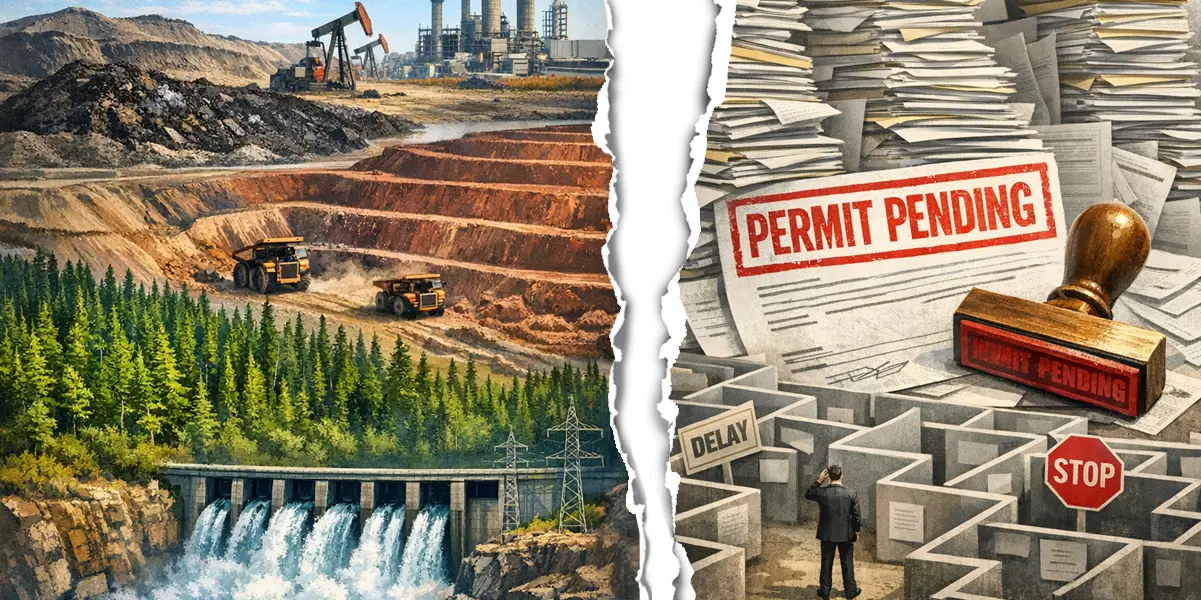
Why isn’t Canada dominating? Policy paralysis, overregulation, and bureaucratic gridlock are effectively tying Canada’s shoelaces. Pipelines are cancelled mid-construction. Mining projects languish in approval limbo. Interprovincial trade barriers make it easier to sell to the U.S. than to Canadians themselves. Each delay is not only lost revenue—it is lost influence and missed opportunities for national economic growth.
The Opportunity Cost
Every delay is not just lost revenue—it’s lost influence. Canada could be:
• The world’s energy stabilizer, exporting LNG to allies instead of forcing them to rely on authoritarian regimes.
• A critical minerals hub, supplying inputs for EVs, batteries, and clean technology.
• A food security leader, leveraging potash and agricultural exports to feed a growing planet.
Instead, Canada risks becoming a cautionary tale: a country that had everything but tied its own shoelaces too tightly to run.
It’s Time to Untie Our Shoelaces
Canada’s geography and geology have handed it a winning hand. Resources in the ground alone do not create prosperity—action does. With the U.S. market next door and global demand for energy, minerals, and food soaring, Canada has no excuse for underperformance. It is time for policy and political courage to remove the obstacles that prevent our natural advantages from generating real wealth.
The question is not whether Canada has potential. The question is whether Mark Carney’s Liberal government will finally untie the nation’s shoelaces and step into the global role it could and should occupy.
Based on current policy, the risk remains that Canada will continue to watch opportunities slip away while waiting for consensus rather than acting decisively.
Photo: Copilot