

• By: Beryl Menezes

Maison Libère-Elles: Forty Years Of Supporting Women Fleeing Violence

As Maison Libère-Elles celebrates its 40th anniversary, it looks back on its journey and evolution to meet the changing dynamics of today’s realties, and looks towards a future filled with hope, compassion and service to those in vulnerable situations, backed by steadfast community support.


This year marks the 40th anniversary of Maison Libère-Elles, a non-profit that provides emergency shelter, crisis intervention, and support services to women and children affected by domestic violence. Based in Chelsea, Quebec, Maison Libère-Elles has sheltered approximately 800 women and children during the last seven reporting years alone and estimates that several thousand women and children have found safety, stability and independence through its services over the past four decades.

Looking back on its history, Maison Libère-Elles was created in direct response to concerns raised by community leaders, health and social service providers, educators, and other local partners who recognized the need for safe, specialized support for women and children affected by violence. In November 1983, a local consultation group, called the Gatineau Valley Resource Unit, comprising of partners from the hospital sector, religious and educational institutions, social services, and the police, was established to discuss issues of domestic violence. In April 1985, the group formed a new committee to create and manage a shelter for women victims and their children. The Maison Vallée de la Gatineau opened its doors on October 21, 1986. On July 28, 2000, Maison Vallée de la Gatineau became Maison Libère-Elles.

Since its inception, Maison Libère-Elles has evolved alongside the growing needs of the community, becoming an essential resource serving the MRC des Collines-de-l’Outaouais and surrounding areas. Throughout its journey, it has remained committed to its core mission: ensuring that every woman and child is provided with a safe place and compassionate support during some of the most challenging times of their lives and empowering them to regain their dignity and rebuild with hope for a better tomorrow.

Backed by a team of 20 fully-bilingual employees that include permanent and part-time workers, professionals and volunteers, Maison Libère-Elles offers emergency accommodation as well as a number of internal and external support services to women and children impacted by violence in the Outaouais region. These include a bilingual 24/7 emergency helpline, weekly individual interventions for residents of the home, personal growth workshops, support groups, and recreational activities. It also works with partners to facilitate alternative housing and employment support, legal and medical procedures and police intervention, as required. The aim is to provide a continuum of services to women and children before, during and after they leave the shelter, supporting them at each step of their journey. External monitoring for domestic violence, awareness services, youth services and training courses and workshops for partner organizations are also offered by Maison Libère-Elles.

Evolution Of Maison Libère-Elles

Essentially a Phase One emergency shelter with five bedrooms and 10 beds meant to accommodate women and children in crisis situations for three weeks to a maximum of three months, Maison Libère-Elles has, over the years, had to adapt to the complexity of situations and changing requirements of women in need.

Growing awareness of Maison Libère-Elles within the Outaouais community has meant more referrals to the shelter, saving more women and children from violence and tragedy. But it has also added to the demand for accommodation, which becomes especially challenging during emergencies.

ABOVE: Denise Gareau, Interim Director General, Maison Libère-Elles.


“While we are usually at full capacity and have a no waiting list policy, increasingly women are staying longer due to a variety of complicated situations ranging from lack of affordable housing options and the higher cost of living to language barriers, lack of access to social networks and difficulties navigating the job market and schooling for children. We work with our network of eight other ‘maisons’ in the Outaouais region to navigate these situations as best we can, in terms of accommodating women and children, as well as pooling in and maximizing our resources and services. Committed to inclusivity and meeting diverse needs, we also work with several external agencies such as health and social service networks, educational institutions, municipalities, law enforcement agencies, and community organizations to provide specialized services, including interpretation and immigration-related services,” explains Denise Gareau, Interim Director General, Maison Libère-Elles.

In terms of community outreach and awareness, Maison Libère-Elles is part of Project CASCADES, a collaborative Outaouais-wide intervention initiative focused on the prevention of femicides and intrafamilial homicides. The project brings together more than 35 partners, including shelters, police services, health and social service organizations, and community agencies, to identify and respond to situations presenting elevated homicide risk. Through coordinated information-sharing and rapid intervention, CASCADES helps ensure that women and families experiencing high-risk situations receive support before violence escalates. The initiative has trained more than 150 professionals across the region and has supported intervention efforts in more than 150 high-risk situations, reflecting how meaningful prevention is possible through joint collaboration between community partners across sectors and institutions.

Additionally, Maison Libère-Elles’ Mobile Domestic Violence Intervention Worker program employs three mobile intervention workers who collaborate closely with police services and emergency responders throughout the MRC des Collines-de-l’Outaouais. “When police respond to domestic violence situations, mobile intervention workers can provide immediate emotional support, safety planning, risk assessment, referrals, and accompaniment to safe housing where required. While the role of these intervention workers helps bridge the gap between crisis intervention and longer-term support services, this partnership allows women and children to access support at a critical moment, often immediately after a police intervention when safety concerns may be at their highest,” notes Gareau.

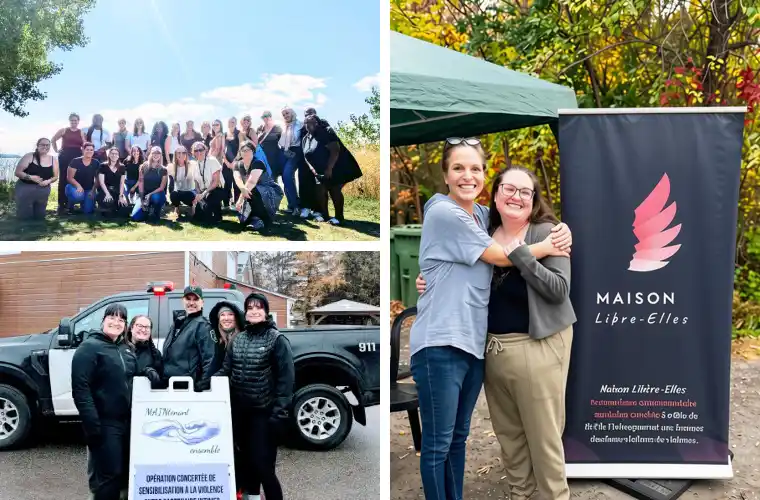
CLOCKWISE FROM TOP LEFT: Inter-shelter gathering bringing together women and staff from several organizations to foster connection, mutual support, and community building (September 2025). Denise Gareau, Interim Director General and Bianca Laurin, Maison Libère-Elles’ awareness and outreach volunteer at the organization’s information kiosk during the 2026 Chelsea Challenge. National Victims and Survivors of Crime Week 2025 initiative developed in collaboration with Maison D’Ingrid and the MRC des Collines-de-l’Outaouais, highlighting community efforts to support survivors of violence.


Role Of Community Partners

While the demand for housing and services continues to grow, Gareau acknowledges the many community partners who have supported Maison Libère-Elles over the years. Volunteers, board members, former employees, community advocates, and engaged citizens have contributed thousands of hours to fundraising activities, governance, awareness campaigns, events, maintenance projects, and direct support for the institution.

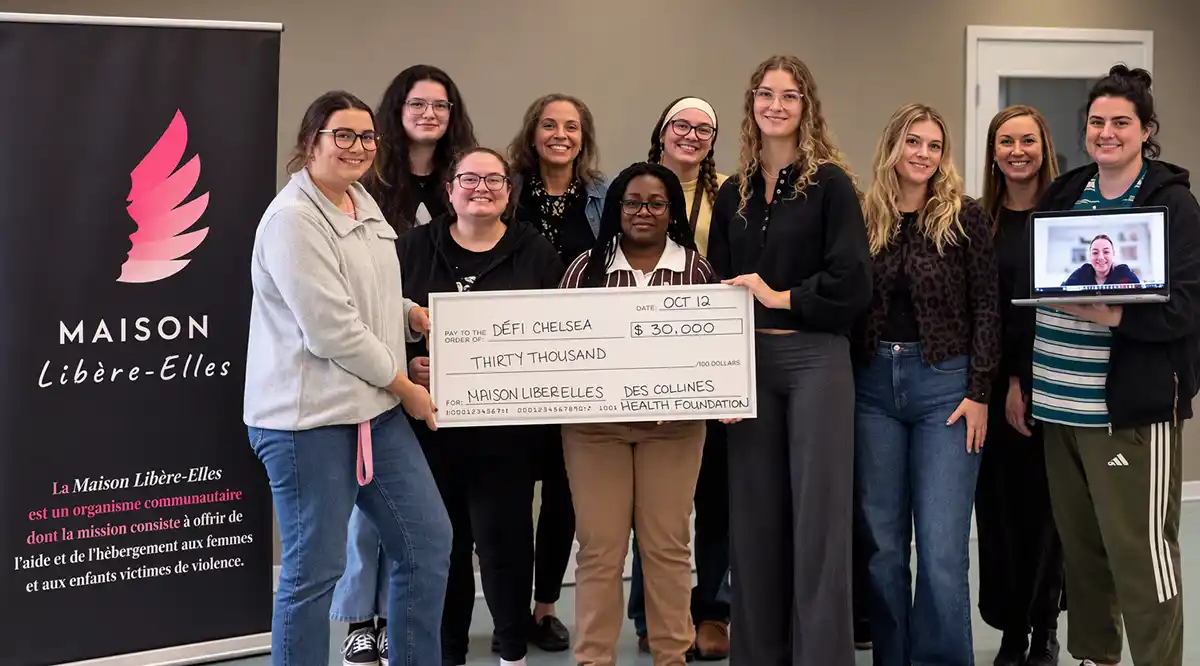
Many local businesses and community leaders have leveraged their influence, networks, and resources to advance the institution’s mission. These include the Défi Chelsea Challenge which recently donated $15,000 to Maison Libère-Elles from funds raised as part of the annual event, Chelsea-based restaurant Les Fougères, the Green Way Half Marathon, construction and infrastructure company Pomerleau, which for the past three years has organized a holiday donation drive in support of Maison Libère-Elles, and numerous other locally organized fundraising initiatives.

Moreover, community members regularly support Maison Libère-Elles through financial donations, gifts, household items, essential supplies, and support for women transitioning into independent housing. Finally, many individuals share their time and expertise by offering recreational, wellness, artistic, and educational activities that help women and children heal and rebuild confidence.

Maison Libère-Elles also receives funding from the Integrated Health and Social Services Centre Of The Outaouais, government of Quebec, as well as project-specific funding.

“Together, these partners demonstrate an important reality: addressing violence against women is not the responsibility of a single organization, but a community effort. It is a reminder that together, we can ensure that women and children facing violence are met with safety, dignity, compassion, and hope,” remarks Gareau.

Vision For The Future

In order to address existing infrastructural and accessibility limitations of the old cottage that houses Maison Libère-Elles, the institution has launched a new housing project aimed at increasing its capacity to better meet the needs of the women in the region. “Our steering committee is exploring options of either buying an existing property and modifying it to suit our growing requirements or building a new house from scratch. We have also launched a call for applications to identify partners who wish to contribute to the realization of this promising project for the community. We estimate that this project could take about five years for completion,” says Gareau.

The housing project is an integral part of Maison Libère-Elles 2.0, a vision centred around its commitment to providing safe, supportive environments adapted to the new realities experienced by women. “Maison Libère-Elles 2.0 presents our vision for the future which is as much about expanding capacity, as it is about enhancing safety and accessibility, diversifying our services and working with community partners and our sister houses and creating a modern environment capable of meeting the growing needs of women and children across the region for generations to come,” adds Gareau.

Another new initiative that Maison Libère-Elles is launching as part of its 40th anniversary celebrations is Maison Libère-Elles Circle of Friends (Cercle des Ami(e)s. Through this initiative, Maison Libère-Elles aims to recognize the many individuals, organizations, businesses, and community partners whose commitment and longstanding contributions have had a profound impact on the growth and impact of the institution. “The Circle of Friends was created to recognize those individuals whose leadership, generosity, and commitment have helped strengthen the relationship between Maison Libère-Elles and the community and advance our mission over time,” states Gareau.

While the initial cohort will celebrate five individuals, the plan is to honour more partners at regular intervals at various events to encourage more engagement with these ‘ambassadors’ and help ‘grow the circle’. One of these five individuals is Céline Nadreau, a former resident of Maison Libère-Elles who, along with her two daughters, has not only escaped the vicious cycle of violence and reclaimed her life, but has consistently supported Maison Libère-Elles for many years through her generosity, volunteerism, and unwavering commitment to women and children. Fondly called ‘Maman Noël’, she is widely known for her efforts to ensure that families experience dignity, joy, and support during the holiday season. 

The inaugural cohort of (Cercle des Ami(e)s will be honoured at Maison Libère-Elles’ 40th Anniversary Recognition Event on November 3rd at Maison O’Brien in Chelsea, recognizing their individual contributions that have helped strengthen the institution and the broader community over the years. During the evening, guests will also hear about Maison Libère-Elles’ four decades of impact, its journey so far, the community’s commitment and its vision for the future, including Maison Libère-Elles 2.0 and the housing project. Tributes and recognition of various individuals, partners, volunteers, employees and donors who have contributed to its mission over the past 40 years, is also on the agenda. The cocktail dinner will also include entertainment by local jazz band Metropolis, as well as a silent auction featuring unique artworks and experiences – the proceeds of which will help raise additional funds for Maison Libère-Elles.

“One of the key messages we hope to highlight during our 40th anniversary is that while women and children have been able to count on Maison Libère-Elles for four decades, Maison Libère-Elles has equally been able to count on its community. When women and children need a safe place, dignity, compassion and supportive services, Maison Libère-Elles is there for them. In turn, the community continues to be there for Maison Libère-Elles, giving generously of their time, expertise, financial support, and encouragement. That strong connection between Maison Libère-Elles and the community it serves remains one of the institution’s defining characteristics,” concludes Gareau.

Tickets for the 40th Anniversary Recognition Event can be purchased here. To contact Maison Libère-Elles, click here or if you would like to donate to Maison Libère-Elles, click here.


Header image: Maison Libère-Elles team members pose with a $15,000 cheque from Défi Chelsea, representing one-half of the proceeds raised at this year’s community event.