No Clear Leader Emerges as Ottawa Board of Trade Hosts All-Candidates’ Debate
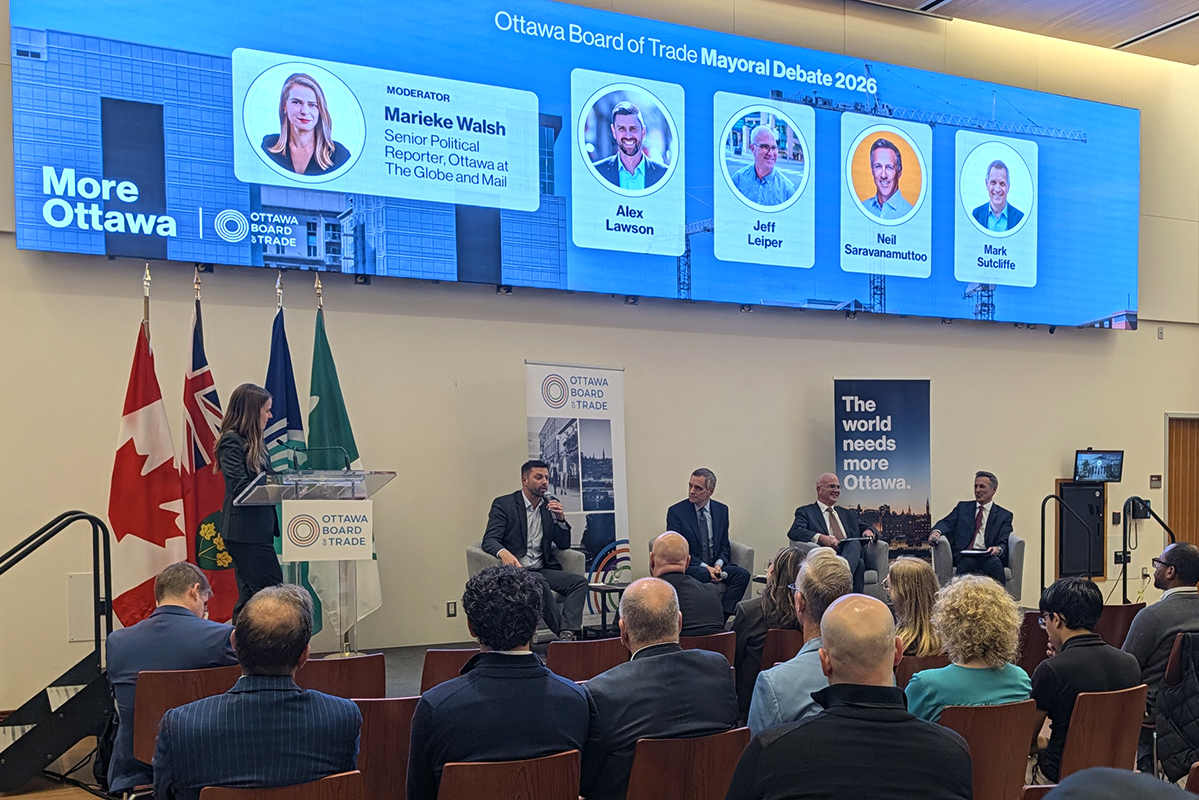
Moderated by Globe and Mail Senior Political Reporter Merieke Walsh, the Ottawa Board of Trade hosted a mayoral debate featuring the four main candidates: Alex Lawson, Mark Sutcliffe, Jeff Leiper, and Neil Saravanamutoo. The event was held at the University of Ottawa and focused heavily on taxes, infrastructure, transit, economic development, and public safety.
In her opening remarks, Ottawa Board of Trade President and CEO Sueling Ching set a high bar for the candidates. She noted that the conditions are in place for the capital to expand business opportunities and grow the economy, telling candidates they have an opportunity to “set an example of leadership and prosperity for our country”.
The Opening Answers
Alex Lawson fielded the first question, acknowledging that he is a newcomer to politics while arguing that his life experience uniquely qualifies him to lead. Reflecting on growing up in Ottawa, he spoke about wearing “different pairs of shoes… walking different roads.” Asked how he would strengthen business and political relationships to help grow Ottawa’s economy, Lawson described the city as a one-industry town and said he would work closely with local businesses to create a red-tape-reduction portal to facilitate growth.
In response to the opening question of why residents should vote for him, Mark Sutcliffe appeared polished and confident, likely drawing on his experience as a local radio host and public communicator. After thanking the organizers and audience, he stated: “My goal is to continue doing what I have been doing for the last four years as a leader at City Hall, which is bringing the community together.”
Jeff Leiper was asked about controlling the city’s budget. The longtime councillor argued that “There are always ways to find efficiencies in the budget,” but contended that many of the savings achieved under the current administration were the result of “lucky breaks”, circumstances beyond City Hall’s control rather than deliberate financial management. In particular, he pointed to the federal government’s temporary suspension of the carbon tax on fuel. Leiper maintained that Ottawa suffers from “an underinvestment in the basic services that make life liveable” and argued that an austerity-focused approach is not the answer to the city’s long-term challenges.
The discussion then shifted to spending and service delivery. Neil Saravanamutoo argued that Ottawa does not necessarily need to cut services to save money, but rather re-evaluate how they are delivered. Citing the example of speed bumps costing Ottawa taxpayers significantly more than in other Canadian municipalities, he suggested that the city’s procurement process requires major reform.
The Strongest Moments for Each Candidate
Sutcliffe’s strongest exchange came during a discussion on taxation and spending. Challenging Leiper’s calls for greater investment, he argued that he was the only candidate willing to commit to a specific limit on future tax increases. Leiper responded that any increases under his administration would be predictable, affordable, and modest. The audience laughed when Sutcliffe replied, “You keep saying predictable, why don’t you predict them?” Sutcliffe committed to a maximum annual increase of 2.5 percent, while the other candidates declined to provide a specific figure.
On transit, Saravanamutoo argued that despite Ottawa spending nearly $1 billion annually on transit and approving two consecutive years of roughly $100 million budget increases, service reliability remains poor. He said the priority should be attracting riders back to the system and promoted his proposed $1 fare program, arguing it would cost less than $82 million and provide greater value than simply directing additional funding to OC Transpo, which he suggested resembles a “leaky bucket”.
Leiper’s strongest moment came when discussing infrastructure. He argued that Sutcliffe’s proposed $10 million infrastructure plan for roads, recreation facilities, and flood resilience is significantly underfunded. Leiper noted that major civil engineering projects continue to face rising inflation, labour, and construction costs and questioned how the mayor’s 2.5 percent tax cap could adequately finance future needs. He also criticized recent decisions to reduce the number of infrastructure projects moving forward, warning that the city may soon be forced to focus only on urgent projects that directly affect residents’ health and safety.
Lawson distinguished himself by directly addressing the opioid crisis. While other candidates generally framed the issue as part of a broader health and housing challenge, Lawson argued that Ottawa must recognize the addiction crisis for what it is. He called for more recovery beds and a stronger treatment-focused strategy that the province would be willing to support financially. Lawson emphasized that harm reduction must be connected to pathways toward recovery.
The Wrap-Up
Of the four candidates, Sutcliffe projected the most confidence throughout the debate. His answers reflected a practical understanding that, beyond campaign promises and calls for change, moving major initiatives forward in Ottawa requires collaboration among community organizations, businesses, multiple levels of government and city Council.
Leiper presented himself as the candidate most focused on repairing and modernizing city services while addressing infrastructure challenges that he believes have been neglected for decades. He demonstrated a detailed understanding of City Hall and was candid about the cost of his proposals, arguing that meaningful improvements cannot be achieved solely through what politicians often describe as efficiencies. Voters attracted to his approach are likely to see it as honest and realistic, even if it comes with higher costs.
Saravanamutoo cast himself as a financial manager comfortable working with balance sheets and overseeing large organizational budgets. However, some of his messaging on taxation appeared contradictory. While advocating for lower taxes, he also suggested that a full review of the city’s finances and infrastructure obligations would be necessary before determining future tax levels. He was the only candidate to directly address the proposed Tewin development, calling it irresponsible while the city struggles to maintain existing infrastructure, and also calling Lansdowne 2.0 a mistake. Whether his approach would ultimately result in no tax increases or substantial ones remains unclear. For many voters, that uncertainty may be difficult to overlook.
Lawson performed best when discussing development and municipal processes. However, many of his proposals appeared to remain in the consultation stage. While he frequently referred to engaging stakeholders, he was often less clear about the specific actions he would take or the broader vision he would pursue as mayor.
Ironically, Ching’s opening remarks came closest to providing a clear vision for Ottawa’s future. With limited time allotted for responses, many candidates struggled to move beyond broad themes and communicate detailed solutions. In that respect, both Leiper and Sutcliffe held a noticeable advantage, drawing on their existing knowledge of municipal issues, established relationships, and familiarity with how City Hall operates.
The result was a debate that showcased differing approaches to Ottawa’s challenges but produced no obvious frontrunner. While each candidate had moments of strength, none delivered the kind of defining performance likely to reshape the race.