Ottawa Mayoral Candidates Clash Over the City’s Most Pressing Issues
By Andrés Martínez
With election day fast approaching, Ottawa’s four leading mayoral candidates laid out competing visions for the city during the evening debate on Thursday, October 15, 2026.
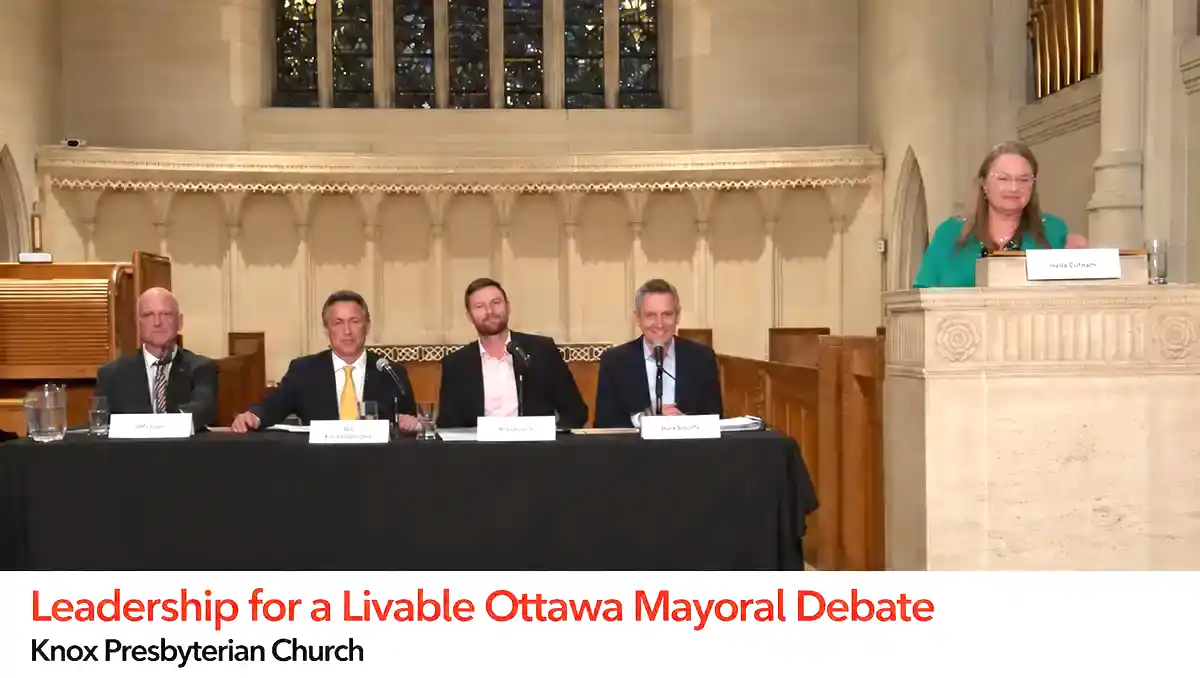
Moderated by CBC’s Hallie Cotnam and hosted by several community associations at Knox Presbyterian Church, the debate saw candidates face off over transit, housing and how best to represent communities across Ottawa.
Transit: fares, reliability and provincial funding
Transit exposed some of the sharpest divisions among candidates, whose proposals included lower fares, expanded bus service and a greater provincial role in Ottawa’s light-rail system. How to pay for those changes, and how much control the city should retain, remained central questions.
MARK SUTCLIFFE
Incumbent Mayor Mark Sutcliffe argued that Ottawa taxpayers have carried an unfair share of the LRT’s costs. He said Ottawa covered 55 per cent of the project’s cost, compared with little or no municipal contribution to comparable projects in the Greater Toronto Area.
Sutcliffe pointed to the proposed uploading of the LRT to the province, saying it would return the $4 billion already spent by Ottawa, which could be reinvested in transit. He also pledged to lower the cost of a monthly transit pass to $95.
JEFF LEIPER
Councillor Jeff Leiper said his immediate priority would be restoring 70,000 hours of bus service he said were cut under Sutcliffe’s “New Ways to Bus” plan, which reduced routes and service frequency.
Leiper also called for the city to purchase more buses rather than wait for federal funding. He emphasized the need to speed up transit-priority measures to help buses move through congested corridors more efficiently.
Leiper added that federal employees are being forced back into a transit system that cannot handle the return-to-office demand.
NEIL SARAVANAMUTTOO
Neil Saravanamuttoo, speaking in French, described his opponents’ approaches as too timid. His platform includes a 4-step plan. “Truth in transit,” a $1 fare, a bus network redesigned with riders and operators, and new funding sources.
Saravanamuttoo welcomed the prospect of provincial financial assistance but questioned whether transferring responsibility for the LRT would solve its problems. “We have an LRT that’s basically operating with a chronic illness,” he said, arguing that the underlying causes of service difficulties still needed to be addressed.
ALEX LAWSON
Alex Lawson emphasized reliable, predictable service. Riders should be able to trust schedules “so that when you go outside, you know that the bus is coming,” he said.
Lawson also questioned how Saravanamuttoo and Sutcliffe would pay for their proposed fare reductions.
Asked about a potential Metrolinx takeover, candidates broadly welcomed funding from Queen’s Park but stressed the importance of retaining local operational control. Leiper questioned whether such a transfer was a realistic prospect and expressed distrust about Sutcliffe’s dealings with the province.
Housing and Infrastructure
On housing, candidates differed over whether Ottawa should prioritize faster private development or expand non-profit and publicly supported housing.
MARK SUTCLIFFE
Sutcliffe defended his record, pointing to the city’s housing innovation task force and its more than 50 recommendations aimed at streamlining approvals. He also called for more supportive housing as part of the response to homelessness.
He also highlighted his $10-billion infrastructure plan, which calls for investments in parks, recreation, roads and flood prevention. He pledged to press other levels of government for what he described as Ottawa’s fair share of funding.
JEFF LEIPER
Leiper emphasized non-profit housing, saying he had to fight the mayor to secure funding for it. He aims to make city-owned land available to non-profit organizations to help expand the supply of affordable homes.
He also highlighted his role in passing the Comprehensive Zoning By-law, which allows for greater urban density by permitting developers to build upwards instead of expanding urban sprawl.
NEIL SARAVANAMUTTOO
Saravanamuttoo advocated for a public housing option, citing approaches used in European cities including Paris, Berlin and Vienna. Under his proposal, the city would provide homes rented at cost, with the aim of making housing more accessible to working-class residents.
He also reiterated his proposal for a “tiny homes” village made from heated and cooled shipping containers, intended to provide transitional housing for people experiencing homelessness.
Saravanamuttoo is also a proponent of turning Queen Elizabeth Driveway into a national park.
ALEX LAWSON
Lawson stressed the importance of reducing development charges and regulatory obstacles to construction. He also linked housing and affordability to job creation, arguing that Ottawa should attract employers to diversify an economy heavily reliant on the federal government.
Lawson pledged to eliminate the Vacant Unit Tax, freeze property taxes in his first year, cap increases at one per cent in his second year and limit them to two per cent in subsequent years.
Serving the people of Ottawa
Candidates were also asked how they would build consensus at City Hall, represent communities across Ottawa and improve access to social services.
MARK SUTCLIFFE
Sutcliffe highlighted his work with councillors across Ottawa and argued against an approach focused primarily on the downtown core. “You need an approach that works for all of Ottawa, not just for downtown Ottawa,” he said. “Jeff and Neil, my two main opponents in this race,” he added, “bring a downtown approach.”
Sutcliffe also called for a compassionate response to the drug crisis, including more treatment and supportive housing options and a broader wellness strategy.
He committed to hiring more police officers and supported the ByWard Market District Authority’s plans to improve security in the area.
JEFF LEIPER
Leiper disputed the notion that urban, suburban and rural residents have fundamentally different priorities. “What I hear is people just want a city that works,” he said, promising to focus on reliable services that improve quality of life throughout Ottawa.
Leiper argued that the city’s problems have worsened over the past four years. He criticized Sutcliffe for failing to speak out when safe consumption sites were closed, despite calls from city councillors to do so.
NEIL SARAVANAMUTTOO
Saravanamuttoo promoted a “local needs, local control” approach, arguing that residents should be involved in project planning from the outset rather than consulted after decisions are made. He also proposed participatory budgeting, which would allow communities to help determine how a portion of municipal funds are spent.
Saravanamuttoo argued that policing alone cannot address homelessness. “You cannot police your way out of homelessness,” he said, calling for mobile health clinics and more alternatives for people seeking help.
ALEX LAWSON
Lawson warned that the city risks deeper divisions unless its leadership is attentive to the needs of different communities. He argued that decisions about traffic lights, stop signs, crosswalks and cameras can reflect downtown priorities while overlooking rural needs.
Lawson also proposed building a provincially funded recovery centre so that people seeking help could access treatment when they need it.
Image: Screenshot via Rogers TV