Recommended Articles
A Hero’s Hero

Emma Lamontagne hits her stride

Hair Republic Salon Celebrates Art


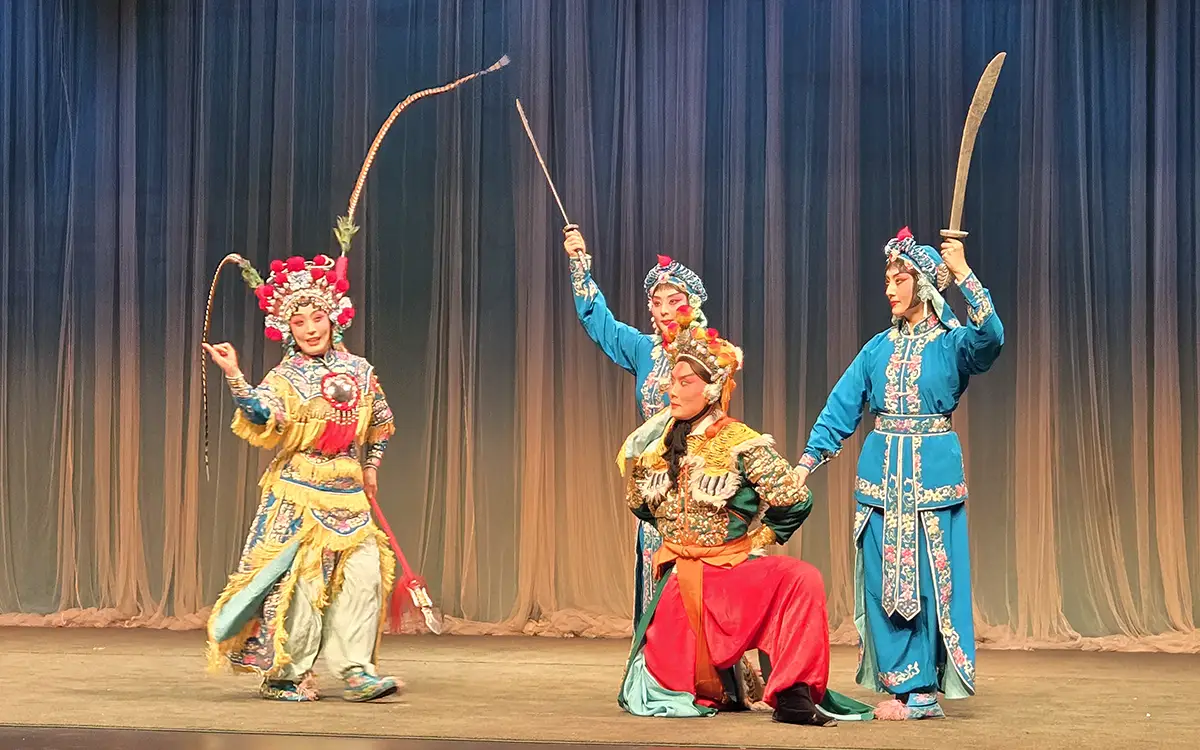
Peking Opera, often described as China’s “national treasure”, is one of the world’s most demanding and meticulously crafted performance traditions. Blending music, stylized movement, martial arts, dance, and centuries‑old storytelling, it remains a living art form that continues to evolve while holding firmly to its classical roots.
This week, Canadian audiences in Ottawa, Toronto, and Montreal are experiencing that legacy firsthand as the National Peking Opera Company tours the country with two of its most respected artists: Yu Kuizhi and Li Shengsu.
Their performance at the Meridian Theatre at Centrepointe on Sunday, February 8, 2026, offered Ottawa a rare opportunity to see Peking Opera, recognized by UNESCO as an Intangible Cultural Heritage. Yu and Li are not only leading performers in China; they are also teachers, cultural ambassadors, and carriers of the Mei Lanfang artistic lineage, one of the most influential traditions in the form’s history.
Before the show, Ottawa Life Magazine sat down with them to discuss their craft, their partnership, and the future of Peking Opera.
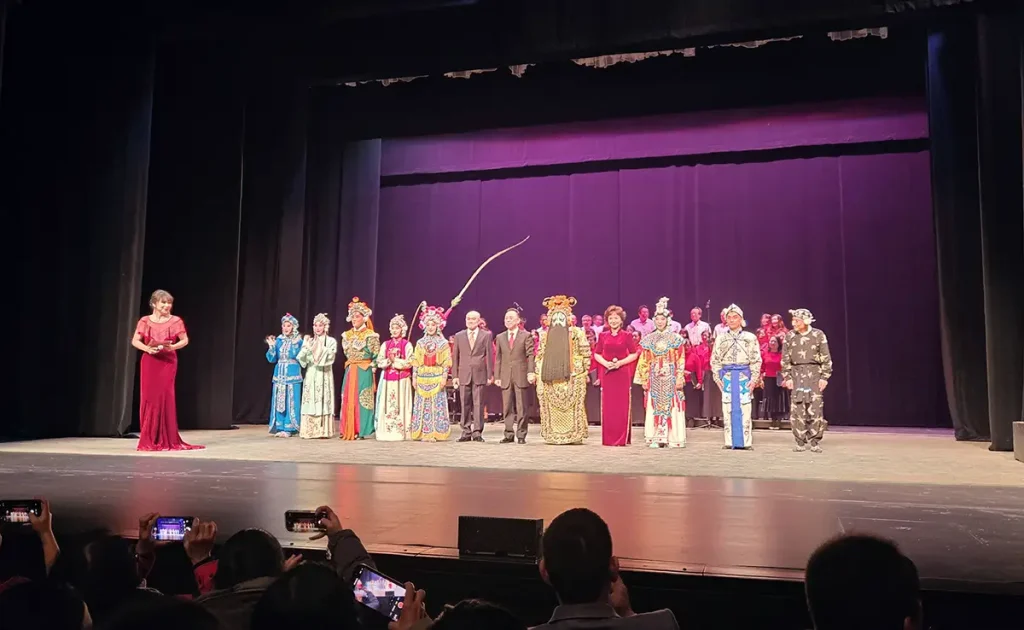
ABOVE: The cast of the Peking Opera take a bow after their performance at the Meridian Theatre at Centrepointe.
OLM: Peking Opera demands extraordinary discipline. Looking back on your early training, what was most challenging, and how did it shape your approach to performing
Yu Kuizhi: Training begins very young — usually between the ages of 10 and 12 — and continues for at least 10 years before an actor performs a major role. Every gesture, vocal line, and posture must be built on a solid foundation. We learn both ‘literary’ and ‘martial’ skills: singing, recitation, dance, and martial arts. Without that early training, you cannot create a character or express their inner life.”
OLM: Your Canadian tour continues a tradition known as ‘Peking Opera Diplomacy.’ How do you see the role of cultural exchange today?
Yu Kuizhi:Peking Opera has played an important role in China’s cultural diplomacy for decades. No matter how the international landscape changes, our cultural exchanges never stop. This tour was commissioned by the Ministry of Culture and Tourism of China, and we received strong support from the Chinese Embassy and consulates in Canada. Over the years, our company has performed in nearly a hundred countries.”
OLM: Many Canadians are seeing Peking Opera for the first time. What should new audiences focus on to fully appreciate it?
Yu Kuizhi: Western audiences often notice the costumes and makeup first — they are very different from other art forms. But the heart of Peking Opera is how we express emotion through stylized movement and singing. The stage is symbolic: a table and two chairs can represent anything. Everything depends on the actor’s performance and imagination.
OLM: How is Peking Opera adapting to the 21st century while preserving its traditions?
Yu Kuizhi: We are constantly exploring how to keep pace with the times. Traditional performances once ran three to four hours; now they are condensed to about two, with tighter pacing and more dynamic staging. In newly adapted plays, we incorporate elements that resonate with younger audiences while maintaining the core of the tradition.”
OLM: Ms. Li, The Legend of the White Snake is one of your signature roles. What makes it so demanding?
Li Shengsu: It’s a beautiful love story, but it requires both a strong vocal technique and intense physical training. Actors must start young — practicing kicks, backbends, somersaults — because the role combines literary and martial elements. It’s closer to Western musical theatre than people expect, with singing and acting woven together.”
OLM: Can you share an example of how Peking Opera moves audiences across cultures?
Yu Kuizhi: When we performed The Heroines of the Yang Family in Latvia, the audience included the country’s president. During a key scene, the entire hall was silent, and afterward we learned how deeply the story resonated. The themes — loyalty, family, sacrifice — are universal.
OLM: How do you approach teaching and passing on your skills to the next generation?
Yu Kuizhi: We are now in a stage of inheritance. We continue performing, but we also teach at the National Academy of Chinese Theatre Arts. Young actors must rigorously learn the traditions passed down by their predecessors while also exploring new possibilities.”
Li Shengsu: Our students performed with us in Canada. It’s important for them to experience the stage and understand the responsibility of carrying this art forward.”
Sunday’s performance at the Meridian Theatre at Centrepointe didn’t disappoint and was a reminder of why Peking Opera occupies such a distinct place in China’s cultural landscape. Led by Yu Kuizhi and Li Shengsu, the program showcased the precision, discipline, and narrative detail that define this distinctive art form, supported by younger performers who have clearly absorbed their training and were masterful on stage.
The show drew sustained applause and a standing ovation, a reflection of how strongly it resonated with the crowd. For Ottawa, it was an uncommon opportunity to see this level of Chinese artistry up close; for the company, it marked a well‑received stop on a Canadian tour focused on cultural exchange, continuity, and the steady passing of a demanding tradition from one generation to the next.
Watch the full interview here: