
Reflections on Retired Gen. Wayne Eyre’s ‘Into the Breach: A Soldier’s Journey’
By Brett Boudreau
Improbably in Canada, defence is suddenly in vogue. The planned spend of more than a half-trillion dollars and a $163B Department of National Defence (DND) budget by 2035, plus new initiatives to incentivize national industrial military production and accelerate procurement, sets favourable conditions over time to put the ‘armed’ back into the Canadian Armed Forces (CAF).
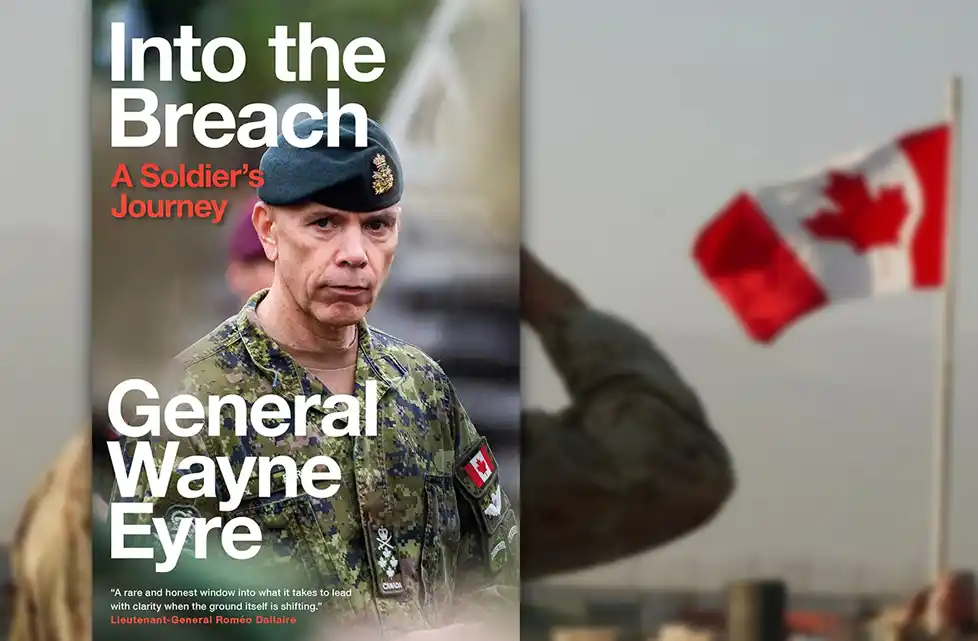
It is timely then that retired Gen. Wayne Eyre, two years after being Chief of the Defence Staff, or CDS (Feb 2021- July 2024), has published his autobiography, Into the Breach: A Soldier’s Journey. The book is his warning about various threats and perils to the nation, and makes an urgent call to restore military capability, enhance readiness and grow the force. Now in broad release, those who have a general interest in this nation’s military affairs will surely find much to like, including his depiction of operational experiences, background to newsworthy events he was part of, and complexities of leading the CAF during a particularly challenging time.
Early reviews have been flattering; this kind treatment is due in part to the rarity of a Canadian general/flag officer even writing about their career – retired Gen. Rick Hillier’s A Soldier First being the only precedent as CDS. Some generosity of spirit is reasonable given Eyre’s lifetime of uniformed service, the circumstances of how he became CDS, and having the fortitude to work through the “existential crisis” (his words) and a recruiting/retention “death spiral” (defence minister Bill Blair’s words).
Many CAF-knowledgeable readers, though, are likely to find the account of his time as CDS to be overly defensive, sometimes performative and selective of facts, particularly about the efforts around culture change (not just misconduct of a sexual nature) in the military. Eyre provides useful insight into senior leadership pressures, the political environment, and the challenges of managing various crises but is less forthcoming about whether the institution itself has always acted fairly, proportionately, or competently. The time was a circus for sure, but was a self-indulgent period where the norms of due process and human relationships were sometimes forgotten by those in leadership positions in an effort to “look good” to political masters.
At just over 400 pages, Into The Breach is an approachable read. With just 15 brief endnotes, this is a book of personal experiences, not an academic treatment of grand military strategy or theory. Complex environments are reduced to easily digestible bites (the take-away from his 1993 UNPROFOR tour in the former Yugoslavia: “without order there is chaos, and tragedy follows. In fragile states, this can happen rapidly.”) This is a cathartic, here’s-what-I-did account by an accomplished practitioner of the profession of arms. Close one’s eyes and one can almost hear him speaking the text; it’s that much his voice.
Those unfamiliar with the military experience will find interesting details about many exercises, courses, operations, workings of an infantry battalion, and family challenges associated with multiple moves from his time in uniform as a 12-year-old army cadet, through military college, and various ranks and assignments. It takes nearly 250 pages and lots of shout-outs to colleagues he served with and admires to arrive at the point of assuming the top job early in 2021. The book is sensibly organized in chronological order by assignment as he progressed in rank, ending with short chapters of advice to leaders and reflections on an eventful career.
The author admits that in normal times he would not have reached the apex of the Canadian military, referring to himself as the ‘accidental CDS’, having been appointed on a few hours’ notice following a historical allegation of misbehaviour of a sexual nature against then-CDS Adm. Art McDonald, in office for less than a month.
Eyre’s candid admission that he was not well prepared for the ‘real-world’ of being CDS is revealing insight into the insufficiency of senior military officer education. Despite a career of nearly four decades in positions of increasing responsibility, including nearly a decade in training and educational programs (with Master’s degrees in military studies, operational studies, and strategic studies from U.S. military institutions), the U.S. Special Forces course and multiple operational tours and headquarters assignments, the learning curve was “like a cliff”. Until then, he was “only peripherally aware of NORAD’s inner workings”; realized “that most of my time was spent focused up and out” (political offices and senior officials not part of the DND); exposure to deputy minister interdepartmental meetings including operations, national security and emergency management were all new to him; and, he had reached the pinnacle of the profession without having made a parliamentary committee appearance to that point.
Looking back in retirement, he recalls, “perhaps my greatest learning came in the subject of political-military relations” and that the task as CAF commander and principal military advisor to government “was perhaps the one for which I was least prepared.” Here was a real opportunity for insight about how to improve officer education. Instead, he concludes that exposing potential successors to opportunities to brief the minister, appear before parliamentary committees and accompany the CDS to cabinet or PM meetings were enough to improve succession planning. In view of his own experience and recent history, this seems ‘weak sauce’.
In the book, Eyre recounts the institutional thinking behind the misconduct allegations, the CAF response to the COVID-19 pandemic and associated events including the trucker convoy in Ottawa and other demonstrations across the country, Russia’s invasion of Ukraine part II, the scramble to leave Afghanistan, responding to natural disasters in Canada, and war in the Middle East. Compounding the challenge were long-standing systemic issues with military readiness, budget shortfalls, a serious and worsening recruit and retention problem, the previous government’s dilly-dallying on updating the defence policy, and working with three distinctly different personalities as defence minister (Harjit Sajjan, Anita Anand, and Bill Blair).
Much of the advice he offers is what one would reasonably expect from a CDS: grow the defence budget; spend new money faster to buy usable capability and on more mass-produced, less costly systems rather than expensive major platforms; improve military readiness and resiliency; speed procurement; invest in quality of service for members; Russia is a threat; the defence relationship with the U.S. will continue to be of utmost importance; and the Canadian military is overstretched.
The discussion of indifference to defence by the government of the day and the “exasperating two-year odyssey of strategic indecision and procrastination,” over the eventual One Nation Strong and Free defence policy is one of the more interesting elements of the book (an aside: the key civilian official behind that policy is suing the federal government for nearly $2M over dismissal from her director general job at DND). Eyre explains that months would go by between face-to-face meetings with the PM, and “our international standing and relevance were in freefall,” with military officers increasingly excluded from important meetings with allies. Sharing this with a very senior public servant, Eyre was told, “the government didn’t care.”
Other nuggets include learning Canadian officers in the US-led coalition HQ in Qatar were involved in planning air strikes against the Houthis in Yemen in 2024; that he is open to conscription for national service including but not limited to military applications; that obtaining nuclear weapons for Canada is an idea “of dubious utility at this point”; and that he condemns (unnamed) politicians for “taking up the anti-vaccination cause” thereby providing “indirect encouragement for some [CAF] members to disobey legal orders.”
Unfortunately, several potentially useful insights remain unexplored. While studying at a U.S. War College, he learned of a number of programs to enhance senior leader wellness and resilience that apparently influenced his thinking for the CAF – but which initiatives, and just for high-ranking officers? What specific learnings did he draw on to improve mental health and resilience here and how? He also advises growing the Regular Force from 71,500 to “well over 100,000”, and to triple the Reserve Force to more than 100,000. Left unexplained is how that is possible given the military’s inability to process and train the volume of applicants now. In addition, he suggests expanding diplomatic and military partnerships with other friends and allied nations, especially in Europe and the Indo-Pacific, and joining “coalitions of the willing for whatever the crisis or issues at hand.” But, with whom do we need to deepen our relationships, and what does that look like? Did we do any of this under his watch, and if so, what were these initiatives? More importantly, what crises or issues at hand have we been remiss in not being a part of?
The former CDS is also quick to absolve the military of responsibility for any institutional shortcomings in public communications, and loath to admit any cause for low trust by government in DND – even for low-hanging fruit like procurement, bemoaning the “constant suspicion over the years, often unfounded but impactful nonetheless, that the military would shape options and advice, and even leak information, to get its way.” The woe-is-us mindset suggesting the CAF is a misunderstood impartial actor, and those who think otherwise are “useful idiots for Putin”, is an underlay throughout the book and his public communications. In short, disinformation is to blame. Even those who expressed their unfavourable opinion about his comments urging serving members thinking of leaving the CAF, “not to retreat into retirement” (he later quietly apologized for this characterization) were “egged on by controversy seekers.”
Early on, he compellingly explains his formative UN peacekeeping experience with the PPCLI on UN duty in Croatia in 1993, and the fight with the Croatian army caught in the act of ethnically cleansing the Serb population in the Medak Pocket region. Eyre laments that, “for years, Canada strove to downplay the battle.” Yet, in September 2023, to mark the 30th anniversary of these events, CDS Eyre sat with CBC to share his role in events, Murray Brewster reporting that before that exchange, “[he] had never spoken publicly about the experience,” other than in an interview years before for a regimental history. Eyre also writes post-tour, “there were inquiries on various subjects”(!!). Unmentioned is the nearly three-year military board of inquiry led by Col. Joe Sharpe that investigated complaints by hundreds of soldiers of debilitating medical issues during that tour, determining combat stress as the most likely culprit. This work was the catalyst for mindset and policy changes about mental health for deployed members, and the subject of much public discussion about the mission at the time.
During the frantic evacuation from Kabul in August 2021, Eyre explains the ongoing federal election (as is common practise during a federal writ), restricted public communications, and this “limited our ability to tell Canadians what was going on, leaving imagination to fill in the gaps.” But after the election, without those strictures, what efforts did the CAF make to communicate the great work of those on the ground in such circumstances? Why wait five years to tell it?
These are all own goals. In no small measure, it is a lackadaisical approach to public communication by CAF and civilian DND leadership that fuels mis- and disinformation, leading to a loss of faith, trust and confidence in the institution.
In the “Crisis of Confidence” and “The People Crisis” chapters, Eyre sets out his account of managing the cultural upheaval and CAF people-related issues that defined his tenure. These provide a useful window into the political and senior leadership pressures of the day, but consistently frame decision-makers in the most favourable light, omitting key context that would otherwise provide a more nuanced, objective assessment to the careful reader.
Eyre’s defense of the CAF COVID-19 vaccination policies, including to release from service those who refused the shots, is a one-sided explanation of that decision. The reader is left to wonder about the reasons members declined the vaccine, how challenging were those discussions inside NDHQ, and whether, or why not, lesser measures were considered such as deployment restrictions or career repercussions other than being kicked out.
He makes two minor concessions about his overarching record: he would have taken a more incremental approach to dress regulation changes given a “do-over”, and that later in his career, in discussions with subordinates, he discovered he had “failed to pick up on cues that some were experiencing harassment and other misconduct,” because of his focus on operations – without acknowledging the same could be possible for anyone else – and that “sometimes the fundamental value of respect was lacking.”
Some insight would have been welcome into the reasons for and actions taken under his watch to address root causes of deeper, more problematic behaviour that has led to incidents involving serving or former members including the recent crypto-motivated kidnapping; the death of a former PPCLI corporal (released from the CAF for refusing to take the COVID-19 vaccine) in Belleville, Ont., on the cusp of a hate-motivated attack on a synagogue; a terrorism plot in Québec; involvement of some in violent neo-Nazi groups; hateful and inappropriate content posted on an Ottawa-based unit on-line chat group; and more.
On the recruiting/retention “death spiral”, we are informed that much has improved, and recruiting is on the upswing. How the system might serve to recruit and train more than 100,000 reservists he advises Canada needs (or up to 400,000, under the current CDS plan) is not clear. The retention challenge is a multi-headed hydra, but a key factor is a lack of trust in senior leadership. In the 2024 Public Service Employment Survey, for instance, only 54 percent of DND respondents expressed confidence in the senior leader cadre. The reality of this was laid bare during an April 2024 virtual town hall, when Chief Warrant Officer Bob McCann, the CAF’s senior enlisted member, told the assembled officer corps that members were leaving the service not because of geographical postings, but because of “toxic leadership or bad leadership.” These issues deserved mention in the book at least, if not a substantive airing.
The 2021 misconduct revelations were not an unprecedented shock to an otherwise healthy system, but rather the latest iteration of a well-documented history. In a nine-month window in 2021, more than a dozen men, 10 of major-general rank or higher, representing nearly 20 per cent of the 48 most senior leaders in the CAF, in quick succession faced criminal charges, court martial, or sidelining for deficiencies in conduct or personal judgement. Eyre explains the strain, angst and institutional despair of this period and notes “the desire to act – to do something and be seen to be doing something – was overwhelming.”
He also distinguishes the reactions of accused senior officers as those who “lashed out with outrage, fabricated claims and a sense of entitlement” and those who handled their “predicament” with quiet humility, dignity and grace. Yet, he leaves those individuals unnamed and offers no explanation of the subsequent outcomes of the legal proceedings or investigations that defined this period.
The evidence from three criminal court cases, a court martial, multiple Military Police Complaints Commission reports, media coverage and social media commentary including by serving and retired members paints a dark picture, revealing a deeply dysfunctional military police service, negligent investigations, complainant bias, influence of career management processes, lack of fairness and proportionality, efforts to withhold documents including via the Access to Information (ATIP), and a lack of due process including by those quick to issue public comments that implicitly presumed the guilt of the accused. In short, Eyre’s account of the period is overly exculpatory of how senior CAF leadership responded to the culture change war.
Ultimately though, Into the Breach remains a worthwhile contribution to the limited catalogue of Canadian senior officer military memoirs, offering interesting insights into contemporary military operations, civil-military relations, and leadership. Eyre — a lifelong professional soldier skilled in fieldcraft, armed with a strong sense of duty, and adroit at seeing the institution through the eyes of Cold War adversaries — deserves credit for stepping up to serve as acting, then substantive, CDS, knowing the appointment would be fraught with challenges.
Credit too, for writing about his experience. At times though, the autobiography feels performative, with an underlying tone that is defensive and thin-skinned toward reasonable public criticism of the CAF, and it sometimes struggles to comprehend how the public, the media, political leaders, and external oversight bodies viewed the institution. As such, this should be read as a selective personal explanation rather than a definitive, balanced history of the period, affecting the value of an otherwise important firsthand account.
Brett Boudreau is a Fellow with the Canadian Global Affairs Institute and served nearly 30 years in the Canadian Armed Forces, mostly in public affairs assignments, retiring as a colonel.