The 200,000-puff vape, and the number that stopped meaning anything
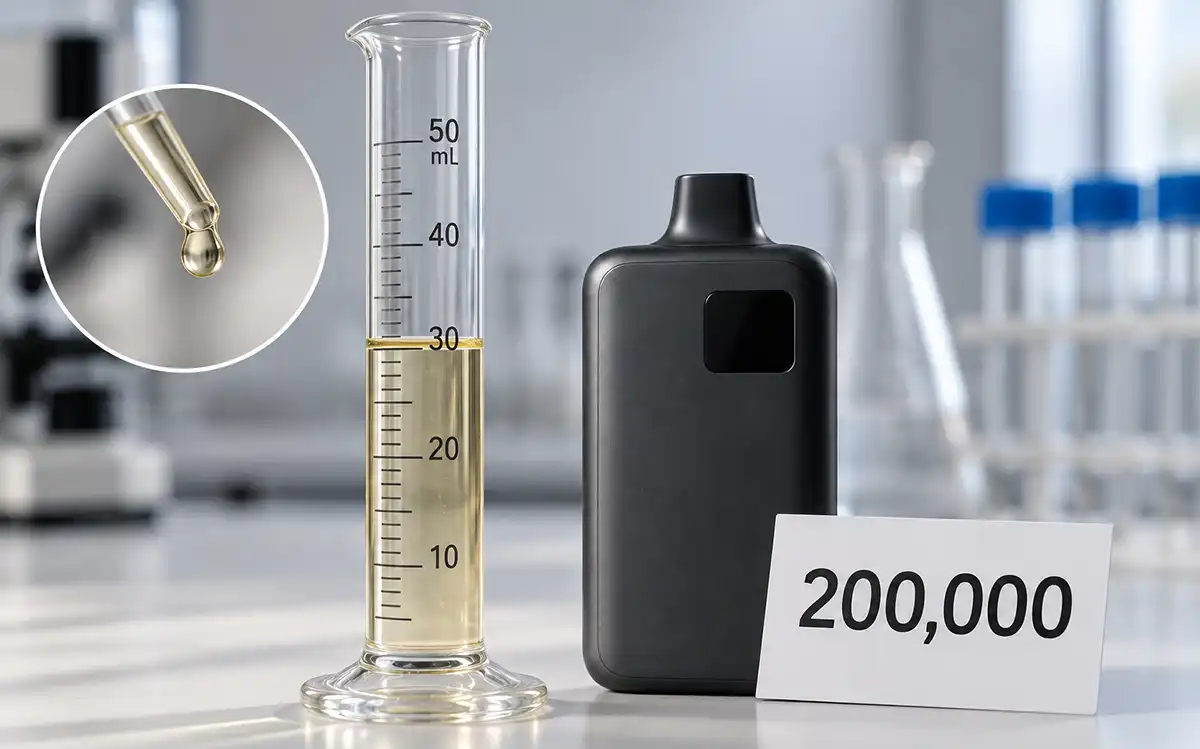
Walk past the counter of almost any vape shop in Ontario and the boxes read like a bidding war. Forty thousand. Eighty thousand. One hundred and twenty thousand. The newest have crossed 200,000 puffs, which for a heavy user would be most of a year from a single device the size of a deck of cards.
It wasn’t always like this. At the end of 2023, the big disposables on Canadian shelves promised 7,000 or 8,000 puffs from 13 or 14 millilitres of liquid. Smaller ones promised 1,600 puffs from 6 mL. Those were modest numbers, and as it turns out, roughly honest ones.
The product listings of Vape Cloud, which runs 25 vape stores across Ontario and has an online catalogue going back to late 2023, show what happened in between. Line the specs up by date and the pattern is hard to miss.
Twice the liquid, twenty-five times the promise
The 8,000-puff device from 2023 held 14 mL of liquid, which works out to about 570 puffs for every millilitre. The 1,600-puff model was even more conservative, at about 270 puffs per millilitre.
By the spring of 2025, the shelf had moved to 50,000 puffs from 20 mL, or 2,500 puffs per millilitre. Later that year came 80,000 puffs from 30 mL. In 2026, a 120,000-puff device arrived with the same 30 mL tank, and then a 200,000-puff device, again with 30 mL.
Put the ends side by side. The largest tank went from 14 mL to 30 mL, a little more than double. The puff count on the box went from 8,000 to 200,000, twenty-five times higher. Each millilitre of liquid is now credited with about 6,700 puffs, where two years ago it was credited with somewhere between 270 and 570.
Liquid did not get ten or twenty times more efficient. The puffs got smaller, at least on paper.
How big is a puff, really?
Scientists who study vaping measure puffs with smoking machines, and their results give a useful yardstick. A 2017 study in the journal Analytical Methods ran a machine through four-second puffs and measured 42 micrograms of nicotine per puff from a liquid holding 14.14 milligrams of nicotine per millilitre. A second liquid, at 6.28 mg/mL, gave 21 micrograms per puff.
Run the arithmetic backward and both work out to roughly three microlitres of liquid per puff, or about 300 to 340 puffs per millilitre. Four seconds is a long, deep draw, so be generous and assume a real puff uses half as much. Even then, a 30 mL device works out to around 20,000 puffs. That is a tenth of the 200,000 printed on the box.
Notice where the 2023 devices land on that scale. At 270 to 570 puffs per millilitre, the old ratings sat close to what the physics allows. The ratings did not climb because the hardware learned to do more with less. They climbed because nothing anchors them.
Where the numbers come from
Puff counts are not invented out of thin air. They come from machine tests too. The difference is the setting. As retailers’ own fine print now tends to explain, ratings are based on short, machine-timed draws at the lowest power setting. Real people take longer, deeper draws, and many of the newest devices include a boost mode that burns through liquid faster still.
There is no common yardstick. Each maker picks its own puff length and its own setting, so a 100,000 rating from one brand and a 100,000 rating from another may not describe the same amount of anything. Recent listings have started to say so, with lines noting that the actual count varies with draw length, airflow and power mode.
Once the puff count stopped being comparable, it became a marketing number, and marketing numbers only go one direction. A device that ships with 30 mL and a 60,000 rating looks weak beside one that ships with 30 mL and a 120,000 rating, even when the two will last exactly as long in your pocket. One recent model credits an onboard “AI smart chip” with pacing the liquid. The tank is still 30 mL.
What to look at instead
The useful number is already on the box, usually in smaller type: the e-liquid volume in millilitres. At the same nicotine strength, millilitres are what you are actually buying. Two devices with the same volume will last you about the same length of time, whatever the front of the package claims.
If you are comparing prices, divide the price by the millilitres rather than by the puffs. It is a less exciting number, and it is the only one that holds still.
Battery size, screens and charging ports are worth knowing about, but nearly every large disposable is now rechargeable, so the battery is rarely what ends a device’s life. The liquid is. When the tank is empty, the device is done, however many puffs it has on its odometer.
And if a device runs out well short of its rated count, nothing is wrong with it. That is exactly what the arithmetic predicts.
A number worth retiring
None of this makes the newer devices worse. A 30 mL device really does hold more than twice the liquid of the biggest ones from two years ago, and it really does last a good deal longer. It just does not last twenty-five times longer, and the box should not suggest that it does.
Puff counts made sense when the devices were small and the ratings sat near the truth. Today they mostly measure how far each brand is willing to stretch the test, which is not something anyone needs to know before buying. The millilitre has been on the box all along. It is time to start reading it.