Adirondacks Escape: Fall Colours, Friendly Locals, and a Shared Past

If you’re looking for a quick getaway that delivers big on scenery, history, and small-town charm, the Adirondacks are hard to beat. Just under three hours from Ottawa—via Ogdensburg and the scenic stretch through the Thousand Islands—you’ll find yourself in a part of upstate New York that feels both familiar and refreshingly different.

The drive itself sets the tone. The roads quiet down, the landscape opens up, and the pace slows. It’s the kind of trip where you roll down the windows, breathe in the crisp October air, and watch the leaves shift from green to gold to deep red. Fall in the Adirondacks isn’t just beautiful—it’s dramatic. We left Ottawa on a bright morning, the kind where the sun feels warmer than it should, and lucked out with five straight days of clear skies and sunshine.

A Fall Ride Through Lake Placid and Saranac Lake

There’s something about the Adirondacks in October that makes you want to slow down. The colours are sharp and vivid, the sky a clean blue, and the mountains lit up with that warm, golden glow you only get in early fall. 

Crossing into New York State via Ogdensburg, we made our way south toward Lake Placid, but not before stopping in Saranac Lake for lunch. Lake Flower is the centrepiece of town, and Lakeside Drift is the only Adirondack waterfront restaurant on its shore. It’s a relaxed spot with a fresh, local menu and outdoor seating that looks out over the lake. In early October, the shoreline was starting to turn, and we observed a few kayakers paddle quietly across the water. It was a relaxing, serine and steady way to ease into the trip.
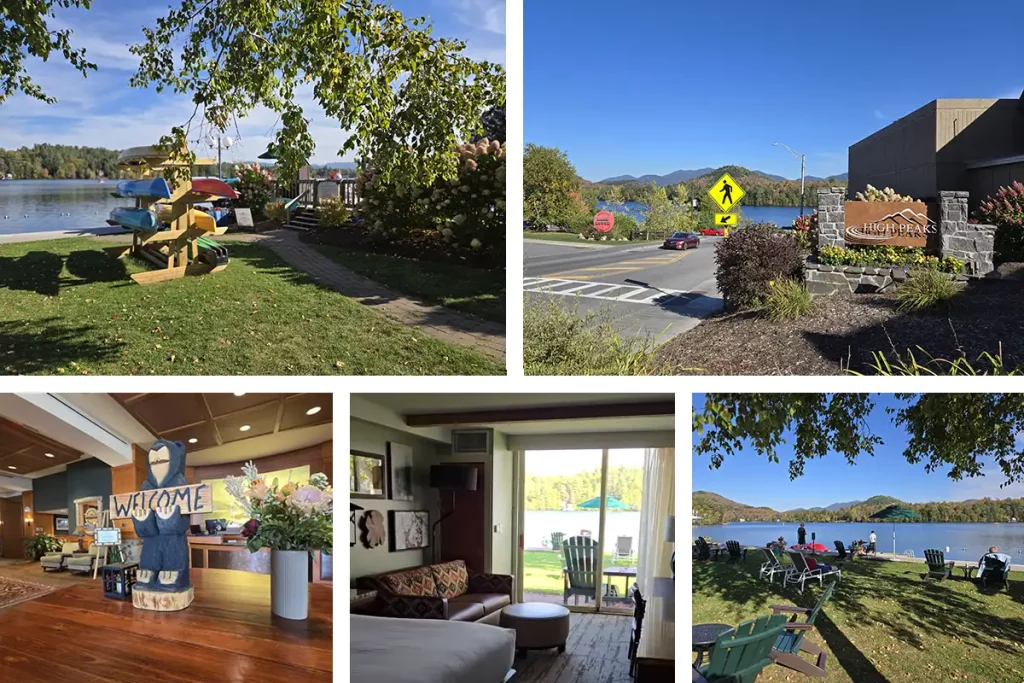
ABOVE (CLOCKWISE): High Peaks Resort’s Lakeside Pool and watercraft that available for guest use. Across the street, the High Peaks Resort hotel main entrance with a view of Mirror Lake. The hotel’s Lakeside open directly onto a green space with access to the water. The High Peaks Resort hotel’s main lobby has an inviting Adirondack vibe. 

From there, it was a short drive to Lake Placid, a town that’s earned its place on the map by hosting the Winter Olympics—twice. The first was in 1932, when 17 nations and 252 athletes gathered during the height of the Great Depression. It was the first Winter Games held outside Europe and introduced the Olympic victory podium. Local speed skater Jack Shea won two golds, and Eddie Eagan became the only athlete in history to win gold in both Summer and Winter Games.

The second was in 1980, remembered for the “Miracle on Ice,” when the U.S. hockey team stunned the Soviets. These Games brought global attention to Lake Placid and cemented its reputation as a world-class destination and sports hub.

We stayed at High Peaks Resort, right on Main Street, in one of their lakeside rooms that open directly onto Mirror Lake. The views were stunning—especially at sunrise—and the rooms were modern, clean, and incredibly comfortable. The staff were friendly and helpful, and the location couldn’t be better. It’s the kind of place where you feel like you’re in the middle of everything, but still have your own quiet retreat. It was really perfect in every way. And, even in early October you can still take a nice brisk swim in Mirror Lake Inn, which I highly recommend.

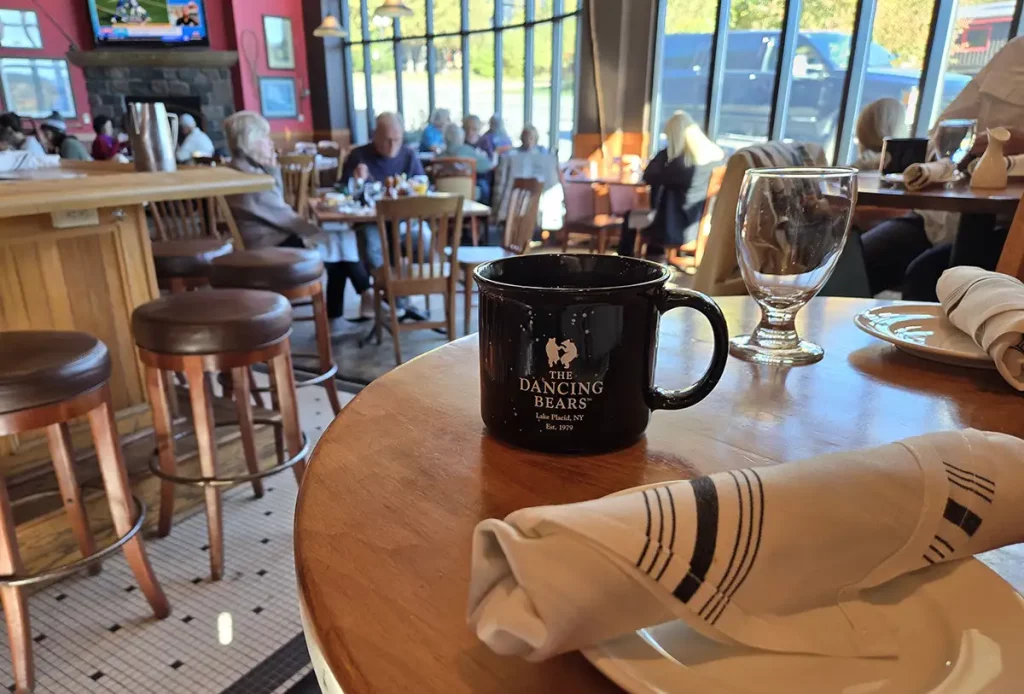
Dinner at Dancing Bears Restaurant, inside the High Peaks Resort, was a solid choice for our first night. The bar had a good buzz, with a strong lineup of craft beers, spirits, and wines. The dinner specials leaned into comfort food—straightforward, well-made, and satisfying. We ended up coming back the next two mornings for breakfast, which clearly has a local following. Generous portions, quick service, and a relaxed atmosphere made it an easy favourite.
Just a few minutes from town is the Olympic Jumping Complex, home to the towering ski jumps used in both Olympic Games. Recently renovated, the site now features the Skyride gondola, which takes you up to the base of the jumps. From there, a glass elevator lifts you to the top of the 128-meter tower, offering panoramic views of the Adirondack High Peaks. Looking down the jump ramp is humbling—these athletes launch themselves into the air with precision and courage. Lake Placid has long been a training ground for U.S. ski jumpers, and the complex continues to host national and international competitions.

On the backside of the ski jumps is the John Brown Farm State Historic Site, the final resting place of the famed abolitionist. Brown led the 1859 raid on Harper’s Ferry and was later executed for treason. His grave and farmhouse are preserved as a New York State Historic Site, and the walking trails around the property are peaceful and scenic—especially in the fall. It’s a quiet, reflective stop that adds depth to any visit.

The next day, we set out to explore the newly completed Adirondack Rail Trail—a 54.7-kilometre path that follows the historic route of the New York Central Railroad. For a comfortable day ride, the 10-mile (16 km) section between Lake Placid and Saranac Lake is ideal. The terrain is smooth and well-maintained, with a gentle grade that passes through Ray Brook, Lake Clear, and alongside Lake Colby, Little Colby Pond, and Lake Flower. It’s accessible year-round and has rejuvenated the region by connecting communities and boosting local tourism.
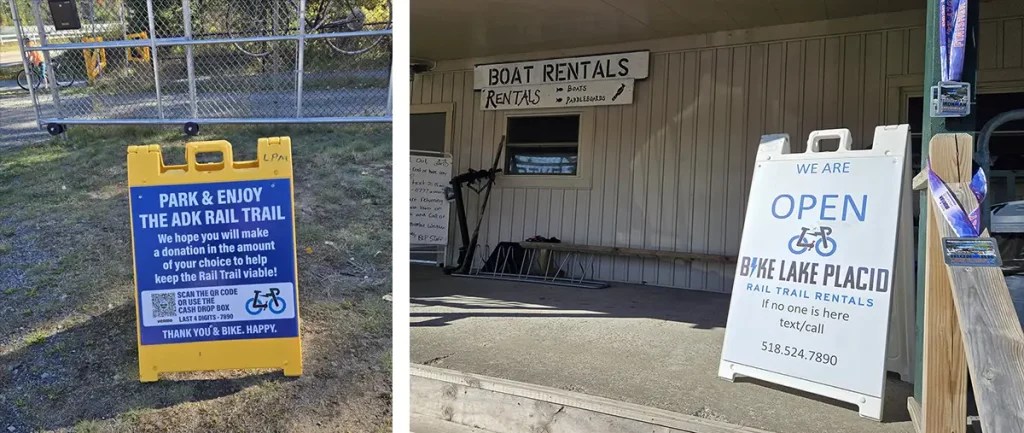
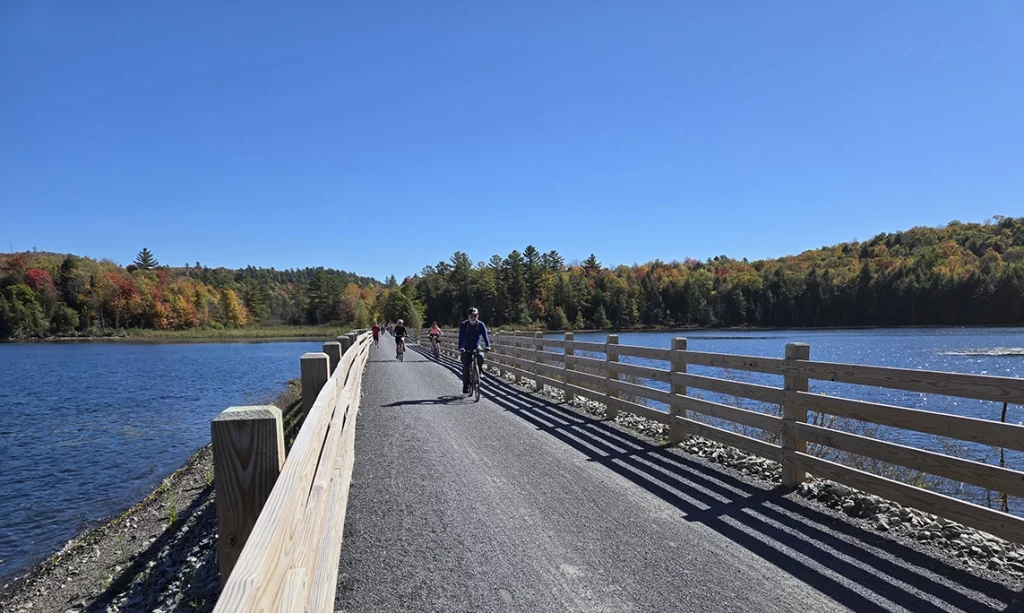
ABOVE (CLOCKWISE): Whether you rent or bring your own, Bike Lake Placid, with its ample parking adjacent to the former rail line, is a great starting point for a ride on the 54.7-kilometre Adirondack Rail Trail that connects Lake Placid, Saranac Lake and Tupper Lake. The Rail Trail is open year-round and passes over the Insta-worthy Little Colby Pond.

We rented bikes from Bike Lake Placid, located at 455 Old Military Rd. Their team was friendly, knowledgeable, and offered great prices on both standard and e-bike rentals. They know the trail inside out and gave us tips on scenic stops and places to eat.

The ride itself was relaxed and scenic. We cycled from Lake Placid to Saranac Lake and back, covering about 32 km at a leisurely pace. The trail winds through forests, over rivers, and past lakes, with plenty of spots to stop and take in the views. It’s quiet, peaceful, and perfect for riders of all levels.

In Saranac Lake, we stopped for lunch at RiverTrail Beerworks, a lively brewpub that’s become a local favourite since opening in 2022. It offers a farm-to-table menu with standout items like the Rainbow Trout, Pad Thai and tacos. Their beer list is impressive, with rotating taps that include the Blackberry Sour, Clear Skies IPA, and Backcountry Kölsch. The vibe is hip and welcoming, the staff are knowledgeable, while the food is fresh, flavourful and includes healthy options along with pub favourites.

Even if you’re not cycling, Saranac Lake is made for walking. The Riverwalk Trail runs along the Saranac River and through the historic downtown, while nearby paths offer easy access to nature. Locals say the best way to know the town is to walk it—and they’re right. 

Back in Lake Placid, we capped off the day with a visit to the Cloudsplitter Rooftop Bar at the Grand Adirondack Hotel. It’s the only rooftop bar in town, and the views of Mirror Lake and the surrounding peaks are unbeatable. The cocktails are well-crafted, and the atmosphere is relaxed and stylish.
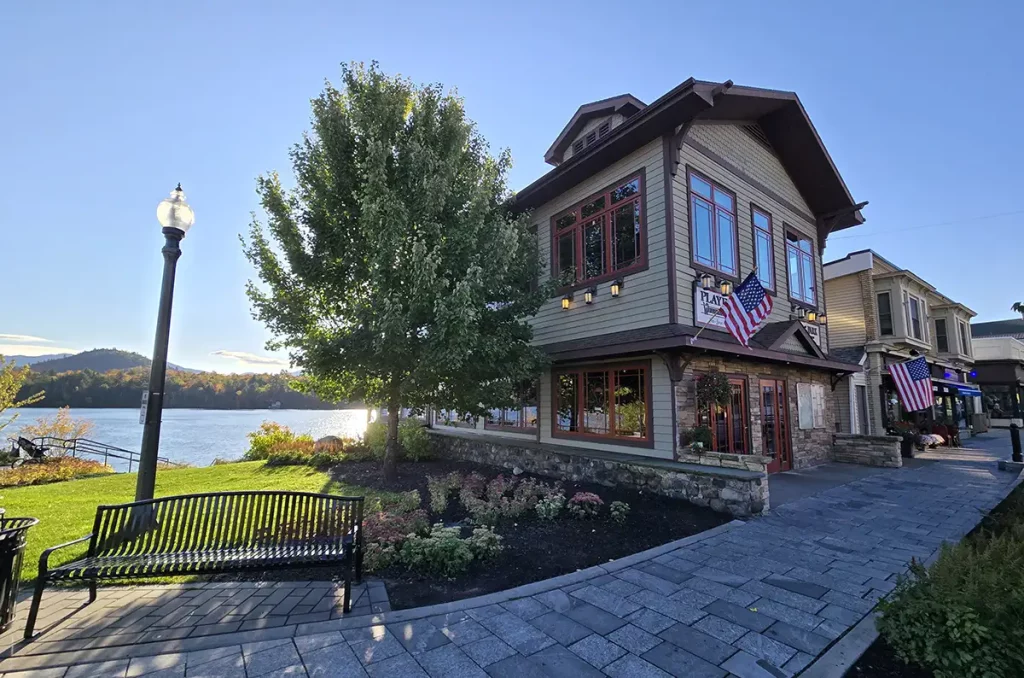
ABOVE: The east end of Main Street features the outdoor ice-skating oval, the 1932 Olympic Arena, and the Olympic Museum, while the west end opens up to lake views and a charming mix of shops and eateries.

A great dinner stop can be found at The Cottage, just steps from High Peaks Resort. Perched right on Mirror Lake, it’s cozy and casual, with a menu that includes warm brie, chipotle salads, and hearty entrees. The lakeside setting and friendly service make it one of Lake Placid’s most inviting spots.

This stretch of the Adirondacks offers everything—scenery, history, great food, and a trail that ties it all together. Whether you ride, walk, or just sit back and take it in, it’s a trip worth making.

Route 73 to Route 9N: From High Peaks to Champlain Valley

After a couple of days at Lake Placid and Saranac Lake, we packed up and headed east on Route 73. The road cuts through the heart of the Adirondack High Peaks, and in early October, the hillsides were lit with fall colour. It’s a quiet drive—no billboards, no rush—just long views, trailheads, and the occasional roadside diner.

Keene and Keene Valley sit along this stretch and are worth a stop. These towns are rooted in the mountains. Hikers launch their climbs here, but there’s more than trailheads. Keene Arts hosts concerts and exhibits year-round. Dartbrook Lodge offers well-kept cabins and suites in the Great Camp style, and its on-site shop and Forty-Six Restaurant are both worth visiting. East Branch Organics is part garden centre, part local market, with a good selection of regional beer and wine.

The Noonmark Diner in Keene Valley is a fixture. Known for its pies—especially raspberry crumb and blueberry—it also serves solid breakfasts and lunches. It’s the kind of place where muddy boots are welcome and the coffee keeps coming.
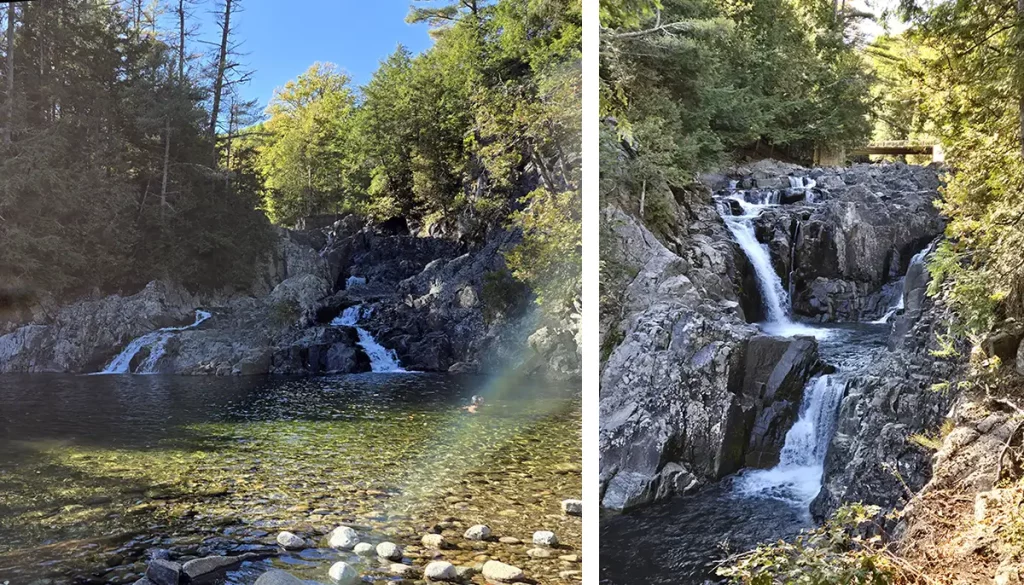
ABOVE: Despite having no signage, Split Rock Falls has a small pull off for cars and can be easily found using Google Maps. 

Route 73 eventually meets Route 9N, and we turned south toward Elizabethtown. Before reaching town, we made a quick stop at Split Rock Falls—just a pull-off from Route 9 and a short walk down to the water’s edge. It was a warm midweek afternoon in October, the kind of day that tricks you into thinking summer hasn’t quite let go. The falls were roaring, and the leaves were at their peak. I kicked off my clothes and took the plunge. It was refreshing-cold water chill dissipated quickly in the comfort of the warm fall sun. Swimming beneath the upper cascade, with sunlight cutting through the trees, felt like stepping into a postcard that hadn’t been staged. A perfect afternoon. What makes Split Rock Falls stand out isn’t just the beauty—it’s the vibe. Locals and travellers mingle here like it’s a shared secret. No gate, no fee, no fuss. Just nature doing its thing. The upper pool is deep enough for a proper swim, and the lower tier offers a gentler flow for lounging or dipping your toes. If you’re carving through the region, this stop deserves more than a glance.

Elizabethtown: History and a Good Meal

Elizabethtown is small, but it has a lot going for it. Pleasant Valley Café, is open from 6 am to 2 pm during the summer season and has modified hours in other seasons. It serves great coffee, a hearty breakfast, and a reliable lunch. The Adirondack History Museum, housed in a 1916 school building, is well worth the time. Its exhibits cover everything from logging and mining to the suffragette movement and early conservation efforts. The “Hiking in the High Peaks” display, which features Grace Hudowalski, the first woman to scale all 46 peaks in the Adirondacks and the pioneer of the 46-sixer Club, is particularly well done, as are the “Worked/Wild” and “Suffragette” displays. Outside, there’s a colonial garden, a sugar house, and a fire tower you can climb.

ABOVE: We hadn’t expected to discover the story of Inez Mulholland and the suffragette movement at the Adirondack History Museum — a true gem worth visiting.

Dinner that night was at the Deer’s Head Inn, a tavern and boutique inn that’s earned its reputation as a regional draw. One of the owners is a local doctor, and the place reflects that kind of grounded, intentional care. The dining room was packed—locals, hikers, couples passing through—all of them leaning into the weekend. The staff moved with purpose but never rushed, and the whole place had a rhythm to it: busy but welcoming.

ABOVE: Dinner at the Deer’s Head Inn hit all the right notes: fantastic food and the kind of friendly service that makes you feel at home.

The menu shifts with the season. That night, the grilled steak frites and kombucha and honey nut squash were standouts—rich, well-balanced, and clearly made with attention. The bar poured regional beer and solid cocktails, and the room stayed full well into the evening. For a town this size, it felt like the place to be. It was one of the trip’s unexpected highlights—not just for the food, but for the energy, the people, and the sense that this wasn’t just a restaurant, but a part of the community.

Westport: A Quiet Stay on the Lake

We spent a couple of nights at The Inn in Westport; part Victorian inn, part bookstore, and artful curiosity shop. Each room is named after a writer and decorated with a literary touch. The inn is quiet and comfortable, with Wi-Fi, Roku TVs, and a small bookstore and café on site. The hosts were helpful and well-informed, and there’s a park across the street with a bandstand that leads down to the lake. A few shops and pubs are within walking distance. It’s a good base for a day trip to Fort Ticonderoga.

From the architecture to the pace of life, the town is like a living museum. It is also an active hub for arts and culture. The Depot Theatre is a professional theatre company that operates seasonally out of the town-owned refurbished Westport train station. It touts itself as being the only professional theatre in the Adirondack Park. The Mill is a more recent refurbishment project thanks to the vision of two professional artists who relocated to the area and transformed the 11 thousand square foot flour mill into a mixed media venue that opened to the public in 2024. 

Our host beckoned us to return in the summer months to take advantage of the cultural offerings, including local concerts given by the students of the Meadowmount School of Music, a well-known summer intensive program for violinists, violists, cellists, and pianists, founded in 1944, along with boating and hiking the local trails. Wesport is also part of the Lakes to Locks Passage, a tourism marketing initiative designed to promote the historic and scenic corridor of the Lake Champlain and Lake George area. Early Canadian history is intertwined with the history of America in this part of the northern U.S., as the lakes and rivers were once routes travelled by British and French ships.


ABOVE: The Inn in Westport is a comfy spot to call home during a stay in the Lake Champlain area of the Adirondacks.

South on 9N: Toward the Fort

From Westport, we continued south on Route 9N. The road follows the lake closely, passing through farmland and small towns. Eventually, it leads to Fort Ticonderoga, near the southern tip of Lake Champlain, where the water narrows between the Adirondacks and the Green Mountains. It’s a route shaped by geography and history—and one that still feels connected to both.

Fort Ticonderoga: Where Canada and the U.S. First Collided

ABOVE: Expect to spend a whole day at Fort Ticonderoga. From the guided tours to the demonstrations and Carillon Boat Tour, there is plenty to do, see and learn!

Fort Ticonderoga isn’t just an American landmark—it’s a cornerstone of North American history. Built by the French in the 1750s and originally named Fort Carillon, it was constructed to defend access to Lake Champlain and protect trade routes linking Montreal to the interior. Its strategic location between Lake George and Lake Champlain made it a flashpoint in the struggle for control over the continent.

During the Seven Years’ War, the fort saw fierce fighting as British forces pushed to dislodge the French and gain dominance over the region. In 1758, the Battle of Carillon became one of the bloodiest engagements of the war, with the French repelling a much larger British force. A year later, the British returned and captured the fort, renaming it Ticonderoga.

ABOVE: A plaque at the entrance to Fort Ticonderoga lists the famous names from history that walk across the threshold into the fort. (RIGHT) A canon at Fort Ticonderoga bears the French coat of arms, fleurs de lis embellishments and the whimsical snails from Medieval knights’ lore.

Its importance didn’t fade. In 1775, at the dawn of the American Revolution, Ethan Allen and Benedict Arnold led a surprise attack that seized the fort from the British. It was the Continental Army’s first major victory—and the cannons taken from Ticonderoga were hauled to Boston, helping drive British forces out of the city. George Washington, among others, recognized the fort’s strategic value.

For Canada, Fort Ticonderoga represented both a gateway and a threat. Its position offered direct access to Quebec and the St. Lawrence River, making it a key point of tension between colonial powers. Control of the fort meant influence over trade, military movement, and territorial claims.

Walking the grounds today, you can still feel the weight of that history. The staff are passionate about recreating history, offering demonstrations and tours in period attire, all hand-sewn at the fort; even the buttons are made there. The museum is excellent, well-curated and informative, and the views from the ramparts are worth the climb. It’s one of those rare places where geography and history collide in a way that shaped nations. 

In celebration of the 250th anniversary of the American Revolution, the Northern Department, a military organization established in 1775 to manage the war in the northern parts of New York, New England and Canada, is being celebrated with an interactive website that highlights 18 historic destinations, including Chateau Ramsay in Montreal, Fort Lennox, Fort Saint-Jean and Fort Chambly. Content will be available and shared on social media during the commemorative period. For more information or to sign up for notifications, visit northerndepartment.org.

Lake Champlain: The Artery of Empire

Lake Champlain itself was more than a scenic body of water—it was a lifeline. Stretching from southern Quebec into New York, it connected the St. Lawrence River to the Hudson Valley, offering a rare north-south corridor through dense forests and rugged terrain. In an era when roads were scarce and rivers were the highways of commerce and conflict, Champlain was a prize.

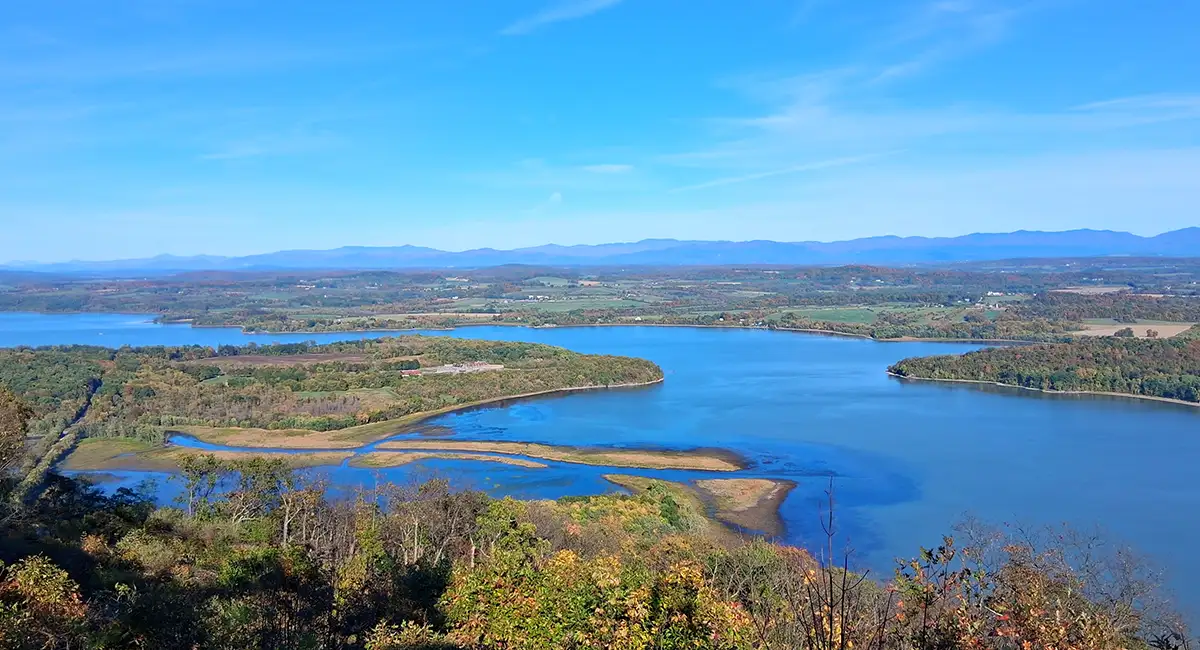
ABOVE: A view of Fort Ticonderoga and the mountains of Vermont from Mount Defiance, a location that played a pivotal role during the French & Indian War.  

Both the French and British recognized its strategic value. Forts like Ticonderoga were built to control access, protect trade, and secure alliances with Indigenous nations. Whoever held the lake held the keys to the fur trade, military movement, and influence across a vast swath of early North America.

During the American Revolution and again in the War of 1812, Lake Champlain was a flashpoint. The Americans saw it as a gateway to Canada and a buffer against British incursions. The Battle of Plattsburgh in 1814, fought on its waters, was a decisive American victory that helped end the war and secure the northern border of the young republic.

Its Known for its Past, but the Present Makes Ticonderoga Worth the Stop

Ticonderoga is having a moment—and we were lucky enough to catch it. Nestled between Lake George and Lake Champlain, the town of Ticonderoga is steeped in history but clearly looking forward. After winding down from Fort Ticonderoga, we found ourselves in a town that’s quietly reinventing itself. Bicentennial Park is beautifully maintained, and the LaChute River Trail—a three-mile loop through reclaimed industrial land—is a surprisingly peaceful walk, with interpretive signs that trace the town’s pulp mill past. Downtown is seeing fresh energy, thanks to a $10 million revitalization grant from New York State’s Downtown Revitalization Initiative. You can feel the ambition in the air.

ABOVE: The Neo-Georgian town hall in Ticonderoga stands proud on the main street. (RIGHT) Street signs in Ticonderoga, New York, could just as easily be spotted in Montreal or Quebec City.  

The locals couldn’t have been more welcoming. While strolling down Montcalm Street, my partner stopped to ask a man standing outside American Legion Post 224 about a nearby landmark. When he learned we were Canadians—and that I’m a veteran—he smiled, shook our hands, and invited us inside for a late-afternoon beer. The drinks were complimentary, the conversation easy, and the gesture unforgettable. It was one of those spontaneous moments that remind you why small towns matter: genuine hospitality, shared stories, and kindness without pretence. A highlight of our day, without question.

ABOVE: Burleigh’s Luncheonette is a retro diner in the town of Ticonderoga.

And then there’s Burleigh’s Luncheonette, a retro gem that feels like stepping into a Norman Rockwell painting. Located on Montcalm Street, this 1950s-style diner serves up classic comfort food with a side of nostalgia. We stumbled in expecting a quick bite and left raving — the service was warm, and the vibe authentic without trying too hard.

We wrapped up our day just a short drive from Ticonderoga at War Cannon Spirits, a New York farm distillery that’s as much a destination as it is a tasting room. Housed in a fully restored 1820 sawmill in Crown Point—about eight miles north of Fort Ticonderoga—the place blends Revolutionary War history with modern craft spirit culture. Their Defiance Hall tasting room is a stunner: exposed beams, creek-side seating, and a bar that serves elevated pub fare alongside small-batch whiskey, gin, and vodka. We tried the house burger and a seasonal cocktail made with their own rye—it was outstanding. The whole experience felt like discovering a secret Adirondack hideaway with serious style.

ABOVE: You can’t miss War Cannon Spirits in Port Henry—its restored historic warehouse hugs the curve of Route 9N between Westport and Ticonderoga.

Why Go Now

October and November are the sweet spots. The crowds are gone, the colours are peaking, and the weather is cool enough for hiking but warm enough for patio beers and lake swims (in October!)—if you’re up for it. The Adirondacks offer a mix of nature, history, and culture that’s hard to find anywhere else, and it’s all just a short drive from Ottawa.

Whether you’re chasing fall colours, exploring old forts, or just looking for a change of pace, this trip delivers. And if you time it right, you’ll catch the Adirondacks at their absolute best.